
Anthropic's $80.7B loss: Why AI accounting is not cash burn
Reports say Anthropic lost $80.7B in H1 2026, including roughly $72B in accounting charges. We separate reported loss, actual cash outflow and what remains unverified.
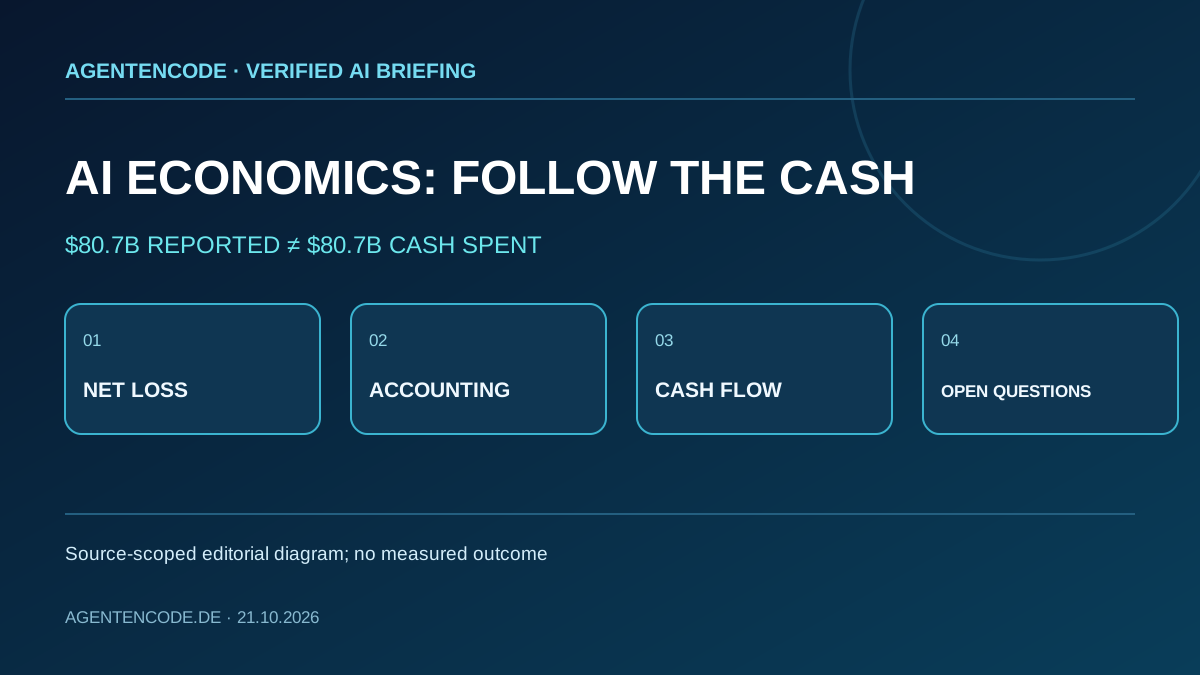
Reports put Anthropic's first-half 2026 net loss at $80.7 billion, with about $72 billion attributed to valuation-related accounting charges. That does not mean $80.7 billion was paid out in cash.
AI labs are often judged by revenue growth, model releases and customer adoption, while the real economics of chips and data-center commitments remain harder to see.
Reporting about a draft IPO prospectus highlights accounting charges and long-term compute obligations. The absence of a fully verified public filing places limits on confidence.
What did the reporting actually establish?
On October 20, The Wall Street Journal reported on a draft Anthropic IPO prospectus it had reviewed. The publication said the draft disclosed an $80.7 billion net loss for the first half of 2026. Reuters followed the WSJ account and identified approximately $72 billion of the reported loss as an accounting charge related to convertible financing instruments. AgentenCode has not independently inspected a complete audited financial statement for this period. These figures are therefore clearly attributed to reporting, rather than described as our own primary-source financial verification.
A net loss is not automatically cash spent
Convertible financing instruments may need to be marked to estimated value. Their changing valuation can generate a reported accounting expense without an equivalent payment of cash in the same reporting period. If the $72 billion estimate is accurate, it represents about 89 percent of the reported $80.7 billion loss. It would be wrong to label the remaining amount as operating cash burn without a cash-flow statement and further detail. It would also be wrong to infer that Anthropic has no real cash expenses. Research, personnel, inference and data-center access can involve substantial direct payments.
Why the economics still matter
The WSJ account describes strong revenue growth alongside very large future compute obligations. Both can coexist. A successful AI product may generate demand while requiring heavy investment in chips, power, network capacity and infrastructure contracts. Revenue growth alone does not settle the question of financial sustainability. Conversely, a net loss dominated by valuation movements is not proof of imminent bankruptcy. A serious assessment needs operating cash flow, cash balances, contractual payment schedules, realized revenue and the timing of infrastructure commitments, none of which can be inferred from one dramatic headline.
Our evidence boundary
The underlying prospectus was described as a draft and the reporting is not equivalent to a final independently audited filing. Reuters largely references the Wall Street Journal's initial account, so readers should not mistake the two articles for independent attestations of the same company documents. The most defensible conclusion concerns the distinction between types of financial measures, not the exact amount of money Anthropic physically spent. New filings or amended figures should trigger an explicit update to this story.
AgentenCode assessment
This is a meaningful development in AI economics, but calling the $80.7 billion net loss ‘cash burned’ is unsupported by the cited reporting. Most of the reported figure is attributed to a valuation-related accounting charge. Reliable comparisons require cash-flow and infrastructure-contract disclosures.
Sources and fact-checking
Reporting and source claims are evaluated separately. Vendor descriptions are not independent proof of effectiveness. Source dates and editorial review dates are distinct.