
After the Click: Satya Nadella and the new economics of AI agents
Satya Nadella expects AI agents to redraw web economics. Analysis of traffic, commerce protocols, platform gatekeepers, permissions and checkout.

Nadella's warning is about economics, not just technology
Speaking at the New York Times DealBook Summit on November 18, 2026, Microsoft CEO Satya Nadella discussed how AI agents might reshape the businesses that earn money from web traffic and transactions. TechCrunch reports that he compared the potential transition with the historic shift from web portals such as Yahoo to search engines.
This is a reported forecast, not an established market outcome. A full primary transcript of this particular DealBook discussion was not available for independent inspection, so the argument is attributed to the news report rather than presented as a verified verbatim quotation.
The underlying question nevertheless matters: what happens to services built around clicks, visits and advertising when software evaluates options before a person opens a page? The issue is not whether browsers disappear, but whether the economic value of their traffic changes.
From a search query to a delegated task
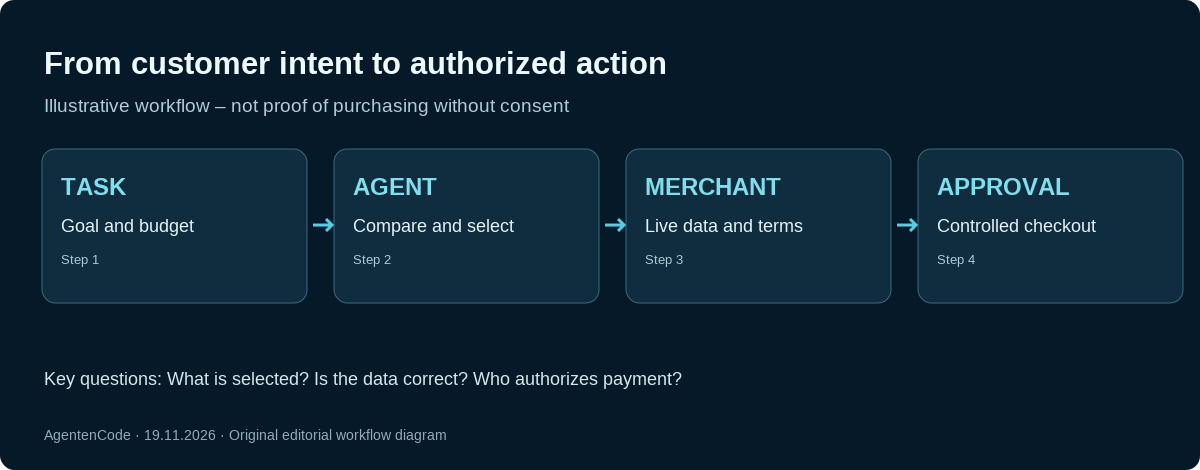
Imagine a buyer who needs an ergonomic office chair below €400 and wants delivery within a few days. Today, the buyer may open search results, read reviews, compare shops and decide. With suitable access and authorization, an AI agent could investigate competing offers and prepare a purchase for approval.
That scenario is illustrative. AI agents cannot reliably shop everywhere today, nor should they complete consequential transactions without the appropriate authority. Merchant coverage, payment support, inventory access and user protections remain limited.
The critical economic moment moves earlier in the process. Instead of competing only for a human click, a merchant may have to compete for inclusion in the agent's initial selection. Structured product data, accurate conditions and accessible interfaces could become as significant as the storefront itself.
The new gatekeeper may be the assistant
A conventional search page gives a person several options to inspect. An agent could evaluate hundreds of possibilities and show only two or three. The ranking may depend on price, delivery, preferences, risk controls and whatever integrations the agent can access.
This could help smaller providers if the selection is based on reliable, relevant data. It could also create new bottlenecks controlled by whoever operates the assistant. Without an auditable account of how products were selected, neither neutrality nor openness can be assumed.
Users and businesses need to know where recommendations originate, which terms were checked and whether commercial relationships influenced a result. The operator of a widely used purchasing assistant could become a powerful intermediary, even if the websites beneath it remain available.
Shopify and Google are building the plumbing
In a November 13 announcement, Shopify describes shoppers using AI agents to browse, compare and sometimes complete purchases without visiting a conventional storefront. Such interactions require up-to-date product descriptions, inventory, prices and merchant-specific checkout rules.
The Universal Commerce Protocol (UCP), co-developed by Shopify and Google, is one technical attempt to standardize this exchange. Its published documentation illustrates how an agent can discover merchant capabilities and interact with checkout processes, including discounts and other business logic. It does not mean every merchant or assistant supports the protocol.
Shopify also reports growth in AI-related traffic and orders across its network. These are company-reported figures, not evidence that the entire economy has already moved to agents. They do, however, show concrete commercial investment in the new channel.
Payments turn convenience into a trust problem
OpenAI introduced ChatGPT Wallet in November 2026, describing a way to support user-approved purchasing within agentic workflows using existing payment protections. The product has defined eligibility and integration requirements; it is not a universal permission for autonomous spending.
The distinction between advice and authority is fundamental. A software agent may research options without having the right to sign contracts, spend money or share sensitive customer information. Before a payment, the merchant, total cost, delivery details and the user's explicit authorization still matter.
Technical progress should therefore be measured against correct and reversible outcomes, not just fewer visible clicks. A useful assistant should surface uncertainty, seek approval at consequential boundaries and produce records that allow errors to be investigated.
Advertising and publishing may need new revenue models
Much of the commercial web monetizes impressions, clicks and referrals. If an assistant uses source material to provide an answer without sending the reader to the origin, those models may receive less traffic. That pressure is especially relevant to independent publishers that fund reporting through visits.
The opposite economic effect is also plausible in commerce: a smaller number of well-qualified purchasing intentions could be more valuable than many speculative visits. Transaction fees, licensed information feeds and new attribution mechanisms are possible responses, but none should be treated as an inevitable outcome.
For journalism, the key question is whether source links, authorship and reporting context survive inside agent-generated answers. Accurate attribution is necessary; it is not by itself a demonstrated funding model. The eventual balance will depend on product design, contracts and user behavior.
Permissions are part of the market architecture
At Microsoft Ignite 2026, the company emphasized agent identity, monitoring and execution controls. Its announcements include Agent 365, Entra-supported agent identities and tighter containment. These are concrete vendor developments, not independent proof that all deployed agents operate safely. The separate analysis of Microsoft Agent 365 governance explains why registration and activity counts require interpretation.
A shopping assistant can misread a price, use outdated availability or mishandle a discount. Real-world transactions therefore require limits on authority, clear confirmation steps, auditable actions and an effective way to stop or correct a process.
A meaningful pilot should measure which merchants are included, whether source facts are accurate, how frequently the agent requests approval and whether it ever crosses an authorization boundary. Such results are more informative than a polished demonstration of an automated checkout.
The AgentenCode assessment: whoever controls selection may reshape the web
Nadella's thesis is plausible because several capabilities are advancing at once: AI-driven discovery, structured merchant data, commerce protocols and software that can act with defined permission. The larger shift is not simply machines navigating websites. It is a possible change in who decides which options people get to see.
The limits are equally important. There is no compelling evidence that ordinary web visits will vanish soon or that agent intermediaries will be more impartial than existing search platforms. Many of the public numbers come from vendors with a commercial interest in adoption.
For merchants and publishers, the useful next step is a narrow, repeatable test of source attribution, data quality, selection transparency, authorization and total cost per successful task. The future of the web may be decided less by the most attractive storefront than by the assistant people trust to make choices on their behalf.
Frequently asked questions
Did Nadella announce the end of websites?
No. He discussed a possible reshaping of digital business models, according to contemporary reporting. The timing and scale are not established.
Can AI agents buy from every online store today?
No. Merchant coverage, technical integration, availability and payment approvals vary. Many integrations are limited.
What is the Universal Commerce Protocol?
An open technical approach to communication between shopping agents and merchants, including checkout operations and merchant rules. Support must be verified in each deployment.
What should a merchant test first?
Whether an agent finds accurate product details and conditions, attributes sources correctly, and refuses to take binding action without appropriate authorization.
RESEARCH & CONTEXT
Sources for this article
This analysis relies on the original publications linked below, which readers can inspect directly.
- TechCrunch – Satya Nadella predicts AI agents will reshuffle the economics of the web (18 Nov 2026)
- Microsoft – Ignite 2026: intelligence, agents and trust (17 Nov 2026)
- Shopify – More places to shop, one place to sell (13 Nov 2026)
- Google Developers – Universal Commerce Protocol, technical introduction (11 Jan 2026)
- OpenAI – Introducing ChatGPT Wallet (13 Nov 2026)
Checked November 19, 2026. OpenAI reports internal research measurements, not independent benchmarks.
Related agents, systems and context
Product links identify the subject of a report; ecosystem links provide context, not shared feature claims.
- Background guideIdentity and permissions