
Microsoft registers 50 million AI agents: Who governs the digital workforce?
Agent 365 now lists more than 50 million agents, Microsoft says. The crucial story is not a digital headcount but a growing need for identity, policy enforcement and reliable operating metrics.
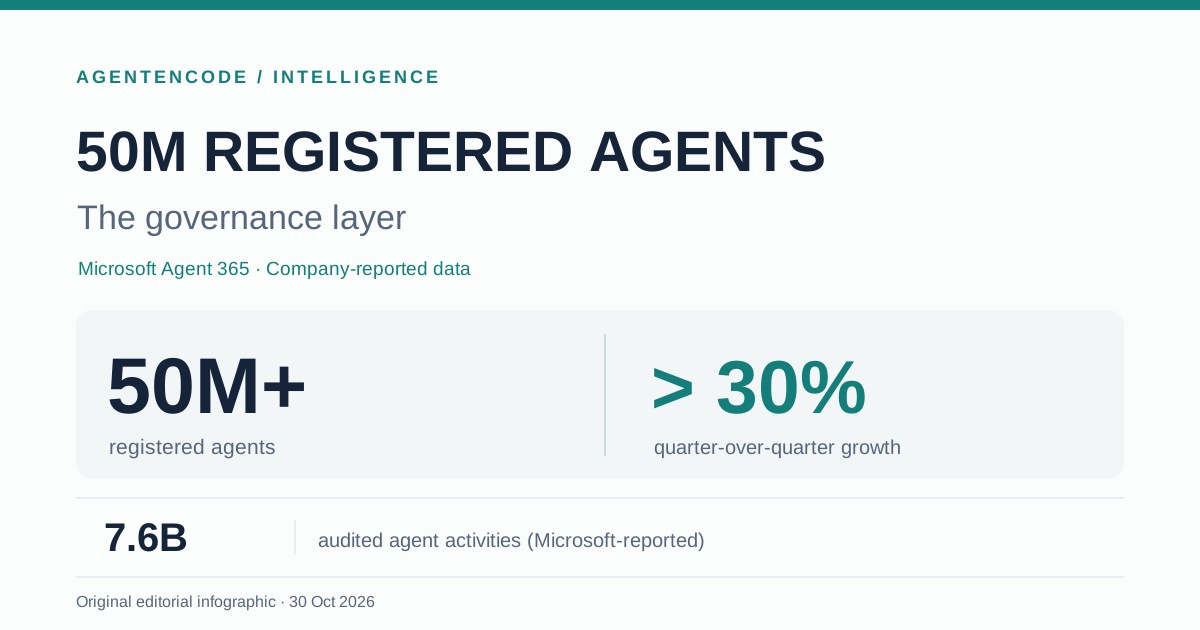
Microsoft says over 50 million agents are registered with Agent 365, up more than 30% quarter over quarter. It also reports 7.6 billion agent activities audited by Purview to date. Neither number independently measures active agents or successful business outcomes.
What is documented—and what remains open
Reported facts, original calculations and unverified allegations are separated.
- Original publication
Microsoft – FY27 Q1 official results (28 Oct 2026)
- Evidence limit
No independent case verification
No invented measurements, nor any cross-vendor security certification.
Fifty million entries are not fifty million digital employees
At the October 28, 2026 earnings call, CEO Satya Nadella reported that more than fifty million agents were in Microsoft's Agent 365 registry, up over thirty percent quarter over quarter. The statement describes a management inventory, not a count of individuals working on behalf of businesses. It does not establish how many entries are in production, how frequently they execute or whether they complete their assigned tasks successfully.
An entry might stand for an active workflow, a trial deployment, a retired configuration or part of a larger orchestration. Without a published breakdown by activity, the number should not be promoted into a labor-productivity statistic. The correct question is what organizations can see, disable, approve and measure when the inventory grows this quickly.
What makes the registry a meaningful development
AI agents can move beyond giving suggestions into calling APIs, reading files, modifying records and launching software. Those actions require explicit ownership and an operational lifecycle. A registry potentially lets administrators discover these software actors, assign human owners, check the scope of their access and retire them when projects end. That is an enterprise-control problem, not simply a model-interface feature.
A useful registry should answer who approved an agent, which tools it can use, when credentials expire and who is responsible if its execution goes wrong. None of these properties follows automatically from a high registration count. Nevertheless the ability to organize agents as managed identities helps explain why this form of infrastructure could become a significant software category.
Three impressive numbers, three different denominators
Microsoft also said customers have audited more than 7.6 billion agent activities with Purview to date, approximately five times the previous quarter's cumulative figure. The earnings presentation also cited nearly sixty thousand customers consuming Microsoft IQ context. Agents, recorded activities and customer organizations describe three different populations. Dividing one by another could create an attractive but meaningless statistic.
A single agent may generate multiple audit events during a single task, including retries, blocked requests and intermediate steps. A customer can have many agents; some will run rarely. The disclosures do not give the event taxonomy, distinct-agent activity or task-success denominator needed to estimate useful automated work. Audit volume tells us more about observability than about business value.
Our calculation: segment revenue up $15.123 billion year on year
Microsoft reported fiscal first-quarter Agents and Infra segment revenue of $76.795 billion compared with $61.672 billion a year earlier. Straight subtraction gives $15.123 billion of additional revenue, while the change divided by the earlier base equals 24.52 percent. These numbers come from published GAAP figures; the percentage is calculated by AgentenCode from those precise amounts rather than taken from a marketing slide.
Importantly, the name Agents and Infra must not be mistaken for a standalone AI-agent product line. It contains substantial infrastructure and cloud businesses. Treating all $76.795 billion as agent revenue would exaggerate the commercial market by conflating different services. The earnings announcement does not supply a separate Agent 365 revenue series, and the revenue increase is not a causal measurement of the new registry.
| Metric (USD bn) | Year ago | Current | Change |
|---|---|---|---|
| Agents and Infra | 61.672 | 76.795 | +15.123 (+24.52%) |
Why identity matters more than persuasive model output
A model can propose an action; it should not be the sole authority deciding whether that action is permitted. Access controls need to check an identity, permitted purpose and resource-specific policy outside the model. That principle remains important when an instruction is embedded in a document or tool response that the model did not receive from an authorized operator.
Microsoft positions its Perception work around separating intelligence from authority. The architectural direction is relevant, but a supplier description does not independently verify any particular customer installation. An enterprise assessment needs to test actual tool-call enforcement with expired credentials, forbidden destinations and manipulated input. A fluent explanation of why something was blocked is not equivalent to the tool really being denied.
Billions of events do not establish billions of good outcomes
Purview's cumulative audit total may reflect a large stream of recorded operations, but it does not reveal the fraction of tasks that failed, required human correction, violated a policy or were reversed after an error. A system could record millions of requests yet miss a consequential unauthorized change. Good governance therefore combines logging with prevention, approval, rapid revocation and recovery.
We would ask suppliers for four different forms of evidence: traces of accepted actions, proof of blocked actions, the time it takes to remove permissions, and the ability to reconstruct which accountable identity approved a write. These metrics can be reproduced in a tenant test. The global event number cannot be used to infer them.
The shift from seat fees to execution consumption
Coverage of Microsoft's call described more than seventy-five percent growth in the number of Copilot customers actively using consumption credits during the quarter, and more than doubled GitHub agentic-feature credit usage. The increases concern reported commercial consumption patterns; they are not counts of completed business transactions or evidence of financial returns.
Agents can create a new variable cost curve through long tool chains, repeated queries, retrieval, evaluation and failed attempts. A meaningful financial pilot measures cost per accepted result, including human review, failed runs, monitoring and fallback. Paying for extra calls is easy to measure; proving a useful outcome requires much better outcome accounting.
The six metrics we would actually publish
A credible agent program should track six separate metrics: registered agents, agents executing in a specified time window, tasks started, tasks completed correctly, policy-denied tool actions and fully loaded cost per accepted task. The first three tell us about inventory and use. The final three begin to describe quality, safety and economics.
Each metric needs a denominator and a reproducible definition. Four failed attempts followed by a human fix should not be reported as four successfully automated tasks. An unsafe call that was correctly refused may be an excellent safety result, even if it produces no apparent throughput. Policy quality cannot be compressed into a single deployment count.
A practical thirty-day evaluation
Begin with three roles: read-only, proposal-only and narrowly authorized execution. Give each role a documented owner and bounded credential. Test a legitimate task, a malicious instruction hidden in retrieved text, an expired identity and a deliberately misdirected recipient. For every case preserve the request trace, actual tool decision, applicable policy and result.
Repeat after changing models, adding tools or transferring ownership. Add model consumption, human intervention and recovery effort to the ledger. This process yields a decision about a specific deployment and its operating conditions, whereas a polished demo only establishes that one happy-path example worked once.
What remains unknown, and why it matters
Microsoft's numbers do not disclose monthly active agents, task success rates, registry concentration among customers or Agent 365-only revenue. They also do not show that agents caused growth in the broader cloud segment. The company has provided a scale indicator, not a controlled evaluation of outcomes.
The headline should therefore not be interpreted as fifty million jobs replaced. Instead, it marks how large the inventory-and-governance problem has become. The most defensible measure of agent value is correctly completed work within verifiable rights boundaries, not the size of a company's directory.
Frequently asked questions
Are all fifty million agents active?
No. Microsoft reported registered entries, not a validated daily active-agent count.
Is $76.795 billion AI-agent software revenue?
No. Agents and Infra includes major cloud and infrastructure businesses.
Are 7.6 billion audited activities completed tasks?
No. Activity logging and validated task completion are different measures.
What should buyers test?
Identity enforcement, blocked tool calls, recoverability, human corrections and true cost per accepted task.