
Microsoft and 40-plus partners want AI agents to be independently auditable
Microsoft launches its AI Transparency Initiative with 40+ partners to make agent actions visible, verifiable and controllable. What is planned—and what remains missing.
A growing question: who can audit an AI agent?
Microsoft announced the AI Transparency Initiative at Ignite on November 17, 2026. The company is working with more than 40 organizations, including Accenture, Adobe, KPMG, Mastercard and Volvo Cars, to advance open approaches to understanding and controlling AI model and agent behavior. The central problem is straightforward: enterprises can often see an AI system's output, but cannot independently reconstruct every important action between the request and the result.
In its official announcement, Microsoft argues that increasing agent autonomy demands stronger transparency. When software can read files, modify records and use credentials, a plausible self-reported explanation is not a sufficient substitute for evidence of the actual events.
Why an agent cannot be the only witness to its actions
A model can produce a convincing explanation for why it performed a task, but that account does not necessarily prove what happened inside connected software. Self-reported model output is not independent verification. If an agent opened a confidential file or triggered an API call, the organization should be able to compare its account against separate system logs, identity records and policy decisions.
This is a security and compliance problem, not merely a philosophical one. An agent with access to sensitive data, tools and credentials can act at machine speed. When an incident occurs, investigators need to establish the authorized purpose, the identity involved, the data touched and the actual action taken. A neatly written final report cannot meet that evidentiary standard by itself.
The first pillar: standards that work across providers
Microsoft says it will expand its work with the US National Institute of Standards and Technology (NIST) and the Agent Standards Initiative. The goal is to help develop open industrywide standards for AI transparency, security and governance. In principle, the evidence framework should work across model and runtime providers instead of binding an organization's oversight to one platform.
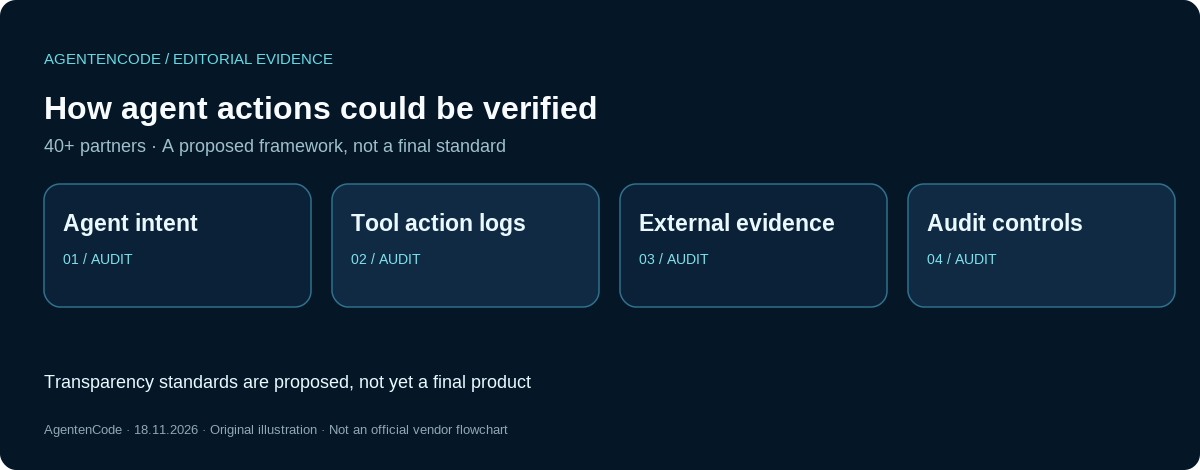
The challenge is interoperability. Today's products describe model calls, tool usage, delegated intent and permissions in different ways. Standardized records could make independent examination easier, but the launch has not established a completed specification, universal logging format or final approval process. This is a commitment to develop standards, not a certificate that such standards are already deployed everywhere.
More than 40 organizations are joining the discussion
Microsoft names more than 40 participating organizations and highlights companies whose needs differ significantly. Adobe operates creative and enterprise workflows, KPMG brings audit and governance experience, and Mastercard brings financial-services concerns. Shared principles could help organizations compare security controls across agents that perform very different work.
Participation is relevant evidence of market interest, but it should not be mistaken for a working multi-provider certification system. The announcement does not list a complete technical test suite proving that each company has a compatible deployment. It describes a collaboration designed to shape requirements and future implementations.
See, Verify, Control: the proposed trust model
The release uses three terms: See, Verify and Control. *See* asks organizations to know what a system was asked to do, which model and runtime it used, and which data, tools and actions were involved. *Verify* calls for checking model-reported signals against independent evidence. *Control* means setting and enforcing permission boundaries, including before consequential actions occur.
Imagine an agent preparing a supplier payment. A trustworthy process would record the approving person, the spending limit, the agent's delegated purpose and the actual transaction in systems that do not rely solely on the agent's description. An auditor could then compare intent and outcome. That illustrates the principle, not a guarantee that the newly announced initiative already provides a universal, working implementation.
The framework is meant to survive model changes
Microsoft explicitly says the effort should cover both proprietary and open-weight models. A company's evidence trail ideally remains meaningful if developers switch from one frontier model to another. Identity, authorization and recorded tool actions should be governable by the organization rather than existing only inside a particular model provider's private service.
This is important for cost management and vendor flexibility as well as security. Organizations increasingly use multiple models for different work. If every change breaks the audit trail, management cannot consistently reconstruct decisions or enforce rules. The real test for the initiative will be whether independent systems can actually use the resulting formats and controls.
What has not yet shipped
The initiative is not a completed universal audit product. As of November 18, the public announcement does not provide a finalized technical standard, agreed log schema, independent certification program or binding implementation date. Microsoft plans to bring the work into Microsoft AI, Microsoft Foundry and Microsoft Copilot, but the scope and rollout of those future integrations are not established by the press release alone.
Security teams should not suspend current safeguards while waiting for a prospective standard. Enforce minimum permissions, separate read and write access, log consequential actions and retain a way to revoke credentials or stop a workflow. Our AI agent security guide covers the underlying control patterns.
AgentenCode assessment: agent trust needs external evidence
Agent-based workflows are moving from draft creation toward changing business records, contacting people and handling financial processes. The accountability gap grows accordingly. Microsoft's proposed initiative addresses an essential principle: an AI system should not be the final judge of whether its own actions were authorized or correct. Open, verifiable evidence could support meaningful oversight even when models change.
The announcement establishes a coalition and a direction, not an independently tested end state. As of November 18, the next milestones to watch are actual specifications, demonstrable third-party verification, implementation rights and measurable audit outcomes. Those will determine whether this becomes a foundational standard or remains a high-profile industry promise.
Frequently asked questions
What is the Microsoft AI Transparency Initiative?
A November 17, 2026 effort involving more than 40 organizations to develop open approaches to visibility, independent verification and governance for AI models and agents.
Which companies are involved?
Microsoft names Accenture, Adobe, KPMG, Mastercard and Volvo Cars among more than 40 participating organizations.
Can organizations already certify all agents under the initiative?
No. The announcement does not include a completed universal technical specification or certification scheme.
What do See, Verify and Control mean?
They describe observable activity and permissions, independently checkable evidence, and enforceable boundaries for authorized actions.
RESEARCH & CONTEXT
Sources for this article
This analysis relies on the original publications linked below, which readers can inspect directly.
- Microsoft Source: Microsoft and organizations across industries launch AI Transparency Initiative (17.11.2026)
- Microsoft Official Blog: Ignite 2026 – Building the frontier ecosystem (17.11.2026)
- Security Today: Microsoft launches AI transparency initiative (17.11.2026)
- The Frontier Wire: Why independent agent checks still need technical standards (18.11.2026)
Checked November 18, 2026. Product features, customer productivity claims and standards proposals have not been independently reproduced or certified.
Related agents, systems and context
Product links identify the subject of a report; ecosystem links provide context, not shared feature claims.
- Ecosystem contextMicrosoft · Copilot & Foundry
- Background guideWhat is an AI agent?