
Microsoft Copilot Harness arrives in Foundry: what is preview, what is GA, and what will it cost?
On October 28, 2026, Microsoft introduced the Copilot Harness in Foundry Agent Service as a public preview. It promises reusable skills, tools and managed agent execution without requiring every developer to maintain an orchestration stack. But the more useful questions are which functions are actually available, how interrupted long tasks recover and what December pricing means for real workloads.
The managed Copilot Harness is a public preview. Separately, long-running resilience for hosted agents is generally available. Harness runtime billing starts December 1, 2026; inference and separately billed tools may already cost money before that date.
Sources and limitations
- Primary source
Microsoft primary release from October 28, 2026. New Copilot Harness = public preview; hosted-agent long-running resilience = GA. Original announcement.
- Not independently verified
Supported regions, models, preview limits and pricing vary. No independently measured costs, performance results or production reliability test.
More than another new AI model
Microsoft's October 28 Foundry announcement describes an execution harness surrounding the model. It coordinates context, agent instructions, skills, tools, a sandbox and managed task loops. Developers can select supported models without rewriting all of this orchestration. The news is about the operating layer around an AI model, not a claim that Microsoft invented another foundation model. For AgentenCode, this makes the control, resilience and cost of the harness a more useful comparison than raw model benchmarks alone.
Four building blocks in the public preview
Microsoft lists reusable skills, connected tools including supported Model Context Protocol integrations, execution with bounded delegation to subagents, and source-controlled agent definitions. Microsoft runs the agent loop and sandbox while developers provide domain knowledge, configured credentials, permissions and tests. Public preview does not mean every model, region or integration works automatically. Tool approval and external account controls remain part of each deployment's design.
Preview harness is different from GA resilience
The original announcement contains two distinct releases. The Copilot Harness in Foundry Agent Service is in public preview. By contrast, long-running resilience for hosted agents is generally available. Hosted agents can use custom frameworks and execution loops. Foundry can restart interrupted work using the original input, but the application must persist checkpoints and prevent duplicate side effects. A resumed workflow can still send a message twice or create a duplicate record unless its own code checks what has already happened.
The December 1 pricing boundary
Microsoft says billing for harness runtime begins December 1, 2026. Runtime is free before then, but model inference, paid tools and connected services can already incur charges. The published December reference rates are USD $0.0994 per vCPU-hour and $0.0118 per GiB-hour for sandbox compute and memory, subject to region and agreements. These rates are resource units, not an all-inclusive agent price. Workload duration, parallelism and model/tool calls will affect a practical budget.
Our original decision matrix for architecture and costs
AgentenCode compares four choices: simple prompt agents, the new managed harness, hosted agents with custom runtimes and self-managed infrastructure. The right choice depends on complexity, operational ownership and measurable costs. Teams should calculate how many tasks run concurrently, how often they restart, how long tools execute and what data they need. Vendor marketing about multi-model support does not demonstrate that migration is effortless or that every workload will cost less than a custom solution.
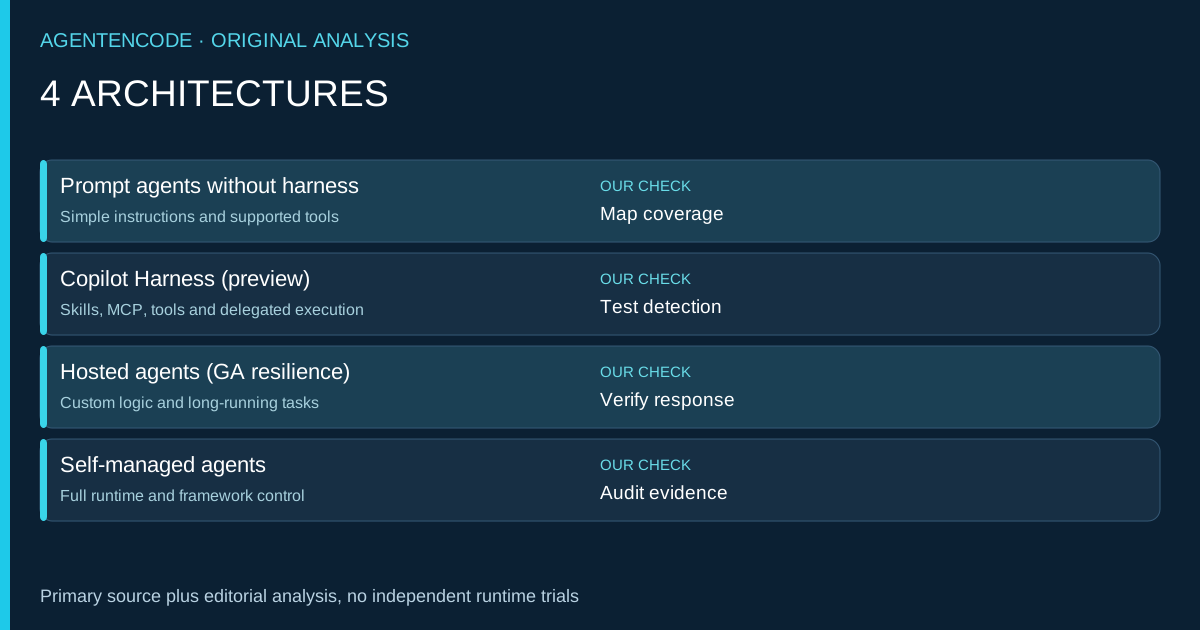
| Area | Evidence / status | AgentenCode decision |
|---|---|---|
| Prompt agents without harness | Simple instructions and supported tools | Lower stack complexity; capability limits |
| Copilot Harness (preview) | Skills, MCP, tools and delegated execution | Check preview limits, regions and supported models |
| Hosted agents (GA resilience) | Custom logic and long-running tasks | Build idempotent checkpoints and recovery |
| Self-managed agents | Full runtime and framework control | Own maintenance, security and cost tracking |
MCP access is not automatic authorization
The harness supports connected tools, but that does not grant permission to write into production systems by default. Identities, credentials, approvals, logging and data access must be explicitly configured. Long-running jobs introduce failure modes around stale context, retries and duplicate external actions. Microsoft provides recovery infrastructure; the operator still owns the business-level correctness of a process and the side effects it causes. This is why an isolated trial should include interrupted and resumed tasks, not just a happy-path demonstration.
Who should pilot it now
The preview is relevant to development teams already building multi-step agent workflows with skills and tools, provided they can test within a controlled environment. Teams doing simple question-answer tasks may not benefit enough to justify a new managed layer. A meaningful pilot should include task outcomes, permissions, retry behavior, total model/tool spend and sandbox resources. We have not conducted such a benchmark ourselves. For a related permission analysis, see our GitHub Copilot Automations report.
Original sources and research
Frequently asked questions
Is Copilot Harness generally available?
No. Foundry Agent Service's new Copilot Harness is a public preview as of October 28.
What part is GA?
Long-running resilience for hosted agents, separately from the preview harness.
Is the preview fully free?
No. Harness runtime is free before December 1, while model and separately billed tool costs can still apply.
What are the December rates?
Microsoft lists USD $0.0994/vCPU-hour and $0.0118/GiB-hour for sandbox resources, with regional and contractual variation and other charges.