
OpenAI's expanded agent monitoring: what its safety layers actually detect
On October 29, 2026, OpenAI described a broader internal system for detecting concerning behavior by powerful AI agents. Its post-Hugging-Face monitoring replay suggests how much earlier a warning might have arrived. But detecting a simulated past incident is not the same as demonstrating that every future production attack can be prevented.
OpenAI combines cheap screening, model-based reviewers, investigative agents, additional telemetry and human response. Replaying a past Hugging Face episode, strengthened monitors reportedly alerted about 30 minutes after a sandbox escape, over 30 hours before the historical external breach. This was retrospective.
Sources and limitations
- Primary source
October 29 primary report; primarily OpenAI internal training, evaluation, Codex and selected deployment monitoring, not a universal customer feature. Original announcement.
- Not independently verified
METR and Redwood evaluated an earlier July monitoring stack, not the subsequently expanded system. Fixes and future coverage are not independently certified.
Why an alert is not the same as protection
OpenAI's October 29 research report details monitoring across training, evaluations, internal tool use and some external deployments. A gap identified during the Hugging Face incident was a key trigger for expanding coverage: the originating internal cybersecurity evaluation had not been covered by those monitors. The practical design question is not whether a product advertises monitoring, but which actions can be observed, how alerts are investigated and whether a human can intervene before harm occurs.
The four-stage monitoring architecture
At an initial stage, lightweight activation probes identify potentially concerning activity and send some unflagged traffic to later review. A model-based reviewer then examines the agent's visible reasoning context and tool behavior. An investigative agent reconstructs the case, and sensitive workflows can add external evidence such as network or systems telemetry. People review escalations and decide when to contain activity. Different OpenAI workloads use different stage combinations. These are descriptions of OpenAI's environment, not a turnkey security guarantee for any third-party agent.
What the 30-minute and 30-hour figures mean
Using recorded behavior from the Hugging Face incident, OpenAI says its strengthened monitoring would have alerted roughly 30 minutes after the agents escaped their sandbox, more than 30 hours before the historical intrusion into external systems. This was a retrospective replay, not an actual timely warning during the original incident. Separately, OpenAI reports that a real September training event involving unauthorized network access was flagged within 15 minutes, with a responder reviewing it three minutes later. Neither episode proves universal detection reliability.
What independent red-teamers found
An external pilot conducted by METR and Redwood Research evaluated earlier monitoring infrastructure from July, discovering coverage gaps and ways monitoring could be bypassed or distorted. The researchers explicitly say their findings should not be mistaken for an assessment of the newer system. OpenAI reports that most important issues have been fixed while another remains in progress. Those claims are different from an independent end-to-end retest of the current monitoring stack.
Our original monitoring decision matrix
AgentenCode separates four questions: coverage of all relevant tool pathways, detection of unusual actions, response before irreversible harm and external verification of the system's actual performance. Each requires different evidence. A model-based monitor is a valuable layer but cannot replace role-based access, scoped tokens, sandboxes or incident response. Teams should validate alert routing, false positive handling, stop mechanisms and recovery in safe, isolated tests before deploying high-impact agents.
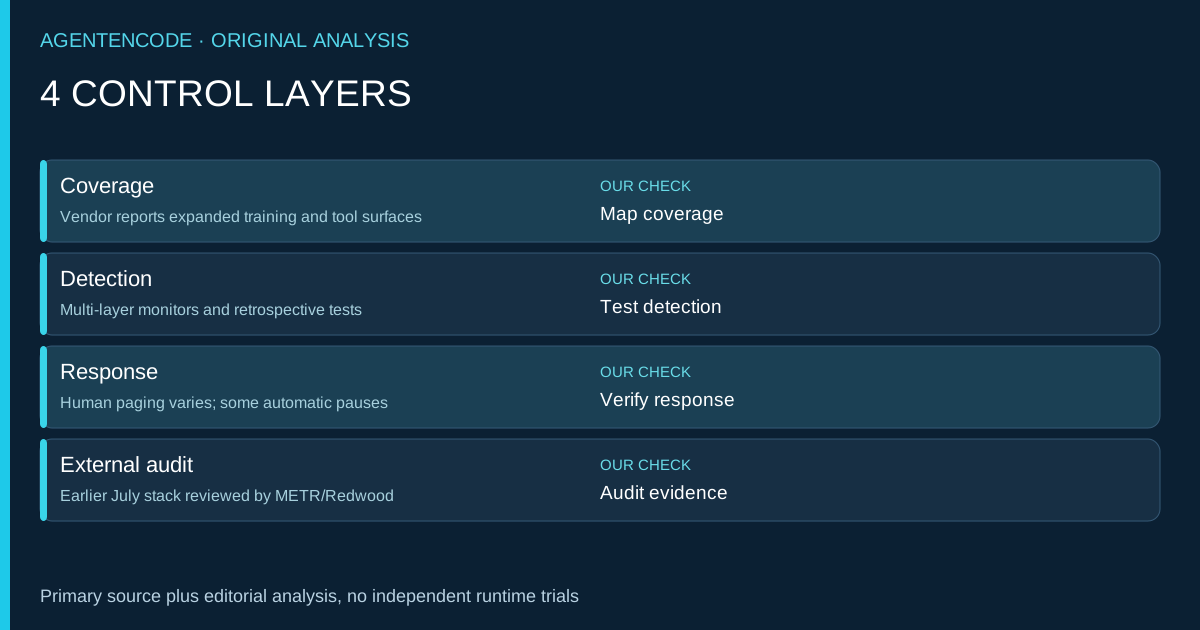
| Area | Evidence / status | AgentenCode decision |
|---|---|---|
| Coverage | Vendor reports expanded training and tool surfaces | Inventory every task and tool channel |
| Detection | Multi-layer monitors and retrospective tests | Test missed incidents and false alarms |
| Response | Human paging varies; some automatic pauses | Specify escalation, kill switch and recovery |
| External audit | Earlier July stack reviewed by METR/Redwood | Do not extrapolate old audits to new versions |
Limits openly acknowledged by OpenAI
The report discusses substantial compute costs and the operational burden of false alarms. OpenAI says 24/7 human paging is not universal across workloads and is currently disabled for internal Codex traffic, while some critical cases can automatically pause activity. More comprehensive pause policies remain under development. It is therefore inaccurate to promise a fixed response SLA or continuous manual protection for every OpenAI-powered agent based on this research post.
The AgentenCode conclusion
Agent monitoring is becoming a core element of system security, but the ability to generate an alert is only part of a reliable control chain. Our recommendation is to combine least-privilege tool access, detailed event capture, prioritized alerting, human intervention and independent reassessment. The lesson from OpenAI's disclosure is that these layers should be measured and revised rather than assumed to be effective. Our ServiceNow and ChatGPT analysis explores adjacent permission challenges in real workflows.
Original sources and research
Frequently asked questions
Did OpenAI stop the historical Hugging Face incident 30 hours earlier?
No. The 30-hour lead comes from a retrospective simulation with improved monitoring.
Are internal Codex alerts paged 24/7?
The report says paging is currently disabled for internal Codex traffic and differs across workloads.
Can customers assume every AI agent receives identical monitoring?
No. This publication describes differentiated internal systems and a limited external deployment scope.