
DeepSeek opens web search, files and voice to developers through its API
DeepSeek brings web search, URL reading, document parsing, OCR and voice capabilities to developers. We examine agent workflows, tool costs, moderation and privacy limits.
From consumer app features to developer building blocks
On November 13, DeepSeek announced that the capabilities behind its consumer chat app are now accessible through APIs. Web search, URL reading, file input and basic content-safety checks can be integrated into other products without developers implementing every supporting service from scratch.
DeepSeek uses the `deepseek-flash` model name for these features across Messages, Responses and Chat Completions. This is an expansion of available application services, not independent evidence that a new flagship foundation model has launched.
Provider-run search and multi-step reasoning
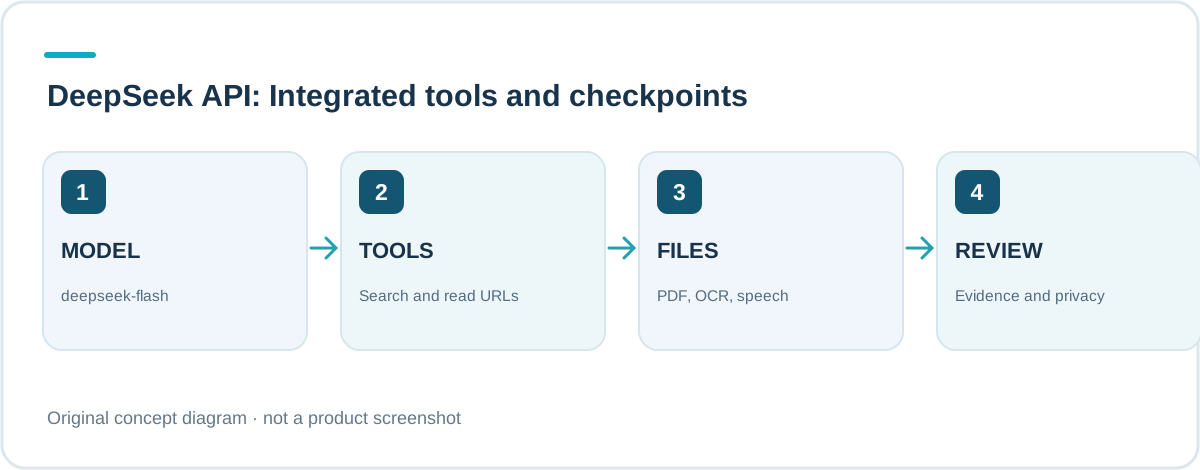
Declaring `deepseek_web_search` lets the model perform web searches and produce cited answers when thinking is disabled. With thinking enabled, it can search and open links across multiple steps. The `deepseek_read_url` tool allows user-provided URLs to be read directly into context.
According to DeepSeek's Web Tools documentation, these actions are handled by the service rather than the client's own code. Developers still need to display references accurately and decide how to handle unavailable pages or conflicting retrieved evidence.
Files and voice expand the application stack
The Files API can process PDF, Word, PowerPoint and image uploads. Developers may choose text-only parsing or richer layout recognition that includes selected diagrams and figures as part of the model context.
Standalone OCR, automatic speech recognition (ASR) and text-to-speech (TTS) endpoints extend the offering. The official Build a Chatbot guide demonstrates how the capabilities can be combined, with an open-source demo frontend. A demo is an integration reference, not a production security guarantee.
Where an agent could use these features
A research assistant could search recent websites, open a source and answer with citations. A knowledge assistant could read an uploaded manual and selected diagrams. A support agent could accept voice input and generate spoken replies, subject to authorized data access.
The main constraint is data governance. Uploading private documents or automatically fetching links may disclose information to the provider, and untrusted pages can contain instructions intended to redirect the model. Teams should identify which classes of data and network access are permissible.
Costs and responsibility remain with developers
Enhanced tools incur fees on top of normal model-token charges. The standalone Search and Fetch APIs charge per successful request rather than per token. Real workload cost therefore depends on tool-call volume, retries and the current service tariff.
DeepSeek says public-facing applications must enable the safety-check parameter. Its documentation also leaves content moderation, applicable registration requirements and AI-output labeling responsibilities with developers. Service-side safety filters cannot replace independent authentication and privacy controls.
AgentenCode perspective: simpler integration, still real operational risk
The main change is a broader developer toolbox: web research, document understanding and voice can share a consistent API integration. That could make richer assistants faster to prototype without establishing that they are accurate or safe in production.
External material still needs verification, tool access should be limited and irreversible actions require approval. Our IBM Granite LLMON analysis explores instruction/data boundaries, while the agent security guide covers layered controls.
Frequently asked questions
Which model exposes DeepSeek's new API tools?
DeepSeek documents them for `deepseek-flash` on the Messages, Responses and Chat Completions interfaces.
Are the new search tools free?
No. Tool use incurs charges in addition to model tokens, and standalone Search and Fetch requests are billed when successful.
Can organizations upload sensitive documents?
The API has file-processing support, but each organization must assess its agreements, data-protection obligations and permission design before sending confidential information.
RESEARCH & CONTEXT
Sources for this article
This analysis relies on the original publications linked below, which readers can inspect directly.
- DeepSeek – The full DeepSeek App experience, now via API, 13 November 2026
- DeepSeek API Docs – Build a Chatbot, built-in tool and safety details
- DeepSeek API Docs – Search & Fetch endpoints and billing
Checked November 14, 2026. Vendor statements, pilot scope and preview benchmarks have not been independently reproduced or certified.