
IBM Granite LLMON: Can open models resist prompt injection?
IBM ships Granite 4.1 LLMON previews in 3B and 8B sizes. We examine instruction/data boundaries, benchmark evidence, open model access and security limits.

When a document contains instructions the user never gave
An assistant reads documents, emails and search results to perform a legitimate task. A malicious command hidden in that material can cause the model to mistake untrusted text for an instruction. This indirect prompt-injection risk is especially serious when a model can call tools or change external systems.
On November 12, IBM introduced two experimental Granite 4.1 LLMON models. The approach changes how instructions and source material are represented rather than relying solely on filtering dangerous-looking words.
LLMON exposes which text is allowed to instruct
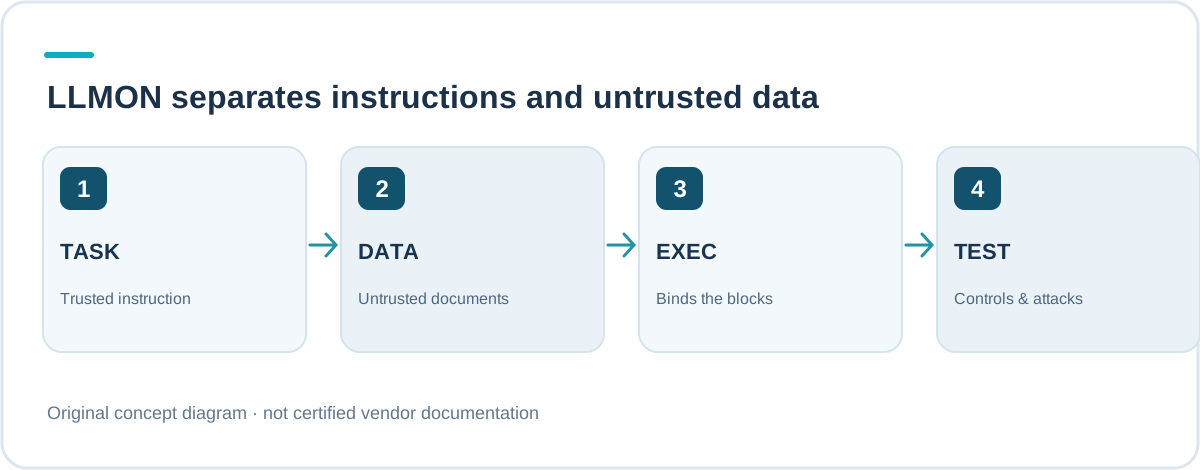
LLMON, or LLM Object Notation, divides the prompt into explicitly typed pieces, such as an instruction, data, requirements and output. Reserved special tokens identify the boundaries so the model does not have to infer structure from ordinary punctuation in a flat text string.
An `exec` element specifies which instruction applies to which input. A contract can therefore remain data to analyze rather than a new command. This learned boundary is not an enforced runtime security guarantee: the application must place each external item in the appropriate field.
Two open experimental previews, not a deployed security standard
IBM released Granite 4.1 previews at 3B and 8B sizes. The 8B model card lists an Apache 2.0 license and documents the bundled chat template. Its open toolkit provides conversion and evaluation examples.
Researchers can use this material to reproduce behavior and explore additional workloads. IBM nevertheless characterizes the release as experimental and not production-ready. A downloadable checkpoint is not a security certification for the product that wraps it.
What the prompt-injection benchmarks do and do not prove
IBM reports strong gains against static indirect attacks. In selected benchmarks, the attack success rate drops close to zero compared with conventional instruction-following models. These are vendor-led results using specified attack techniques, evaluation data and templates.
They do not establish immunity to adaptive attackers across long conversations, mistakes in tool permissions or prompt formats that accidentally promote untrusted content into an authoritative instruction. Independent replications across languages and workflows will be important.
A practical evaluation for agent builders
A useful test runs identical document tasks through a conventional Granite Instruct model and its LLMON counterpart. Measure answer accuracy alongside hidden-instruction compliance, accidental omission of legitimate document content and unsafe tool suggestions.
Focus on the boundaries between search results, tool outputs, system policy and actual user commands. LLMON may strengthen one layer, but file permissions, egress restrictions and independent approvals remain essential. See our agent security guide.
AgentenCode assessment: explicit authority, not magic delimiters
The important idea is that a model learns the connection between a legitimate instruction and the exact material it applies to. If independent evaluation validates this across settings, it could make smaller local models more robust and useful.
For now, these are research previews with published weights, not a drop-in guarantee for enterprise agents. Real deployments still need traceable actions, appropriate permissions and human checks for risky changes. The broader evidence framework is described in AgentenTrust.
Frequently asked questions
Are IBM's LLMON models publicly available?
IBM has published experimental 3B and 8B Granite checkpoints and supporting tools; the model cards list Apache 2.0.
Does LLMON stop all prompt injection?
No. The published gains concern evaluated attack classes, not every adaptive or application-specific threat.
Does LLMON replace JSON?
It is an LLM-oriented representation of structure. IBM provides converters for existing JSON-based inputs.
RESEARCH & CONTEXT
Sources for this article
This analysis relies on the original publications linked below, which readers can inspect directly.
- IBM Granite – LLMON technical introduction, 12 November 2026
- IBM Granite 4.1 8B LLMON Preview – model card
- LLMON – original open-source toolkit
Checked November 14, 2026. Vendor statements, pilot scope and preview benchmarks have not been independently reproduced or certified.