
Corma raises $125 million to build autonomous defensive cybersecurity agents
Cybersecurity AI company Corma raises $125 million at a $1 billion valuation. What its defensive agents promise and which performance data remain unverified.

$125 million Series A at a $1 billion valuation
On November 16, 2026, cybersecurity AI startup Corma announced a $125 million Series A at a $1 billion valuation. NEA led the round, with continued participation from Sequoia Capital, Khosla Ventures and Coatue. According to the company, total capital raised now stands at $185 million.
Corma had only emerged from stealth three months earlier with a $60 million seed round. The new funding illustrates investor expectations for defensive AI systems, but a venture valuation is not empirical proof that the company's agents detect threats better or operate more safely than existing approaches.
The Corma Workforce: Agents alongside security teams
Corma says it is building specialized foundation models for defensive cybersecurity and a Corma Workforce powered by those models. The goal is to have agents work alongside human security analysts, operating within the customer's existing tools to investigate and handle complex work.
That ambition differs from merely summarizing a security alert with a chatbot. An operational agent may need to gather evidence, correlate events and propose or execute actions through permitted systems. The actual degree of autonomy and the exact rights exposed to an agent depend on the product configuration and deployment; the announcement does not prove that every security task is fully autonomous.
Why defensive security is a distinct AI workload
Security operations teams examine signals from endpoints, cloud platforms, networks and identity systems. Benign alerts can overwhelm analysts while a serious incident may appear only as a pattern across several sources. Corma argues that ongoing defensive analysis benefits from different model specialization than general code-generation tasks.
A system trained for security-related logs, configurations and event sequences might capture useful patterns, but this is an engineering hypothesis unless tested against credible baselines. Independent comparisons require shared data, real incident scenarios and explicit false-positive and false-negative rates.
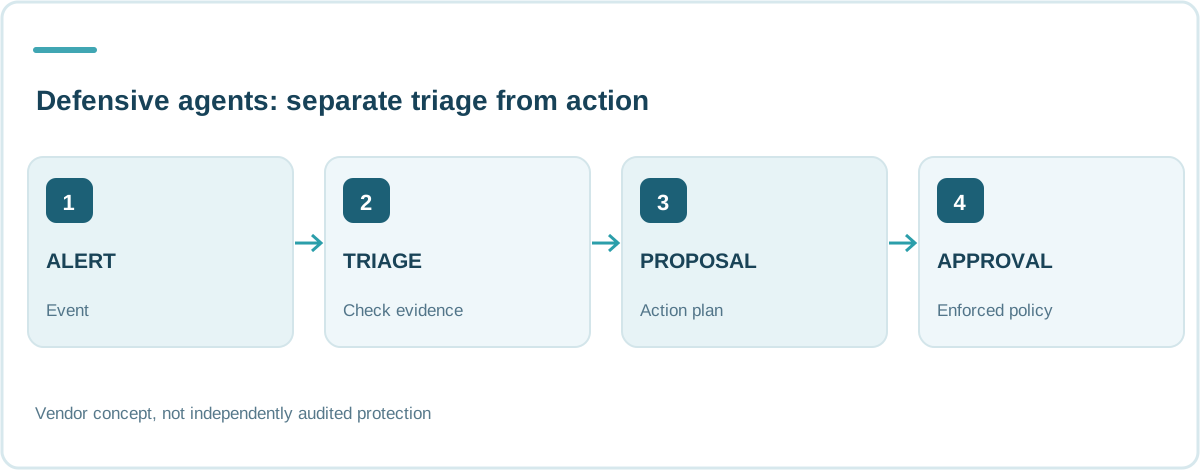
Agent actions introduce their own operational risk
Security research and threat triage are often primarily analytical. An agent that disables an account, changes firewall rules or isolates a server can also interrupt a legitimate business. Conversely, an agent that fails to escalate a real threat can leave the organization exposed.
Defensive autonomy therefore requires least-privilege tool access, approval gates, complete action logs, separation of roles and rollback procedures. A transition from read-only investigation to consequential remediation should be deliberately authorized. Our AI-agent security guide discusses those boundaries.
Vendor reports of demand are not independent performance evidence
In its funding post, Corma says large enterprises already use its Workforce alongside security teams. It also reports strong demand, a waiting list and a shortage of computing capacity. The new funds are intended to scale model development and provide additional compute.
Those are company statements. The announcement does not present independently reproducible operational benchmarks covering detection success, false alarms, safe interventions or long-running customer outcomes. It would be misleading to present the financing itself as validation of the system's effectiveness against real attacks.
Specialized defensive foundation models could be an emerging category
Corma represents a broader architectural shift: instead of using a general language model alone, teams may train domain-specific models and combine them with tool-driven agent orchestration. The model supports interpretation and planning; runtime policy and workflow controls determine what an agent may do.
The significant question is whether this specialization yields better results under realistic conditions and comparable costs. Models must handle missing evidence, adversarial logs, changing attacker behavior and entirely novel techniques. A strong demonstration on a single known attack family is not enough.
What enterprises should verify before adoption
A useful evaluation would disclose detection rate, false-alarm rate, time to safe action, correctly escalated incidents, unsafe automated actions and human intervention rates. Enterprises also need detail on data access, retention, processing region, tool integrations and the ability to constrain or reverse changes.
Corma's November announcement does not publicly substantiate all these controls. Customers should therefore validate contractual and technical safeguards independently instead of equating an impressive valuation with a security audit.
AgentenCode assessment: Keep the safety boundary outside the model
Autonomous cyber defense is an important agent use case because it links high-volume, time-critical analysis with tools capable of changing production systems. Such agents could prepare investigations and reduce repetitive work, but their most important controls cannot depend only on the model deciding to behave safely.
A prudent rollout starts with read-only triage, moves to human-approved actions and considers limited autonomous remediation only after adversarial and failure tests. Corma is a notable vendor to watch, not a currently independently proven security outcome. Verifiable controls and real-world task performance matter more than the amount of venture capital raised.
Frequently asked questions
How much funding did Corma announce on November 16, 2026?
A $125 million Series A, bringing the reported total raised to $185 million.
What valuation did Corma report?
The company announced a $1 billion valuation in its November 16, 2026 funding statement.
What is the Corma Workforce?
Corma's described system of specialized defensive AI agents working with existing security tools and human teams.
Is its security performance independently verified?
The funding announcement does not include a comprehensive independently reproduced assessment of detection rates, false alarms or operational risk.
RESEARCH & CONTEXT
Sources for this article
This analysis relies on the original publications linked below, which readers can inspect directly.
- Corma — Three months in: $125M Series A and defensive AI agent workforce (16 November 2026)
- Corma — Introducing Corma: mission and first-party product background (August 2026)
- The Wall Street Journal — Cyber Startup Corma Raises $125 Million for Defensive AI Agents (16 November 2026)
Checked November 16, 2026. Vendor statements, pilot scope and preview benchmarks have not been independently reproduced or certified.