
Gemini Robotics 2.5: Google reports 96% success in a Mercedes-Benz robot pilot
Google DeepMind reports 96% success for Apptronik's Apollo 2 in a Mercedes-Benz kitting pilot. What the model does and why a pilot is not a universal reliability guarantee.
AI agents move beyond software
On November 10, 2026, Google DeepMind announced Gemini Robotics 2.5, a vision-language-action model for helping robots understand and perform physical tasks. Rather than merely answering questions or using browser tools, these systems aim to turn visual context and human instructions into real movements.
The change matters because the physical world is less forgiving than a text interface. Objects can shift, deform or slip; unexpected people and obstacles create consequences that no fluent language response can resolve. An agent's execution quality must therefore be measured through actual physical outcomes.
How the vision-language-action stack works
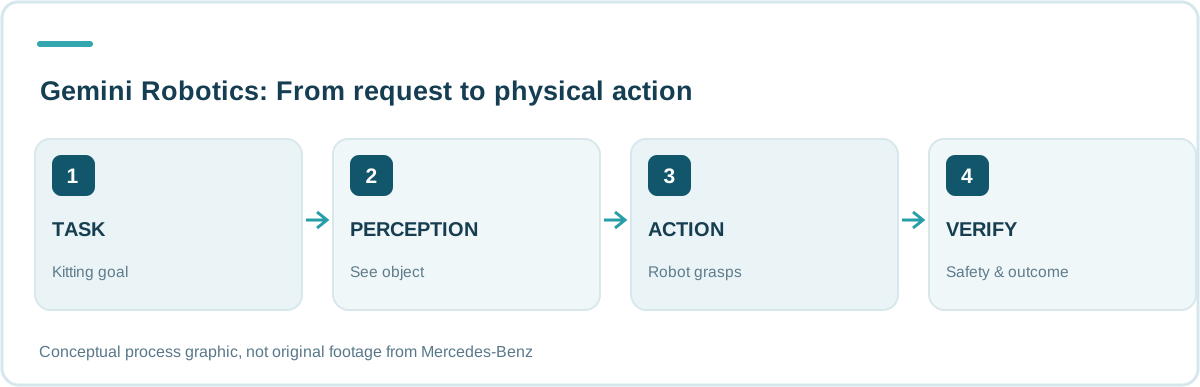
Gemini Robotics 2.5 uses visual observations and task instructions to guide physical actions. For the Mercedes-Benz proof of concept, DeepMind describes an embodied reasoning model, Gemini Robotics ER, tracking the workflow while the Robotics 2.5 action model controls the robot's hands and arms. Planning and motor control are distinct parts of the system.
Google says the model has been evaluated on different hardware, including Apptronik's Apollo 2 humanoid and Franka Duo. Those platforms use different grippers and capabilities; they should not be mistaken for evidence that any robot can run the same unmodified configuration without integration work.
Mercedes-Benz: 96% in a defined kitting pilot
Google DeepMind says the proof of concept with Apptronik and Mercedes-Benz ran on active production lines in Sindelfingen, Germany, and Kecskemét, Hungary. Apollo 2 robots picked metal brackets from bins and arranged them in designated trays. This repetitive automotive-kitting task demands accurate perception and grasping.
Google reports a 96% success rate for this specific pilot. It is an encouraging vendor-reported outcome, not a universal probability of successful industrial automation. The announcement does not provide a complete independently audited breakdown of trial counts, failures or performance across long shifts and other materials.
More than 200 tasks, with meaningful remaining limits
DeepMind reports testing Gemini Robotics 2.5 on more than 200 tasks involving tools, flexible materials and precise manipulation. Depending on the test category, the company cites 30% to 100% higher success rates and task completion 20% to 30% faster than its own baselines.
Those figures are internal evaluation claims rather than reproduced cross-vendor comparisons. Some challenging manipulation examples still fall short of consistently successful completion. Teams should inspect specific failure modes rather than treating improvement percentages as proof of production readiness.
Physical AI changes the safety problem
A robot can hit a person, damage goods or create hazards in shared workspaces. DeepMind describes more responsive obstacle and human-proximity guidance, reporting improvements in safe task completion under internal testing. This is not equivalent to independently verified clearance for autonomous operation in any factory.
Google also released ASIMOV-Jailbreak, a benchmark for adversarial prompts involving unsafe physical actions. Its 99.5% resistance claim applies to Gemini 4 Argon on that particular benchmark, not to the safety of the entire Gemini Robotics 2.5 hardware stack. Treating those numbers as interchangeable would be misleading.
Simulation can accelerate learning, not replace the factory
DeepMind points to Gemini 4 Argon as an important research accelerator. Simulated scenarios help prepare policies, generate varied training experiences and explore cases that may be hard to reproduce. Yet perception, friction, object flexibility and actuator behavior can differ substantially between simulation and reality.
Production suitability therefore needs repeated physical tests with measured errors, interventions and recovery behavior. A successful simulated maneuver cannot independently establish reliable execution on a real industrial line.
Access is rolling out to robotics partners
Google says Gemini Robotics 2.5 is being made available to selected robotics partners. That is not an announcement of unrestricted open-source weights or a universal public API. The Mercedes-Benz collaboration is explicitly described as a proof of concept, not a fleet-wide autonomous factory rollout.
Further deployment depends on hardware integration, safety requirements, economics, human supervision and repeatability. The official launch offers promising evidence for one task, not independent certification of broad industrial maturity.
AgentenCode assessment: the performance standard becomes physical
Gemini Robotics 2.5 illustrates how agents can extend beyond APIs and websites into real-world action. Evaluating such systems requires more than checking reasoning quality or correct tool selection. Safety around people, recoverable errors and reliable motor behavior become central to agent engineering.
We consider the reported 96% pilot result newsworthy while keeping it confined to the documented task. Independent endurance testing and auditable safety evidence would be necessary for broader conclusions. Our AgentenTrust framework separates vendor claims from verified controls. For physical AI, dependable execution matters more than a captivating demo.
Frequently asked questions
Did Google reach 96% success at Mercedes-Benz?
Google reports that figure for a defined automotive-kitting pilot with Apptronik and Mercedes-Benz, not all possible robot tasks.
Which robots are mentioned?
DeepMind describes Apptronik Apollo 2 and Franka Duo platforms with different grasping hardware.
Is Gemini Robotics 2.5 generally available?
The initial rollout is to selected robotics partners. General open-source or universal public access is not established.
Does a 99.5% jailbreak score certify the robots as safe?
No. That vendor-reported result concerns Gemini 4 Argon in a specified benchmark, not the safety of all physical deployments.
RESEARCH & CONTEXT
Sources for this article
This analysis relies on the original publications linked below, which readers can inspect directly.
- Google DeepMind — Gemini Robotics 2.5 accelerates real-world general dexterity (10 November 2026)
- Google DeepMind — Gemini Robotics family and model access
Checked November 16, 2026. Vendor statements, pilot scope and preview benchmarks have not been independently reproduced or certified.