
IBM and Microsoft launch Imagine Enterprise: who governs 6,000 agent assets?
Imagine Enterprise blends IBM Consulting's industry playbooks with Microsoft's AI and security stack. The headline is 6,000 agents and assets; the harder question is which actions can be safely authorized and audited.
IBM's 6,000-plus figure combines agents and assets, not 6,000 independently validated production agents. The meaningful test is a governed, measurable business workflow.
The announcement, without the marketing shortcut
On November 10, IBM and Microsoft announced Imagine Enterprise, a platform for creating, operating and governing AI agents in industry-specific workflows. IBM Consulting contributes implementation expertise and reusable components; Microsoft provides a foundation of AI, cloud, data and security services. The stated ambition is to connect existing corporate systems rather than replace every established process with another chat interface.
Financial services, insurance and retail are the initial industry frameworks. Manufacturing, energy, the public sector, mobility and others are discussed as future expansion opportunities. That distinction matters: a possible sector roadmap does not establish that a finished implementation is already available to every customer.
What IBM's 6,000 figure actually counts
IBM says its Consulting Advantage platform has produced over 6,000 AI agents and assets. The second noun is not optional: assets can include reusable building blocks and templates. The announcement does not document 6,000 separate production-grade agents available for individual purchase, nor does it supply independently validated customer outcomes for that population.
Enterprise buyers should ask which elements match their own process, what custom integration remains, and who will maintain each workflow after deployment. A large library might shorten the path to a prototype; it cannot establish fitness for a regulated production decision.
The architecture: design, context, identity and execution
IBM names Process Studio, Context Studio and Advantage Core as its design and operating layers. Microsoft services including Foundry, Copilot Studio and GitHub Copilot contribute agent development and orchestration. Fabric and Microsoft 365 provide business context; Entra, Purview, Defender and Azure are listed as parts of the identity, governance, security and infrastructure foundation.
Listing those products is not evidence that each individual agent enforces the correct authorization everywhere. The critical chain remains concrete: who owns the agent, which data can it retrieve, which writes need approval, where can operators reconstruct a decision, and how fast can permissions be revoked? These are deployment-level tests rather than assumptions implied by a product family.
Availability and the SEI example
IBM describes several commercial approaches: customers can engage IBM Consulting to deploy and run Imagine Enterprise, co-innovate with the consultants, or use available self-management options. It does not announce a universally accessible free trial or standardized per-agent price in the release.
The financial services company SEI is cited as exploring how agentic capabilities could support its operations together with IBM and Microsoft. That is an account of collaboration and intent, not an independently measured case proving a return on investment or security effectiveness of the new combined platform.
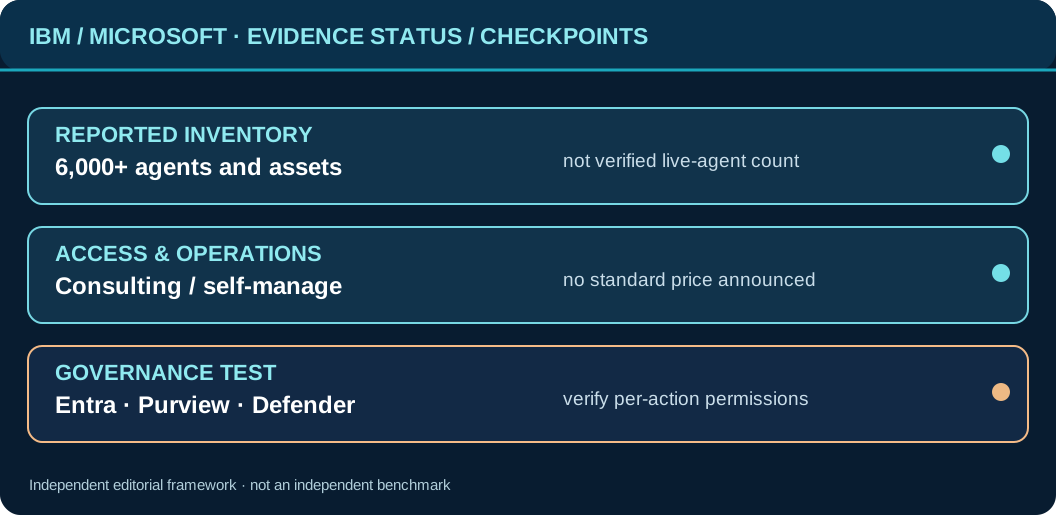
| Component | Vendor-stated status | Buyer verification |
|---|---|---|
| 6,000+ agents and assets | IBM Consulting Advantage; mixed inventory | Which components are deployable for this actual process? |
| Industry frameworks | Initial: finance, insurance, retail | What customer-specific integration remains? |
| Operations and access | Consulting-led, co-innovation, self-management options | Who operates, audits and escalates failures? |
| Governance foundation | Entra, Purview, Defender and other Microsoft services | Can individual actions be scoped and revoked? |
AgentenCode assessment: start with one accountable process
The most consequential aspect is not a bigger agent catalogue. It is the attempt to combine industry-specific operating knowledge, existing business data and enforceable action boundaries. Agent projects often stall when permissions cross departmental lines or no one can explain which downstream API call made a business change.
Our decision framework: choose a bounded pilot with a clear owner and stop condition. Before granting write access, document role inheritance, source data, approval paths, action logs, rollback responsibilities and a repeatable failure scenario. Only then compare task quality, review time and total operating cost with the pre-agent process. These are editorial recommendations, not IBM field-test results.
What the vendors have not independently established
The release gives no general pricing schedule, universal regional data-residency terms or independent production benchmark for the entire platform. Per-tenant entitlements and integration requirements must be checked contractually. The 6,000-plus assets claim should not be reworded into a number of customers, deployed autonomous workers or independently certified automations.
Having Entra, Purview or Defender in the platform architecture does not on its own prove correctly configured cross-system permissions. Enterprise governance lives in actual policy enforcement, audit events and human accountability, especially for sensitive finance and insurance workflows.
Related agent profiles and practical guides
AgentenCode's IBM watsonx Orchestrate profile documents IBM's existing agent stack, while Microsoft Copilot Studio is a distinct Microsoft build-and-management environment. Imagine Enterprise is neither merely a rename nor evidence that the underlying products are functionally interchangeable.
Readers evaluating the operating model can use our guides to AI agents for businesses and AI agent monitoring to define permissions, owner responsibilities and trace-based verification.
FAQ and evidence notes
Are 6,000 ready-to-use production agents included? The vendors do not establish that; the count explicitly combines agents and assets.
Is Imagine Enterprise a standard self-service subscription? IBM describes Consulting-led deployment, co-innovation and self-management options, without publishing a universal price.
Did AgentenCode benchmark the new platform? No. This is an independent assessment of dated IBM and Microsoft primary sources, not a hands-on agent evaluation, ROI measurement or security audit.
Official sources and method
- IBM: Imagine Enterprise, 10 November 2026
- Microsoft: Joint announcement, 10 November 2026
- IBM Consulting: Imagine Enterprise overview
Editorial source review on November 10, 2026. Vendor statements are identified as such. No independent agent executions, security audits or benchmarks.