
Claude Message Threads speed up agent loops—but introduce a privacy trade-off
Anthropic introduced Message Threads in the Claude Messages API on November 2, 2026. After an initial full request, clients send only new messages and the preceding response ID. This can reduce overhead in long-running agent loops, but threads are not permanent memory or a token-billing shortcut: they expire after five minutes of inactivity, and the feature is ineligible for Zero Data Retention and HIPAA.
Anthropic introduced Message Threads in the Claude Messages API on November 2, 2026. After an initial full request, clients send only new messages and the preceding response ID. This can reduce overhead in long-running agent loops, but threads are not permanent memory or a token-billing shortcut: they expire after five minutes of inactivity, and the feature is ineligible for Zero Data Retention and HIPAA.
Source-backed facts and limitations
- Primary sources
Official documentation and announcement: Anthropic (2026-11-02).
- Not independently tested
Availability, feature and performance claims derive from vendor originals. AgentenCode has not executed product workflows, fault scenarios or benchmark replications.
What Anthropic actually shipped
Anthropic's November 2 release notes introduce Message Threads as a beta of the Claude Messages API. A create request carries the full conversation, system instructions and tool definitions. Subsequent requests can send only new messages together with the ID of the previous response and the thread continuation option. The service reconstructs the conversation before calling the model.
Requests require the message-threads-2026-08-12 beta header. Anthropic documents support through the Claude API, Claude Platform on AWS, Anthropic-managed Claude models on Google Cloud and Claude in Microsoft Foundry. This is a developer-facing API feature, not a claim of unlimited or permanent memory in a consumer chat application.
Where latency in long agent loops comes from
A long agent run accumulates instructions, tool calls, outputs and follow-up requests. Many clients resend the entire conversation on each step. Network transfer, request validation and tokenization can become overhead even when the newest turn contains only a small amount of data.
Message Threads reduce that repeated request payload after the first turn. Lower time to first token is a plausible benefit, but real outcomes depend on context size, caching, tool definitions and the network. AgentenCode has not benchmarked the feature and therefore does not claim a universal percentage improvement or an independently proven latency result.
Five-minute expiry makes replay essential
A thread is best-effort and short-lived. Anthropic says it expires five minutes after its last request and is deleted no later than one hour after last use. A continue operation can return 404 thread_not_found, requiring a full conversation replay. SDK helpers can perform that replay only because they maintain their own copy of prior messages.
The architectural implication is fundamental: your application, not Anthropic's transient thread, remains the authoritative record. Preserve complete conversational state where your data policy permits it. Make tool actions idempotent or store execution IDs, so replaying after an expiry cannot accidentally repeat a transfer, code push or other irreversible operation.
The ZDR and HIPAA boundary is real
Anthropic explicitly marks Message Threads as not Zero Data Retention eligible and not HIPAA eligible. The service holds the conversation in encrypted server-managed memory rather than durable storage, but retaining that conversation at the provider is still central to the feature.
This is not automatically a security vulnerability. It is a data-governance constraint that must be matched to a particular workload. Organizations requiring strict ZDR or HIPAA handling should not enable Message Threads for those workflows. Teams should review data classification, contractual scope and cloud deployment paths before trading lower request overhead for ephemeral server-side state. Other eligible API flows are not made non-ZDR simply by this feature existing.
A five-case go/no-go decision matrix
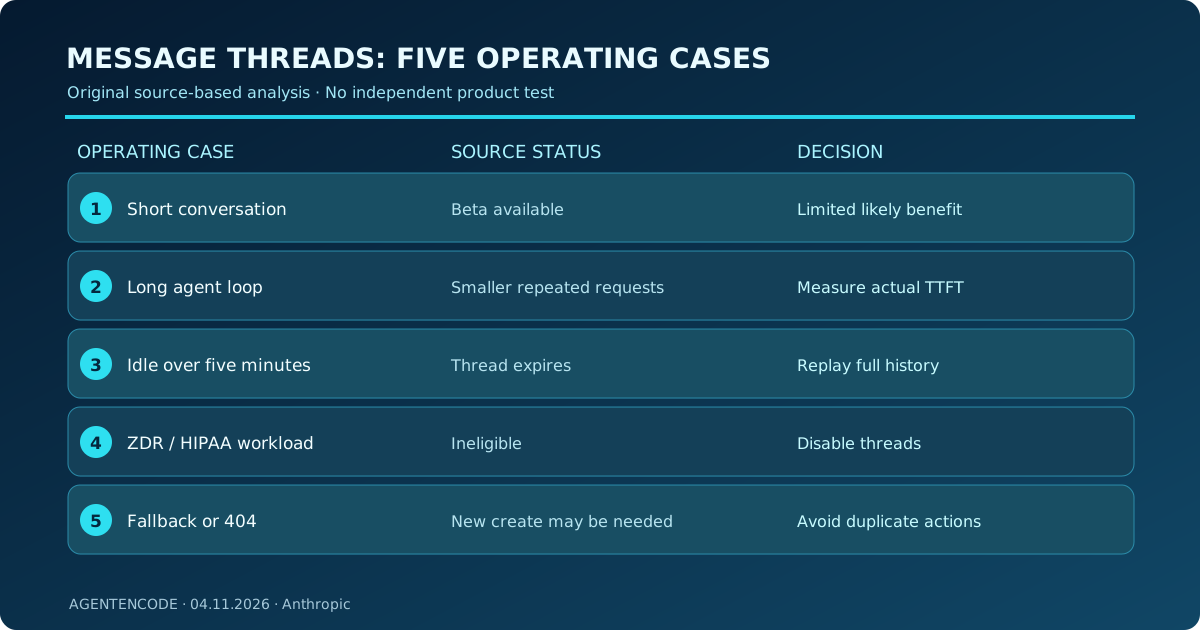
Our original matrix separates a short chat, long synchronous agent loop, long idle interval, regulated workload and failed continuation. Each situation presents a different trade-off. The practical question is not how much conversational state can be compressed into a thread but when the client must take back responsibility.
Faster normal-case requests do not guarantee more reliable agents. Expired threads, changes to fixed settings or responses from fallback models can force a new create call. Without complete replay state, a temporary API optimization can become an application-level outage.
| Case | Sourced status | Decision |
|---|---|---|
| Short conversation | Beta available | Limited likely benefit |
| Long agent loop | Smaller repeated requests | Measure actual TTFT |
| Idle over five minutes | Thread expires | Replay full history |
| ZDR / HIPAA workload | Ineligible | Disable threads |
| Fallback or 404 | New create may be needed | Avoid duplicate actions |
Pricing, prompt caching and unsupported features
Anthropic says Message Threads do not change pricing or rate limits. Sending fewer bytes does not mean the underlying model's context is free. Prompt caching remains separate and must be configured deliberately. System prompts and tools belong in create; sending them again in continue can cause a 400 error.
The feature also excludes Message Batches, thread-specific Token Counting, on-demand Compaction and several context-editing paths. Fixed settings such as model and tool choice must stay consistent, or a fingerprint mismatch may occur. Concurrent attempts to continue the same response ID also require careful handling. A thread is not a general-purpose durable orchestration service.
How to measure the benefit without inventing numbers
A reasonable evaluation compares two equivalent long agent workflows: ordinary full-history requests versus Message Threads with the same model, tools and content. Measure median and p95 time to first token, end-to-end completion time, request bytes, replay rate, error cases and actual charges. Avoid assuming that latency and billing improve together.
Deliberately test an idle period exceeding five minutes, a 404 replay, a fixed-field change and a tool call that has already executed. For sensitive data, the governance decision comes before latency optimization. These are proposed acceptance tests by AgentenCode, not results we have run or verified independently.
Primary sources
- Claude Platform: Message threads (2026-11-02)
- Claude Platform release notes – Nov 2 (2026-11-02)
Frequently asked questions
Are Message Threads generally available?
No. They are a beta Messages API feature requiring a specific beta header, not permanent conversation storage.
Do threads automatically reduce token charges?
No. Anthropic explicitly states that pricing and rate limits do not change. The primary benefit is smaller requests and potentially lower latency.
Can ZDR-restricted applications use Message Threads?
Anthropic marks the feature as ineligible for Zero Data Retention and HIPAA. Such workloads need a different implementation path.