
Gemini 4 Hydrogen reaches Google Search: AI tackles complex questions – what happens to websites?
Google brings Gemini 4 Hydrogen to Search with multi-part questions, parallel searches and visual answers. What users and publishers can actually expect.

The biggest change is not the search box
On November 12, Google announced Gemini 4 Hydrogen for Google Search, calling it the largest model upgrade yet for its search product. The goal is to understand intentions behind complex, multi-part queries and to coordinate the information needed for a useful answer, rather than matching isolated keywords. Google describes a worldwide rollout. The precise experience still depends on product surface, language and the particular query.
Think of someone comparing laptops under a strict budget while requiring specific ports, service options and accessibility features. Previously, they might have combined several separate searches manually. An AI interface can try to research the requirements together and summarize the result. Convenience does not make the result complete or current: product specifications, availability and prices still require verification against original sources.
Query fan-out turns one question into several research paths
One central capability is query fan-out. A complex question is divided into connected subtopics and researched in parallel. With Hydrogen, Google says Search can better understand the user's intent, invoke tools and identify relevant sites across those subtopics. That may surface sources a user would never have found with one narrow keyword query.
There is an important distinction between what a model can do and what a user actually sees. Supporting sources can be consulted without every site receiving a prominent citation. Google's own Search Central guidance says pages must be indexed and eligible for search snippets to appear as supporting links. Neither a model announcement nor technical eligibility guarantees that a particular publisher will receive more visibility.
Visual answers change how people consume information
Google says responses can contain images, comparison tables and other structured assistance adapted to the question. Complex options may be easier to understand when different criteria appear next to one another. Travel conditions, product features and step-by-step requirements are examples where an organized response can be more useful than a block of text.
The visual treatment does not verify the underlying information. A comparison may omit crucial parameters, a photo may be misleading and an AI response may not surface conflicting sources. Users should open primary links for material decisions, especially purchases and advice involving health, law or financial risk. A clear table is a presentation format, not proof of independent fact-checking.
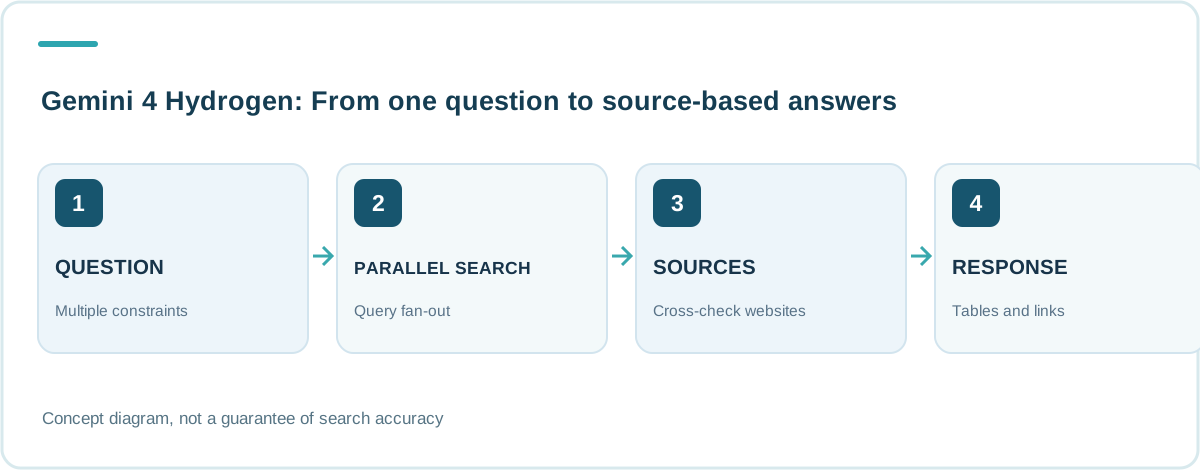
What makes Gemini 4 Hydrogen distinct
Google's official model announcement positions Hydrogen as a speed-oriented Gemini 4 model for everyday execution. Besides Search and the Gemini app, Google lists developer and enterprise availability through AI Studio and the Gemini API. Its multimodal abilities and tool-use behavior are relevant when a user's question crosses images, documents or multiple steps.
Some published benchmark and safety results come from Google's own test setups, including internal evaluations. They should not be treated as an independently established accuracy guarantee for every Search query. Live search quality also depends on freshness, source availability, interpretation of contradictions and how citations are selected. A capable language model cannot eliminate mistakes introduced by incomplete or unreliable web content.
Could AI discovery help or hurt independent publishers?
The effect on smaller websites could go in two directions. Google says query fan-out can discover more relevant sources, including sites the user might not have encountered otherwise. But an AI-generated answer might also satisfy a visitor without a click-through. Google's description does not establish which effect dominates for any given publisher or topic.
A defensible strategy is original, verifiable content rather than publishing many interchangeable summaries. Methodology, primary evidence, accurate dates, useful definitions, tested comparisons and contextual links give users a reason to visit. AgentenCode's AI agent history and protocol reference are examples of durable information hubs. Actual search performance must still be measured in Search Console and site analytics.
What site owners should actually change
Google explicitly states that appearing in AI Overviews or AI Mode does not require special AI-specific structured data, secret GEO markup or new machine-readable files. Basic search requirements still matter: accessible crawlable content, internal navigation, coherent structured data, good user experience and genuinely helpful text on the page. Chasing a new model announcement with keyword stuffing or nearly identical articles is not an evidence-based response.
Owners can instead monitor impressions, inbound queries, click-through rates, landing-page quality and whether visitors reach related resources. Google says AI Search traffic is included in the broader Web performance reporting in Search Console. Those observations reveal trends but cannot automatically attribute any single change in visits to Gemini 4 Hydrogen as opposed to ranking, seasonality, audience behavior or publishing changes.
A practical checklist for readers
Treat a complex AI search answer as a starting hypothesis. Ask which constraints the system actually respected, whether numerical claims are dated, whether links point to first-party evidence and whether disagreements between sources are explained. The stakes determine how much validation is necessary. An engaging conversational answer should not substitute for inspecting sources before consequential decisions.
Developers of AI agents face the same issue: search output can inform a plan, but cannot authorize an action. Strong workflows separate research, tool access, verification and approval. The Agent Architect provides a visual example of those boundaries. Better web research does not remove the need for server-side controls when software might publish content, spend money or modify records.
AgentenCode assessment: the source still matters
Gemini 4 Hydrogen is an important general AI development because it changes a mass-market entry point to information, not merely a specialist developer API. The combination of stronger intent understanding, multiple searches and visual organization could be genuinely helpful for questions with many constraints. It may also change how users discover original websites.
Independent evidence is still needed to assess error rates, the provenance of generated answers and the impact on publisher clicks. Google reports a worldwide launch, but feature exposure is contextual. For independent sites, the sound response remains measurable search performance and trustworthy original content—not a promise that an extra GEO label or a wave of generic AI news will automatically increase traffic.
Frequently asked questions
Is Gemini 4 Hydrogen available in Google Search?
Google announced a worldwide Search rollout on November 12, 2026. Particular AI experiences vary by query, language, product surface and availability.
What does the upgrade change?
Google cites better handling of multi-part questions, parallel subtopic searches and structured responses with tables, images and supporting website links.
Will Google's AI answers automatically reduce website traffic?
Not necessarily. AI answers can replace some clicks or surface additional sources. Any net traffic effect requires real analytics and Search Console data.
Do publishers need new GEO markup for Hydrogen?
No. Google continues to recommend ordinary SEO foundations, indexable useful content, meaningful internal links and accurate structured data.
RESEARCH & CONTEXT
Sources for this article
This analysis relies on the original publications linked below, which readers can inspect directly.
- Google Search – Gemini 4 Hydrogen rolls out to Search, 12 November 2026
- Google DeepMind – Gemini 4 Hydrogen model launch and availability, 12 November 2026
- Google Search Central – AI features and your website
- Google Search Central – guide to generative AI Search visibility, 15 May 2026
Checked November 15, 2026. Vendor statements, pilot scope and preview benchmarks have not been independently reproduced or certified.