
Kiro Crew Bots: Persistent AI agents with memory and approvals
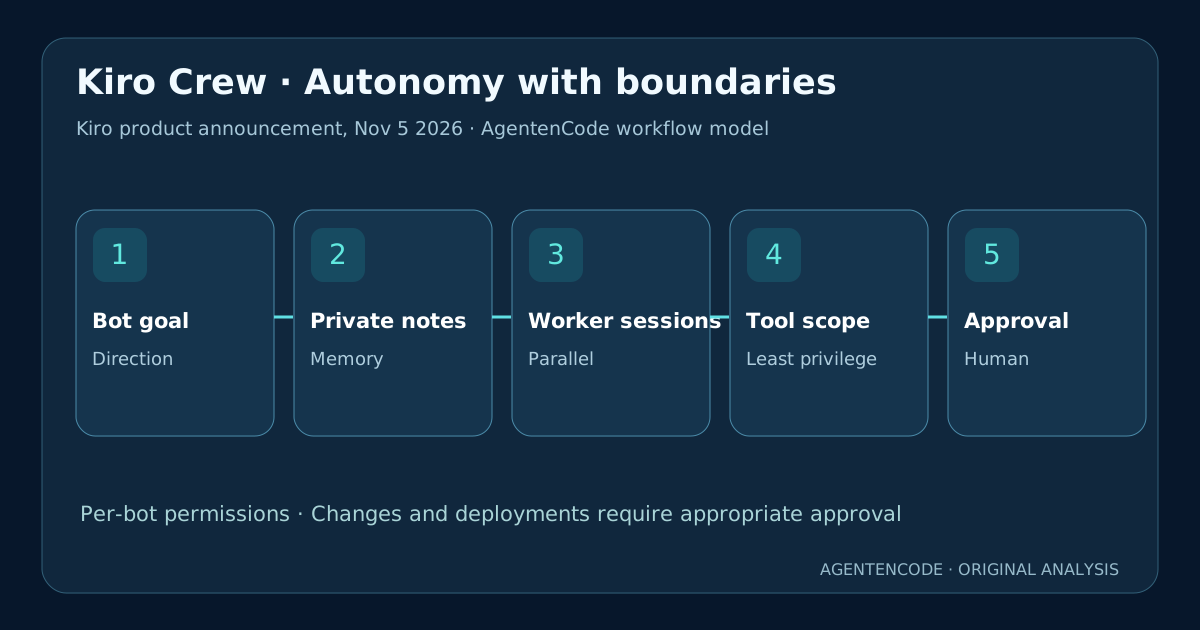
Running five coding agents in parallel can create a new bottleneck: remembering which session is blocked, why a decision was made, and who is permitted to ship an outcome. Kiro has introduced bots, generally available in Kiro Crew, shifting the management unit from a short-lived session to an ongoing responsibility. Each bot has its own chat, notes, workspace and dashboard; it can coordinate worker sessions and scheduled tasks.

What Kiro actually introduced on November 5
Kiro calls bots generally available in Kiro Crew. A bot is a named, customized, long-running agent with an ongoing conversation and its own memory. Its notes record project decisions and open items, while a dedicated workspace and configurable dashboard help users inspect progress rather than reconstruct previous sessions.
These are vendor-described capabilities, not independent measurements proving a bot can replace an engineer or an operations team. The product goal is to move humans away from manually coordinating sessions and toward setting direction and reviewing outcomes.
Responsibility, not sessions, is the organizing principle
Kiro's examples include bots responsible for issue triage, build health, code review and release readiness. A bot carries the context specific to its role and can launch parallel worker sessions, monitor progress and redirect work that has drifted. If a user decision blocks one task, the bot is described as continuing independent work.
Schedules can be created in chat for tasks such as overnight CI investigations or weekly release notes. This goes beyond a queue of independent tasks because the named bot is expected to remember the outcome and the reasoning behind past decisions.
AgentenCode analysis: Persistent agents need three separate design objects: a clearly bounded responsibility, a maintainable memory and enforceable authority. Treating all three as one giant prompt is a fragile operating model.
The core safety claim: Per-bot permission limits
Kiro describes a research bot that can search and read files but not modify them. A deployment bot can run approved deployment scripts yet asks for confirmation before consequential changes. Bots may request additional tools, but permissions only change when the user approves.
That is the vendor's stated permissions model, not proof that external APIs or cloud credentials enforce the same policy. Sensitive organizations still need independent IAM roles, secret management, repository permissions and audit logs. A written instruction not to deploy cannot protect production if the tool credential itself can deploy without a gate.
Useful bot roles and their handoffs
| Bot role | Recurring purpose | Safe pilot action | Human checkpoint |
|---|---|---|---|
| Issue intake | Classify tickets and spot duplicates | Read, suggest labels | Close or escalate |
| Build health | Investigate CI and flaky tests | Explain with evidence | Apply production fix |
| Code review | Check PRs against past standards | Comment and request changes | Approve/merge |
| Release readiness | Confirm tests and notes | Prepare readiness report | Production sign-off |
| Research | Monitor external changes | Collect and cite sources | Publication approval |
Some role examples come from Kiro's post; the specific boundaries are AgentenCode editorial recommendations. In particular, a review bot should not silently approve the code it authored.
Separate models for planning and routine work
Kiro says each bot can choose its own model and a different model for its worker agents. This makes it possible to reserve stronger reasoning for planning and cheaper models for routine checks. Dashboards summarize the work and retain links to the individual sessions.
But the announcement provides no universal cost saving or enterprise success rate. Parallel workers can increase spend. An operational cost study would need to track bot wall time, worker sessions, retries, model selection, human review and eventual outcomes.
Long-running failure modes
Persistent bots can keep acting after assumptions change, carry stale memory, accumulate privileges or conceal failed workers behind a convincing summary. Kiro's announcement explains features, not independently verified long-term reliability.
Multiple bots also introduce handoff risks. A review finding and a release instruction should not silently cancel each other out. Critical workflows need named ownership, traceable handoffs and a fail-closed stop when status is ambiguous.
Original AgentenCode permission matrix
| Action | Research bot | Review bot | Release bot |
|---|---|---|---|
| Read public sources | Allowed | Allowed | Allowed |
| Read private project files | Task-scoped | Review repositories only | Release repositories only |
| Modify project files | No | Proposals/comments | Controlled release branch |
| See credentials | No | No | Minimal temporary rights |
| Approve/merge PR | No | No | Explicit human approval |
| Deploy to production | No | No | Explicit release sign-off |
This is an editorial operating example, not a claim that every Kiro configuration natively offers these exact roles. External authorization must enforce the intended policy.
A measurable pilot without agent sprawl
Start with one read-only build-health bot, not five powerful bots. Over two weeks, assess whether it correctly separates new failures from known flaky tests, attaches evidence to diagnoses and escalates uncertain outcomes. Only then consider limited commenting privileges or a separate release-readiness role.
Measure substantiated findings, false positives, unauthorized-action attempts, approval requests, token/cloud costs, redundant worker sessions and human-review time. Omitting the last measure makes claimed automation gains misleading.
FAQ
Are Kiro Crew bots available today? Kiro calls them generally available in its November 5 announcement. Plan-specific entitlement and regional access were not independently checked.
Can bots initiate other agents? Kiro describes parallel worker sessions controlled by the bot.
Can a bot acquire new permissions silently? The vendor says additional tool access needs user approval; independent technical enforcement still matters.
Can a bot run on a schedule? Yes, chat-configured recurring work is described. Scope, cost and runtime restrictions still need checking.
Does this replace human release approval? No. The stated workflow retains human decision-making for consequential changes.
Bottom line: Durable ownership beats unbounded autonomy
Kiro's shift is from short-lived agent conversations toward named, persistent responsibilities. The outcome will be measured less by worker count than by verifiable permissions, trustworthy memory, controlled handoffs and the ability to stop execution safely when the evidence is incomplete.
Primary source and limitations
- Kiro: Introducing bots in Kiro Crew, November 5, 2026
- Product features are Kiro vendor claims; the matrices and pilot design are original editorial analysis. No independent Kiro product, permissions, security or cost testing; no universal entitlement claim.
Source and evaluation limits
Vendor disclosures and original interpretation are distinguished. No independent benchmark, access or security validation is claimed.