
CrowdStrike's AI Kill Switch: What Can Stop Agents Today—and What Is Still Coming?
AI agents edit files, run code, use credentials and chain actions across enterprise systems. CrowdStrike is responding with an AI Kill Switch in Falcon Guardian and an expanded roadmap for agent-level visibility and anomaly detection. The key procurement question is less dramatic than a red stop button: where does enforcement happen today, what depends on an agent's network path, and what is still planned?
Why agent containment is different
A legitimate agent can execute technically permitted actions that are inappropriate for the actual business task. It may combine file edits, third-party tools and credentialed API calls, or continue after the human's intent has changed. This requires more than conventional malware detection.
Falcon Guardian initially launched in September 2026. The November updates introduce the Kill Switch, a generally available AI Gateway, agent-level hooks, and additional detection and investigation capabilities. CrowdStrike's architecture seeks to correlate what an agent is told to do, what it sends over the network and what happens on the endpoint.
Network-only controls are incomplete for offline or local-model workflows, and endpoint telemetry alone may lack prompt or tool context. Those are sensible architectural observations, not proof that one product currently covers every execution mode.
The exact meaning of 'available now'
The provider outlines a containment sequence: stop the running agent, prevent relaunch through policy, cut enterprise network access and record an authorized administrator's action.
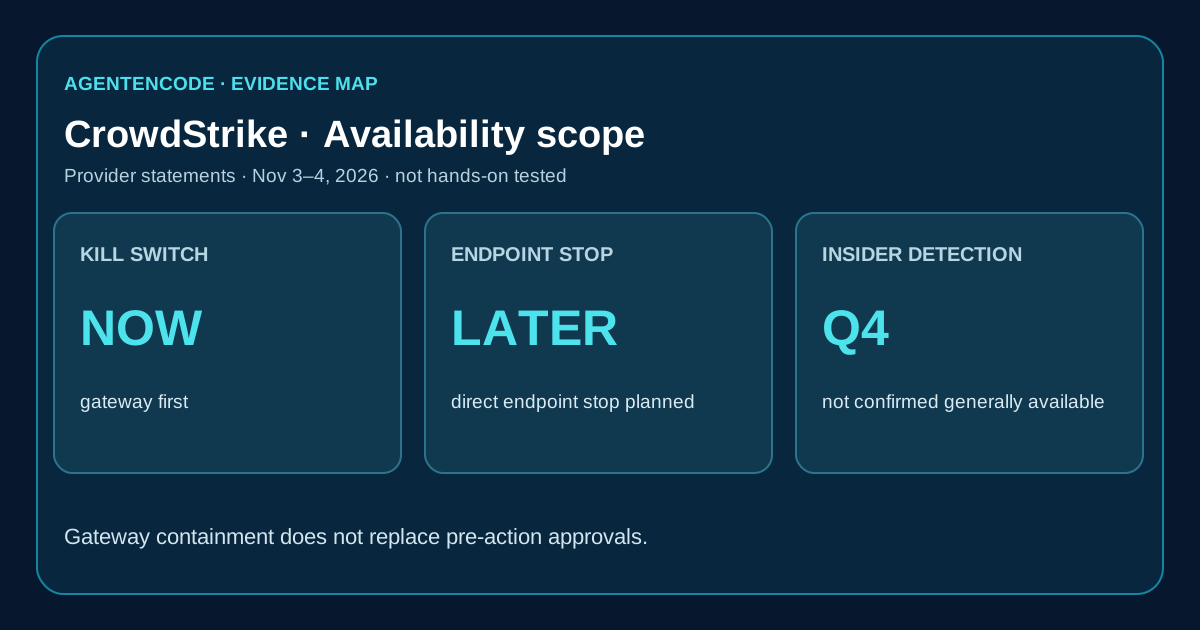
Its own technical availability wording matters: the initial stop occurs at the Gateway, while direct endpoint stopping is described as forthcoming. That distinction is critical for an offline local coding agent or a tool running outside the managed gateway path.
An administrator-triggered stop is reactive. It cannot undo completed file deletion, a transmitted secret or an already executed payment. Any high-impact workflow still needs pre-execution policy and approvals.
Availability matrix, November 7
| Capability | Provider-stated status | Operational caveat |
|---|---|---|
| Falcon Guardian base | GA since September | Verify actual agents and sensors in scope |
| AI Kill Switch | Available, initial gateway control | Do not assume complete local-process termination |
| Direct endpoint termination | Announced as 'soon' | Not confirmed generally available |
| AI Gateway | GA, included with Guardian according to provider | Requires traffic/control-path assessment |
| Agent-level hooks | Available for several major coding assistants | Integration coverage varies |
| Endpoint network inspection | Windows GA; Mac early access | Distinct operating system scope |
| Coordinated multi-agent investigations | GA | Test evidence trace and analyst workload |
| Agent Insider Threat Detection | Planned for Q4 | Not equivalent to GA |
| Policy-drift guardrails | Planned FY28 Q1 | Roadmap only |
The matrix reflects public provider statements, not an AgentenCode hands-on validation or security certification.
Policy violations are the easier problem
A more subtle risk is an agent whose actions are individually permitted but collectively abnormal. Excessive data retrieval, odd timing, unusual tool combinations or a shift in typical behavior can be dangerous without triggering a simple deny rule.
CrowdStrike's announced Agent Insider Threat Detection aims to learn baselines for agents and owners, identify deviations and route them into coordinated investigations spanning endpoints, identity, SaaS, cloud and network. The company positions this for Q4.
That architecture will also need to manage false positives, alert fatigue and explainability. The vendor's press release should not be read as an independent proof of low error rates across customer environments.
Hooks, MCP servers and local models
CrowdStrike lists agent-level hooks for Claude Code, OpenAI Codex, GitHub Copilot, Microsoft 365 Copilot, OpenCode and Cursor. Their purpose is to apply policy close to an agent's instructions and tool activity.
But protection is bounded by the real integration. An agent may act through a different tool, MCP server, local process or unmanaged system. Determine which calls are actually intercepted and which are only logged before approving a deployment.
Test the stop under controlled failure
A practical pilot should run a harmless agent in an isolated workspace with defined permissions. Test allowed edits, blocked network access, forbidden tool use and an attempted restart after administrator intervention. Record whether each action was stopped before execution, detected afterward or escaped the selected control path.
Repeat with local/offline execution, Windows versus Mac and third-party tool integrations where relevant. Capture audit records, intervention time, operator identity and exactly which permissions remained active after containment.
AgentenCode decision matrix
| Scenario | Assessment | Minimum requirement |
|---|---|---|
| Cloud-connected coding agent | Pilot Falcon Guardian | Tool allowlist, identity, gateway coverage |
| Fully local/offline agent | Gateway coverage alone is insufficient | Verify host/process control separately |
| Agent with destructive or payment authority | No autonomous sign-off | Least privilege and pre-action approval |
| SOC multi-agent investigation | GA, but test it | False positives, explanation and audit |
| Purchase depending on insider detection | Roadmap caution | Q4 delivery and integration confirmation |
| Mixed Windows/macOS fleet | Scope the platforms | Windows GA vs. Mac early access for network inspection |
Procurement and privacy questions
The November public releases do not establish a universal price for every Guardian capability or complete regional data-processing terms. Ask about edition, endpoint count, agent coverage, retention, required cloud permissions, telemetry access and the support process.
Prompt inspection, response inspection and tool traces may themselves include sensitive business data. A security system monitoring agents needs its own access controls, retention limits and trustworthy audit trail.
FAQ
Can CrowdStrike stop every local AI agent today? The public wording does not establish that. The Kill Switch is available but initially gateway-based, with direct endpoint termination to follow.
Is Agent Insider Threat Detection GA? The November 4 announcement marks it as coming in Q4. Coordinated multi-agent investigations are GA.
Does the kill switch prevent damage already done? No. A later shutdown cannot reverse an earlier destructive action; pre-execution controls are essential.
Is macOS support identical to Windows? No. Endpoint network inspection is listed as Windows GA and Mac early access.
Who initiates a shutdown? The provider describes authorized human administrators and a recorded audit trail; organizations should validate the precise workflow.
Conclusion
A kill switch is an important containment capability, but it sits at the end of the security chain. The decisive issue is whether a harmful next action can actually be prevented on the specific host, tool or network path an agent uses.
CrowdStrike's announcements are relevant because they expose this operational question. A credible deployment decision must distinguish the usable gateway control from forthcoming endpoint enforcement and roadmap-only behavior detection.
Sources & editorial context
Provider statements and editorial evaluation as of November 7, 2026. We did not independently reproduce benchmarks, install the product in production or certify its security.