
Google Maps brings Ask Maps to Europe—and AI trip planning moves beyond search
Google expands Ask Maps to Germany and Europe. Explore Gemini-powered itineraries and saved-list search, plus why automated appointment calls remain US-first.

A conversational map arrives in Germany and beyond
Google confirmed on November 17, 2026 that Ask Maps is expanding to Germany, Austria and Switzerland, as part of a rollout spanning more than 30 European countries. The Gemini-powered assistant is designed to turn complex questions about places into practical suggestions rather than a flat list of addresses. Google cites information covering more than 300 million places and reviews from more than 500 million contributors; those ecosystem figures do not independently verify the accuracy of each AI-generated answer. Read the original announcement and explore profiles in the Agent Finder.
The consumer promise is easy to understand. Someone could ask where to charge a phone quickly or find a public tennis court with lighting for the evening. Instead of repeatedly applying filters and reading results, users describe an intention. The harder question is whether the reply reflects current access, distance, hours and other constraints well enough to be acted on.
Multi-stop itineraries are the headline planning feature
Ask Maps can now assemble day-by-day travel itineraries, from a local shopping outing to a three-day road trip. Google's product team describes suggested stops, numbered map pins, sharing options and export to Google Docs on desktop. Once the trip is drafted, people can ask to insert a viewpoint, lunch break or other stop and see the plan update.
Generating a plausible itinerary is not the same as producing a reliable journey. Transit time, traffic, charging availability, accessibility and opening hours must still fit together. The point at which a conversational assistant becomes genuinely useful is where it reduces planning effort without introducing costly mistakes. That is a real-world measure of agent quality, rather than how natural the conversation feels.
Users can query their own saved places
A second improvement lets people ask questions across saved lists. Google's example involves finding a suitable place from an existing list for a group within a short time window. Instead of manually searching a collection of starred restaurants or attractions, Ask Maps combines a natural-language query with local place information.
This is useful for groups, frequent travelers and anyone who has accumulated a large set of favorite places. But a displayed possibility should not be confused with a guaranteed booking. Availability can change or depend on an external partner, and the announcement does not establish uniform support for every saved-list feature or booking partner in every market.
The agentic leap: contacting local businesses
The strongest example of taking action instead of only giving advice is the ability to find appointments with beauty, pet care, car servicing and home-repair businesses. Google says the service may search online slots and call a local business, then return available options to the user. The user can choose which appointment to pursue.
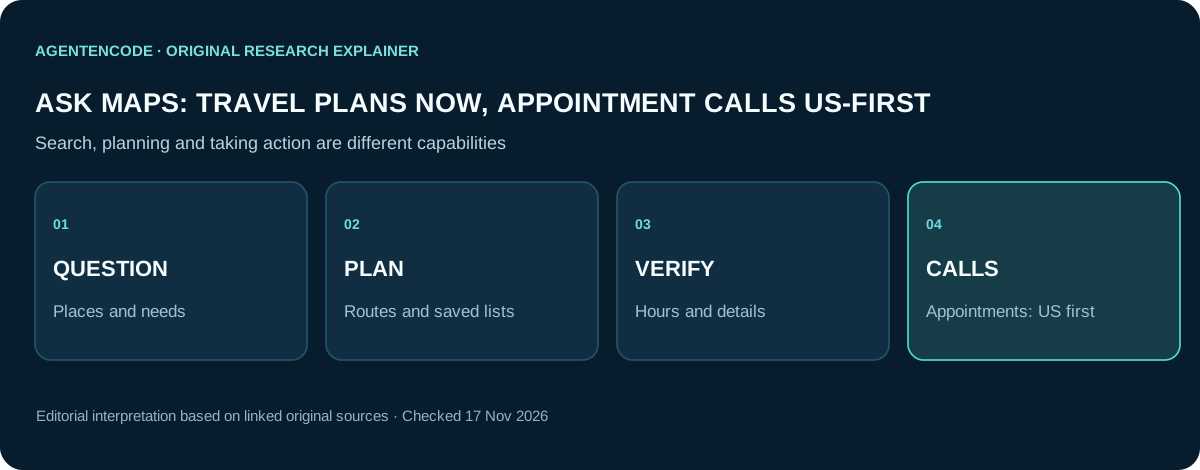
Geography matters. Google's detailed November 16 announcement says that appointment finding and 'Know before you go' route tips are launching first in the United States. The itinerary and saved-list features are intended for all markets where Ask Maps is offered. No announcement establishes that automated appointment calling is already broadly available in Germany, Austria or Switzerland.
Personalization and the question of permissions
An effective local assistant may benefit from context such as current location, travel preferences and saved places. Google describes Ask Maps as personalized, but the public launch material does not document every possible data flow or permission scenario. Users should distinguish between details they explicitly provide, information available from maps and recommendations inferred by the model.
When a system contacts a business, additional questions arise: how does the business know who is calling, what constitutes approval to request a slot, and how are mistakes corrected? The answers may vary across services and regions. They should be tested in the released product, not assumed from an attractive demo.
A practical quality test that anyone can run
Try a time-limited route through a city you do not know. Specify a starting location, one transport mode, a fixed time budget and accessibility constraints, then request two or three relevant stops. Verify every stop's opening hours and whether the suggested sequence is feasible. Change one variable, such as weather or departure time, and inspect what the assistant updates.
Track the number of manual corrections, unrealistic recommendations and saved minutes of planning. A convincing prose answer alone cannot demonstrate usefulness. The same principle applies to business agents: outcomes, permissions and recoverability matter more than fluent text.
What local businesses should watch
Discoverability is likely to change as map applications shift from lists of links to a small number of AI-selected suggestions. Useful, structured information about service offerings, accessibility, location, appointment routes and opening hours becomes increasingly valuable. This could affect retailers and local service providers, as well as travelers.
Yet the rollout does not prove any specific change in organic traffic, calls or sales. A company should not infer a new ranking algorithm from marketing copy. It can, however, make its public information accurate and easy to verify, so both people and digital assistants have less room to misunderstand it.
AgentenCode assessment: places are becoming actionable
Ask Maps illustrates an important consumer-agent transition: natural-language interaction connects location data, personal planning and, in some markets, direct contact with service providers. Proposing a route is advisory; placing a call is a consequential action. The second requires clearer boundaries around approval, privacy and error handling.
For European readers, the immediate milestone is the expanded Ask Maps rollout. The more ambitious automated appointment calls remain a US-first capability. Keeping those facts separate is essential for trustworthy coverage of fast-moving agent products.
Frequently asked questions
Is Ask Maps available in Germany now?
Google announced the expansion to Germany, Austria and Switzerland on November 17, 2026. Access may vary during the rollout.
Can it build a multi-day travel itinerary?
Yes. Google describes editable itineraries with multiple stops, map pins, sharing and desktop export.
Can Ask Maps call businesses for appointments in Europe?
Google describes the new appointment-search and calling feature as launching first in the United States; European general availability is not established.
Does finding an available slot mean it is booked?
No. Showing possible availability is not equivalent to a confirmed reservation or completed booking.
RESEARCH & CONTEXT
Sources for this article
This analysis relies on the original publications linked below, which readers can inspect directly.
- Google Deutschland, 17.11.2026 – Ask Maps kommt nach Deutschland, Österreich und in die Schweiz
- Google Maps Product Blog, 16.11.2026 – New Ask Maps features to help with holiday travel and prep
- Google Maps, 16.11.2026 – Ask Maps is coming to Europe
Checked November 17, 2026. Vendor statements, pilot scope and preview benchmarks have not been independently reproduced or certified.