
MiniMax H3-Image promises 4K images in ten seconds – but its open weights have a licensing catch
MiniMax H3-Image offers 4K generation and 16 reference images, yet its community licence excludes the EU, UK and US. We examine performance and rights.

16 million pixels, not a thumbnail
MiniMax H3-Image adds image generation and editing to the company's H3 family. MiniMax says it can create a 4096 × 4096 square image, roughly 16.8 million pixels, in under ten seconds under its stated setup. Weights are downloadable from Hugging Face, and the same model can take reference pictures for editing.
Speed and quality figures are supplier claims, not independently reproduced AgentenCode results. Performance varies with accelerators, parallel workloads, inference frameworks and resolution. Image dimensions do not guarantee factual correctness, natural anatomy or coherent text rendering.
One checkpoint for generation and editing
The official model card describes text-to-image and image editing through one checkpoint. Creators may provide up to 16 reference images to guide objects, colours or composition. That could simplify work on concepts, campaigns, storyboards and alternative product imagery.
Users must still control reference-image licences, consent, trademarks and privacy. A convincing synthetic picture should never be presented as documentary evidence of a real event. Multi-reference support should be validated for the specific material and use case.
Six-step diffusion and large weights
H3-Image uses a 33.1-billion-parameter diffusion transformer, an encoder inherited from H3 and a generation process distilled to six sampling steps. The model card says it creates the target resolution directly instead of simply enlarging a much smaller image.
Local deployment remains resource-intensive: the image model weights alone are about 69 GB, with an additional text encoder from the H3 family of around 67 GB. That is not a lightweight consumer-laptop install. Documented routes include Diffusers, SGLang, vLLM-Omni and ComfyUI, with hardware-specific requirements.
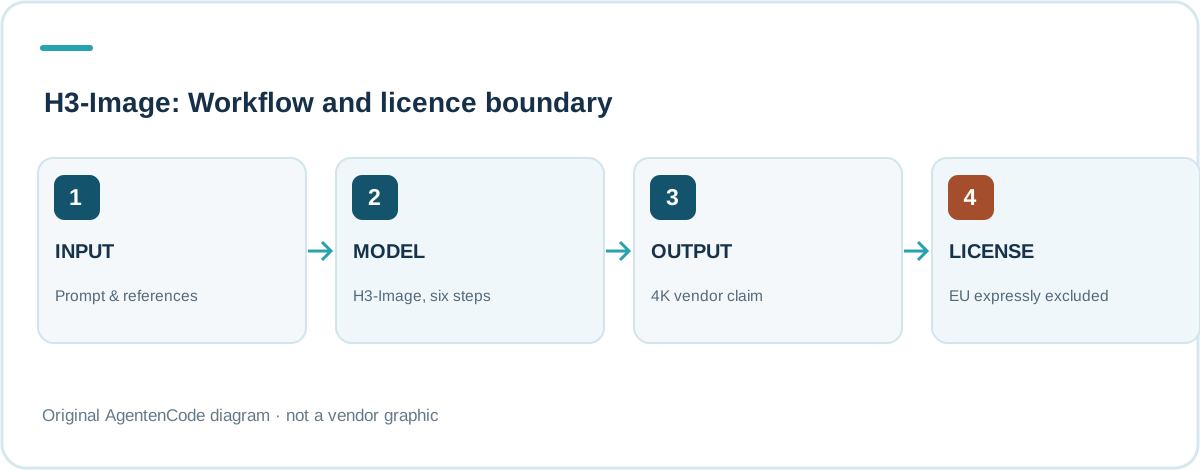
The licensing restriction that matters
The published MiniMax-H3-Image Community License excludes the European Union, United Kingdom, South Korea and United States from its permitted territory. Under this agreement, the usual permission to use, reproduce or host the weights and outputs does not extend into those regions; users are directed to request separate authorisation.
Downloading a file is not the same as receiving rights to use it. In particular, developers in Germany must not treat the publicly available checkpoint as a generally licensed local model. This is a reading of the published agreement, not individual legal advice; separately sold API services may have different terms that need independent review.
Commercial conditions beyond geography
Even in eligible territories, the licence requires written authorisation for customers whose annualised revenue exceeds US$1 million or who offer hosted services to third parties. It also sets display and downstream-use conditions.
That is materially different from an unrestricted permissive model licence. Preserve the version of the agreement evaluated, identify where the service is hosted and where users receive outputs, and obtain legal review before launching a commercial product.
Hosted options may be easier, but distinct
MiniMax offers hosted API access, MiniMax Code and Hailuo AI alongside model weights. These services may be easier to trial than assembling a very large local inference stack, but their costs and rights must be evaluated through the actual service terms, not inferred from the model repository.
Check whether uploaded reference images are stored, which regions and retention settings apply, who may reuse generated outputs, and what is billed for high-resolution or high-speed requests. Vendor marketing comparisons do not replace a controlled benchmark.
Why this matters to the open-model debate
The release shows rapid progress in large generative imaging: high-resolution creation, editing and multi-reference controls in one architecture. But it also illustrates a central weakness of the phrase open weights: publicly downloadable parameters can come with highly restrictive geographical and commercial conditions.
For companies evaluating AI security and data governance, deployment location, user permissions and actual model licence are as important as headline resolution and speed. Technical availability and legal availability must be evaluated separately.
AgentenCode verdict: significant technology, limited openness
H3-Image is technically interesting, but we would not describe it as a freely usable open-source alternative in Europe. The claimed latency and quality advantages deserve independent replication, especially for typographic content and complex reference compositions.
Until licensing, infrastructure and data flows are resolved, practitioners should distinguish the vendor's hosted products from the restricted community checkpoint. That distinction is far more useful than a simple benchmark ranking.
Frequently asked questions
Is MiniMax H3-Image fully open source?
Its weights are publicly downloadable, but the community licence imposes significant geographical and commercial restrictions.
Is sub-ten-second 4K generation guaranteed?
No. This is a vendor-reported result dependent on the specific hardware and serving setup.
Can people in the EU use the community checkpoint?
The published agreement excludes the EU from its permitted territory; users should obtain separate appropriate authorisation before use.
Can it edit several reference images?
Yes. The vendor describes editing from up to 16 reference pictures, subject to quality and rights review.
RESEARCH & CONTEXT
Sources for this article
This analysis relies on the original publications linked below, which readers can inspect directly.
- MiniMax Research – H3-Image 4K launch (11 Nov 2026)
- MiniMaxAI – Official H3-Image model card and deployment
- MiniMax-H3-Image Community License, 10 Nov 2026
- MiniMax image-generation API docs
Checked November 15, 2026. Vendor statements, pilot scope and preview benchmarks have not been independently reproduced or certified.