
Perplexity Decider v1.3: AI that scores decisions and pinpoints evidence instead of writing essays
Perplexity releases open Decider v1.3 and Flash models with locate extraction. We examine classification performance, costs and limits.
Not every task needs a chatbot
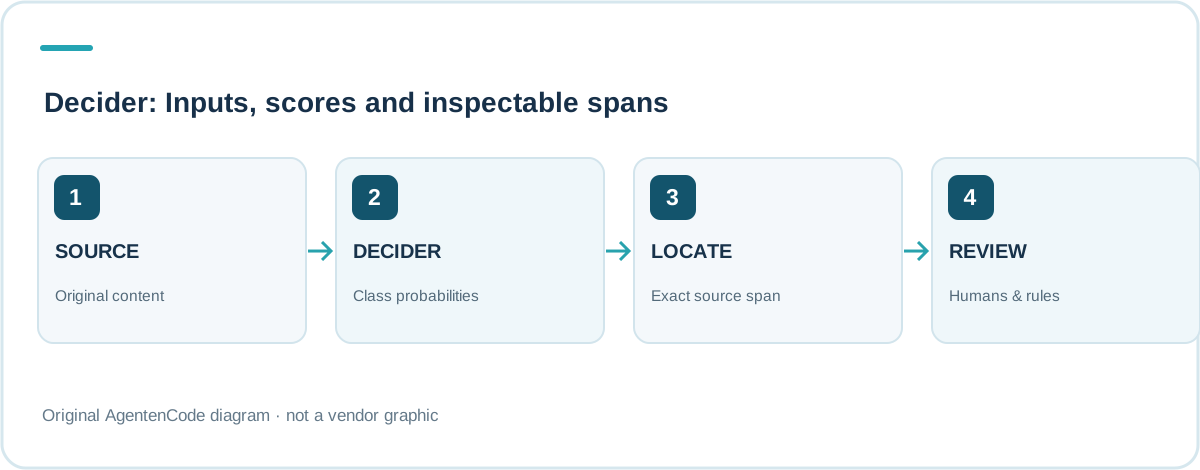
AI systems routinely rank documents, screen unsafe content, route requests, check summaries and assign categories. Many of those decisions do not benefit from lengthy generated text. Perplexity Decider v1.3 and its smaller Flash counterpart are specialised models returning probabilities for predefined choices.
They are not general conversation assistants or legally authoritative decision makers. Their value comes from constrained, repeatable questions whose outcomes can be logged and tested. This approach complements large generative models instead of replacing them everywhere.
The locate feature selects exact passages
The new locate capability can point to the precise substring of an input that matches a request, such as a company name, address or contract date. Perplexity's release describes returning the text together with character start and end positions. A single request can also combine extraction with yes/no, multiple-choice or scoring decisions.
This could make document review and search more traceable, but extracting a span does not establish its truth or legal meaning. Personally identifiable data extraction may miss cases, especially in unfamiliar formats. Human review and deterministic checks remain necessary for high-stakes workflows.
A different model architecture
Decider adapts a generative language-model backbone with a decision head that scores label choices rather than generating a full paragraph token by token. Its updated training uses bidirectional attention and separately handled question blocks to improve stability when evaluating one shared state against several criteria.
Locate adds a separately trained adapter and span head. Perplexity reports that merging this adapter into the backbone currently reduces performance on other decision questions, so it remains a separate component. That limitation is an important caveat to the idea that adding features automatically improves a model.
How to read the reported accuracy
Perplexity reports 91.6% average accuracy across 63 internal classification tasks, 6.54 percentage points above its previous production classifiers. Across 72 retrieval experiments, it reports mean nDCG@10 of 83.99, 1.81 points higher than Qwen3-Reranker-8B.
These are company-reported evaluations involving curated tasks and reference labels, not a guarantee of 91.6% accuracy for any company dataset. External reproducibility, label quality, domain shifts and training contamination all matter. Benchmarks should guide pilots rather than certify operational reliability.
The price comparison needs care
The company presents example processing costs of roughly US$26.47 for one million production requests using Decider v1.3 and US$13.24 for Flash under its setup. Some compared alternatives run through third-party APIs while Decider runs locally.
Without matching assumptions about hardware depreciation, power, latency and batching, these are not directly comparable market prices. The more meaningful idea is workload separation: reserve expensive general models for hard reasoning and use smaller classifiers for high-volume routine judgements.
Open weights and distribution choices
Perplexity says both v1.3 checkpoints are available under Apache licensing on Hugging Face, plus OpenRouter and the Decisions API. The larger model builds on a Qwen3.8-27B backbone, while Flash uses a smaller 4B architecture. Actual licences and dependency requirements should be checked at the checkpoint level.
Local serving allows evaluation under controlled environments, while APIs simplify implementation at a different cost and privacy profile. Data-handling terms and network routes must be examined separately for each deployment option.
What it means for safer AI systems
Perplexity describes applying Decider to logs from its agents, looking for missed policy violations and false positives. Proposed policy changes are subsequently evaluated and approved by people. It is a useful example of dividing responsibility between fast rules, statistical monitoring and accountable operators.
A classifier can still be fooled by malicious content or unusual inputs. Sound agent security requires scoped permissions, tamper-resistant logs, independent tests and review before irreversible changes. A high score is never a substitute for authorization.
AgentenCode verdict: Better systems need specialised components
Decider points toward AI systems assembled from multiple purposeful tools. Ranking, evaluation and extracting evidence can matter more than a model's ability to write convincing prose. Locate is especially useful because it lets users inspect the actual input span behind an extracted answer.
A good evaluation uses labelled examples from each target domain and language, measuring false alarms, misses, processing time, real infrastructure spend and the effect of human approvals. Vendor figures are a starting point, not an independent product certification.
Frequently asked questions
Is Decider v1.3 a conventional chatbot?
No. It specialises in structured classification, ranking, scoring and exact-span extraction.
What does locate do?
It returns matching text along with character offsets, when the model can identify a relevant span.
Are both versions open weight?
Perplexity describes Apache-licensed checkpoints on Hugging Face; verify each dependency and model card before deployment.
Can a Decider score replace human security review?
No. Statistical decisions can fail, so protective controls and responsible human approval remain important.
RESEARCH & CONTEXT
Sources for this article
This analysis relies on the original publications linked below, which readers can inspect directly.
- Perplexity – Decider v1.3 research release (12 Nov 2026)
- Perplexity – Decider v1.3 official model card
- Perplexity – Decider Flash v1.3 official model card
- Perplexity – Decisions API documentation
Checked November 15, 2026. Vendor statements, pilot scope and preview benchmarks have not been independently reproduced or certified.