
United Airlines restricts AI agents: Who can book a flight on your behalf?
United Airlines is restricting unauthorized third-party AI agents across booking channels. We examine identity, account risks, check-in rules and agentic commerce.
United draws a line between assistance and authorized access
On November 11, 2026, United Airlines announced that it would restrict unauthorized personal third-party AI agents on its digital platforms. The policy also covers indirect access through travel agencies and aggregators, with corresponding changes to booking, ticketing and distribution rules.
For builders of autonomous travel assistants, this matters more than another browser feature. An agent may be capable of filling forms or managing a trip, yet lack authorization from the service it wants to use. The airline's announcement is not a blanket prohibition on AI travel research.
United's stated concerns about account safety
United warns that sharing credentials with personal AI assistants can expose sensitive customer information. It also identifies the risk of unintended purchases, account changes and use of MileagePlus miles. These are risks described by the airline, not evidence of a quantified volume of confirmed agent-related incidents.
A multi-step agent can turn a simple instruction into several consequential actions. Trustworthy implementations therefore need boundaries between viewing travel data, proposing an itinerary, editing a reservation and spending money. A user's broad consent cannot be treated as proof that every downstream action was understood.
What unauthorized third-party agents means
The official statement specifically identifies unauthorized third-party personal agents or assistants and addresses both direct digital access and indirect booking channels. A traveler giving credentials to a bot is not the same as United granting access to its systems.
This distinction matters for product comparisons. Ordinary human use of an airline's app, AI that summarizes general travel information, and a bot transacting through the airline's own website are different activities. The precise rules should be assessed from the airline's current terms and any approved integration contract.
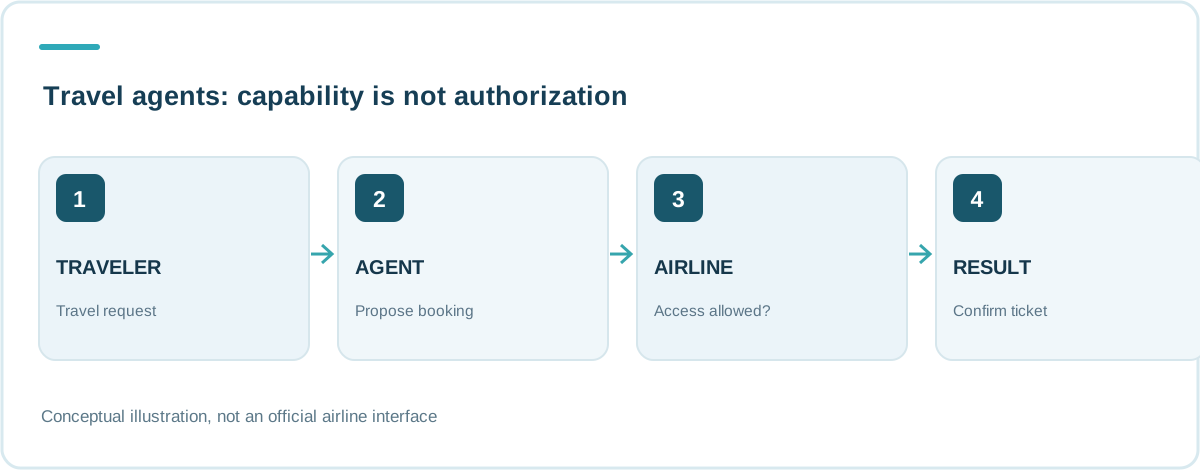
The check-in and aviation-regulation argument
United also points to potential FAA and DOT compliance conflicts. Its example is a passenger's personal acknowledgement at check-in that their baggage does not contain prohibited substances, including explosives. An unattended agent purporting to make such a declaration raises a different class of risk from reading a flight schedule.
This is United's stated regulatory rationale, not an independent legal ruling that all AI-assisted check-ins violate a law. The source does not identify a specific AI agent that regulators found liable. Human attestations and approvals must be handled according to the actual procedure, not inferred from agent capability.
Search, booking and payment are separate permissions
The promise of personal AI assistants is a continuous journey from comparing flights to purchasing a ticket. United's position shows that technical browser access and permitted transactional access can diverge. A high-performing agent may still encounter a contractual boundary before it can complete the task.
Tools such as the newly open-sourced Kitesurf browser can change how an agent navigates websites, but they do not create permission. Nor can MCP itself authorize an agent to use a third-party booking system.
What permissioned agent integrations would require
A more durable model may involve agent identities registered with the service, scoped tokens, explicit transaction review and verifiable confirmation that a booking actually succeeded. Sensitive check-in declarations may need a dedicated person-in-the-loop step rather than being delegated by a generic script.
These are potential design approaches, not announced United API features. The company says it will continue evaluating how personal assistants interact with its services, but has not established a general timetable for new approved agent integrations in the November 11 announcement.
Why the decision matters beyond the United States
The announcement concerns access to United-controlled services and distribution. It is not a general ban on travel assistants in Europe or Germany. However, European agent developers may still have to respect the airline's rules when trying to access its app, website or relevant distribution systems.
For business deployments, review both the destination's access terms and the scope of personal credentials before automating transactions. Avoid treating browser-control permission as an unlimited payment mandate. Record approval evidence and the actual outcome of each consequential action.
AgentenCode assessment: permission may become the bottleneck
AI agent discussions focus heavily on model intelligence. United's policy highlights another limiting factor: who can an agent legitimately act for, and on which service? Even reliable software may be blocked when a platform refuses third-party automation without prior approval.
We expect verified identity, narrow access scopes and revocable user consent to become essential building blocks of agentic commerce. That is an assessment of likely engineering needs, not a claim that every travel company will adopt the same policy. Our Agent Architect helps map action and approval boundaries before implementation.
Frequently asked questions
Does United prohibit all AI travel assistants?
No. Its restrictions target unauthorized third-party agents accessing United's channels and participating in the relevant booking or account workflows.
Can I give my AI assistant permission to book for me?
Your consent does not by itself establish permission from United to access its systems.
Has the FAA found AI check-in tools generally unlawful?
United raises a potential regulatory conflict; its announcement does not establish a blanket regulatory ruling on every AI check-in.
Does this ban European travel-planning software?
It is not a general European ban. United's own access rules still matter when such software interacts with United's channels.
RESEARCH & CONTEXT
Sources for this article
This analysis relies on the original publications linked below, which readers can inspect directly.
- United Airlines newsroom – United Restricts Access for Third-Party AI Agents, 11 November 2026
- United Airlines Digital Trust Center – Third-party AI agents and account security
Checked November 16, 2026. Vendor statements, pilot scope and preview benchmarks have not been independently reproduced or certified.