
Cloudflare open-sources Kitesurf: A browser built for AI agents
Cloudflare releases Kitesurf under Apache 2.0. How CDP and Puppeteer work, the Workers paid-plan requirement, and the limits versus Chromium.

An agent-focused browser becomes open source
On November 13, 2026, Cloudflare released the Kitesurf source code. The engine is designed for programs that load websites, run JavaScript, interact with page elements and capture screenshots. It runs on Cloudflare Workers instead of requiring a conventional Chrome browser container.
The notable change is the Apache 2.0 publication. Developers can inspect, modify and run the engine locally or deploy their own instance. Publishing source code, however, does not mean that an experimental browser is now a fully compatible replacement for Chrome.
Why agents may need less than a full browser
A person relies on tabs, extensions, streaming media and complex visual experiences. An AI agent may only need to read a document, follow a link or fill out a simple form. Cloudflare argues that a task-specific engine can use less CPU and memory on these workloads.
Those efficiency claims are vendor-reported, not independent AgentenCode measurements. Complex applications, long authenticated sessions and certain graphics-heavy sites can still require Chromium. The correct comparison depends on the exact workload, not a headline benchmark.
Connecting Puppeteer through CDP
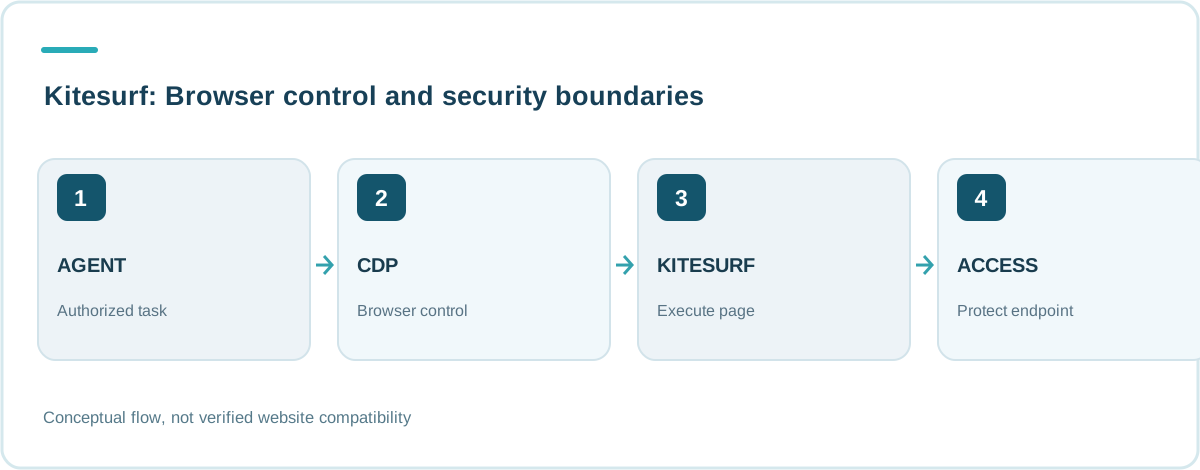
Kitesurf implements part of the Chrome DevTools Protocol (CDP). Its GitHub documentation shows how Puppeteer Core can connect to a local browser WebSocket endpoint, allowing existing automation harnesses to reuse familiar control patterns.
The system separates browser-session management, page execution and rendering across Engine, PageScript and PageRenderer. Rust and WebAssembly components support layout and painting. The architecture is promising, but a CDP endpoint alone does not guarantee complete protocol coverage.
Local builds versus hosted deployment
Developers can review the repository, follow its build requirements and start a local instance using `pnpm run dev`. Open source improves inspectability and provides a basis for reproducing rendering problems and contributing fixes.
A hosted instance is different. The Cloudflare changelog states that deploying Kitesurf to your Cloudflare account requires Dynamic Workers and the Workers Paid plan. Free source access should not be mistaken for free production infrastructure.
The most important security warning
The project does not include built-in authentication for self-hosted deployments. If an endpoint is exposed, an unauthorized user may connect an automation client, make outbound requests through the operator's account and consume paid resources. Cloudflare recommends protecting it with Cloudflare Access or another identity layer.
Access control is only one part of the threat model. Untrusted web pages can contain prompt-injection instructions and misleading content. Agent systems need domain policies, separate credentials, least-privilege tools and explicit approval gates; our agent security guide explains those boundaries.
Compatibility remains an open engineering question
Cloudflare describes Kitesurf as experimental and actively improving its support for Web standards, visual fidelity and reliability. Successfully loading HTML does not prove that a complicated checkout, account login or browser extension will behave correctly.
The company's original technical overview discusses limitations involving WebGL, video and long-running authenticated sessions. Organizations should test representative tasks, record failures and keep a browser fallback rather than assuming functional parity with Chromium.
Why agent developers should pay attention
Reliable browser execution broadens what an AI agent can do. A specialized open engine could make research, document capture and selected form-based workflows easier to scale. The key distinction is between CDP, which controls a browser, and MCP, which defines how agents discover and invoke tools.
Open implementation details can also help outside reviewers understand security assumptions and reproduce bugs. They cannot replace a service-level commitment or customer acceptance testing. Controls around websites, credentials and irreversible actions remain independent requirements.
AgentenCode assessment: infrastructure, not another chatbot
Kitesurf matters because the bottleneck for useful agents is not only model intelligence. Agents also need controlled, efficient access to real websites, transparent authorization and reliable execution environments. Preserving familiar CDP clients while changing the engine is a noteworthy direction.
We regard it as worth evaluating for constrained browsing and extraction tasks, not as a universal Chromium replacement today. A responsible pilot should measure compatibility, error handling, cost and security on actual workflows. The Agent Architect can help map the approval and tool boundaries before any implementation.
Frequently asked questions
Is Kitesurf open source?
Yes. Cloudflare published it under Apache 2.0; third-party components retain their respective licenses.
Does Kitesurf replace Google Chrome?
Not fully. It remains experimental, with partial web-platform and CDP coverage. Compatibility depends on the website.
Can I deploy Kitesurf for free?
Local development is possible, but a Cloudflare-hosted instance requires Dynamic Workers and the Workers Paid plan.
Does Kitesurf have built-in authentication?
No. Cloudflare recommends putting Cloudflare Access or another authentication layer in front of self-hosted instances.
RESEARCH & CONTEXT
Sources for this article
This analysis relies on the original publications linked below, which readers can inspect directly.
- Cloudflare Blog — Kitesurf is now open source (13 November 2026)
- Cloudflare Developer Changelog — Kitesurf open source, limitations and required access controls (12 November 2026)
- Cloudflare — Kitesurf GitHub repository, source, LICENSE and security guidance
Checked November 15, 2026. Vendor statements, pilot scope and preview benchmarks have not been independently reproduced or certified.