
Google gives AI agents user-delegated access: OAuth for A2A and MCP reaches GA
Gemini Enterprise now supports 3-legged OAuth for A2A agents. How Agent Identity manages tool authorization across MCP and APIs, and the remaining security limits.
An agent asks for delegated access rather than a password
On November 13, 2026, Google announced in the Gemini Enterprise release notes that support for three-legged OAuth (3LO) through the Agent Identity auth manager is generally available for Agent2Agent (A2A) agents. Eligible systems can access protected tools on behalf of the signed-in user. This is a specific enterprise integration, not an automatic authorization to use every account on the internet.
The hard part of agentic work begins when an assistant must access private customer data, business records or paid services. A working browser or a convenient chat prompt does not establish whether the assistant has permission to act. Google's mechanism offers a standardized consent path, avoiding the need to paste an end-user password directly into an agent conversation.
Who can use it: ADK, Agent Runtime and Gemini Enterprise
The announced integration specifically concerns A2A agents built with Google's Agent Development Kit (ADK) and deployed on Agent Runtime. Gemini Enterprise communicates with those agents through A2A. Where a downstream tool needs authorization, Agent Identity auth manager brokers delegated OAuth credentials. Google names MCP servers, Google Cloud services and third-party APIs among the supported kinds of destinations.
The scope matters. General availability for this configuration is not a guarantee that any privately hosted assistant, basic Gemini account or arbitrary A2A server can use it out of the box. Administrators still configure the identity provider, register the agent and grant appropriate access at the destination service. Licensing and regional limitations should be checked separately.
How a tool-requested consent flow works
According to Google's A2A agent documentation, an interaction may pause when an external tool needs consent. The product prompts the user, processes the provider's authorization flow, validates the callback and finalizes credentials with Agent Identity. The agent can then resume its interrupted work after a successful grant.
The newer Agent Identity API guide describes tokens stored in a Google-managed credential vault. With ADK, the agent can retrieve and attach an authorized token to a supported tool call. That is preferable to transferring raw passwords inside prompts, but it does not establish universal compatibility with every MCP endpoint or third-party provider.
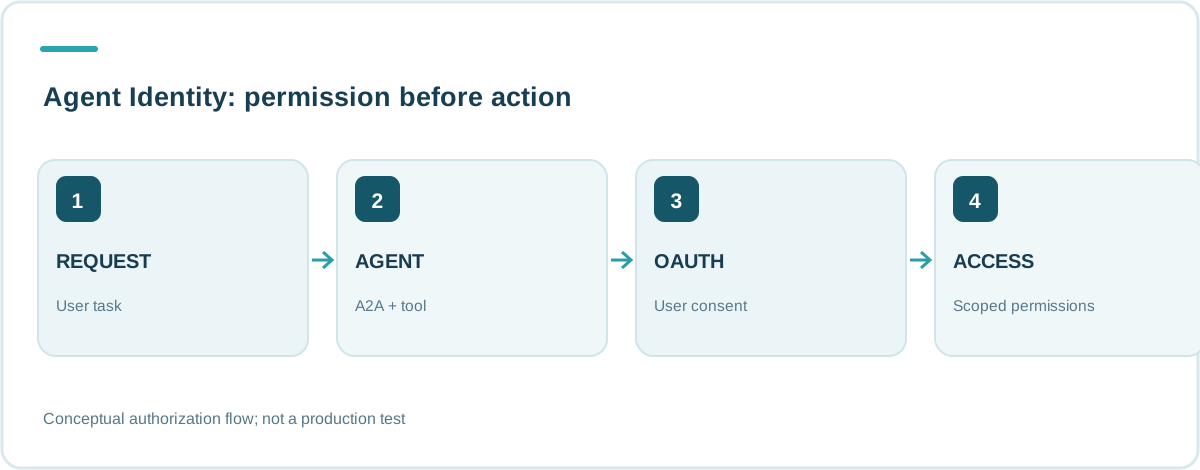
A2A, MCP and OAuth solve three different problems
A2A specifies how agents communicate or hand off work. MCP provides an interface to tools and external data sources. OAuth 2.0 governs user-delegated authorization for an external resource. Treating these as one protocol confuses the ability to reach a service with the right to use it.
An assistant may be discoverable via A2A and able to enumerate a tool exposed through MCP while having no permission to access the underlying records. A token grant from the destination is a separate step. Our MCP overview explains the tool-layer boundary; this Google announcement does not remove the service's own access policies.
What it could enable for enterprise workflows
Consider an agent asked to prepare a customer briefing from a restricted CRM. Instead of receiving an administrator password, the assistant requests a bounded grant for the relevant data service. Once the user completes authorization, it can call a permitted tool with the delegated credential. Access can be restricted to the scopes and resources the provider supports.
That is an illustrative workflow, not a hands-on AgentenCode CRM test. Teams need to examine token expiration, revocation, auditability, access scopes and the split between read-only and write actions. Being permitted to inspect customer notes should not silently grant permission to change financial records or send external messages.
Authorization is not the same as safe execution
OAuth helps with who may access a resource, not whether an agent understands its instructions correctly. An authorized system may still select the wrong customer, make a mistaken edit or obey an injected command hidden inside a document returned by a tool. Safe deployments need separate runtime protections, meaningful approval gates and outcome verification.
The distinction is visible in United Airlines' restrictions on unauthorized AI booking agents. End-user consent cannot automatically override a vendor's platform-access terms. Even a technically valid credential is not a blanket commercial license to use any service or complete any purchase.
Exactly what GA means, and what it does not
Google describes GA for the particular A2A/3LO integration in Gemini Enterprise. It is a real product-status milestone rather than merely a proposed roadmap feature. However, it does not establish general access for free consumer Gemini accounts or universal availability of every third-party connector and region.
The setup requires OAuth client credentials, suitable auth-provider roles and a supported remote agent. Google now recommends the Agent Identity API for new configurations rather than the older IAM Connectors API shown in some preview-era examples. Technical deployment instructions should use the current version rather than historical snippets.
AgentenCode assessment: permission must be designed into the workflow
The development addresses a structural limitation of useful AI agents: intelligence alone cannot grant legitimate access to business systems. Centralized delegated authorization can make enterprise deployments more manageable, especially when several agents or tools are involved.
We would still require a pilot that exercises allowed actions, denied actions, expired tokens, revoked grants and malicious external content. Our Agent Architect provides a way to map those boundaries before implementation. The important question is not only what an AI agent can technically do, but exactly what it is allowed to do.
Frequently asked questions
What did Google announce on November 13, 2026?
General availability for the Gemini Enterprise 3-legged OAuth integration with Agent Identity auth manager for defined A2A-agent deployments.
Does an agent get automatic access to all my services?
No. It must use supported OAuth providers and the destination must permit the requested scopes and user grant.
Can any MCP server use this immediately?
No. Appropriate ADK, Agent Runtime, OAuth and destination configuration are needed.
Does OAuth guarantee that an agent will act safely?
No. Runtime errors, overbroad permissions, prompt injection and poor auditability remain independent concerns.
RESEARCH & CONTEXT
Sources for this article
This analysis relies on the original publications linked below, which readers can inspect directly.
- Google Cloud — Gemini Enterprise release notes: 3-legged OAuth with Agent Identity Auth Manager GA (13 November 2026)
- Google Cloud — Register and manage an A2A agent, 3-legged OAuth configuration
- Google Cloud — Authenticate using 3-legged OAuth with the Agent Identity API
Checked November 16, 2026. Vendor statements, pilot scope and preview benchmarks have not been independently reproduced or certified.