
LifeVal: OpenAI tests everyday AI agents – what impressive example scores do not prove
Can an AI assistant help a family find childcare, coordinate volunteers or complete household administration? OpenAI released LifeVal on November 2, 2026 to evaluate practical everyday tasks. The important question is not just how well an answer scores in a test, but whether an authorized action is reliably completed in the real world.
LifeVal evaluates useful everyday tasks informed by time-use research and a survey of 3,995 people. OpenAI presents impressive percentages for selected examples. Those are not an independently established overall success rate for real-world autonomous agents. Practical deployment still requires verified outcomes, permissions, privacy safeguards and explicit human approvals.
Sources and limitations
- Primary source
OpenAI's November 2, 2026 primary publication describes the sample, task areas and a selection of scores. Read the original.
- Not independently tested
We did not independently rerun the evaluation; no general real-world end-to-end action success rate is established here.
Why LifeVal starts with everyday needs
OpenAI's starting question is useful: what kind of help do people actually want? LifeVal draws on the American Time Use Survey and the Multinational Time Use Study, then adds a vendor-described demographically representative survey of 3,995 respondents. The resulting evaluation covers caregiving, education, household administration, personal finance, shopping and access to government services.
This moves beyond traditional tests of facts, coding or mathematics. A personal assistant needs to help someone make and carry through a practical decision, not simply produce a polished paragraph. Yet LifeVal is described as an evaluation used to track and improve models. The publication is not an announcement that an unrestricted personal agent can autonomously execute every example in production.
How to read the 93.1% and 98.0% examples
OpenAI displays 93.1% for an example comparing kindergarten options after a move and 98.0% for a volunteer-coordination task during flood preparation. A displayed housing-search example reaches 100%. These are selected task illustrations, not a disclosed aggregate percentage for all LifeVal tasks and not a universal probability of success for actual households.
The kindergarten example offers a shortlist and leaves choices for the parents to settle. The health-related meal-planning example likewise prepares a plan for review rather than documenting medical treatment. A generated answer can be helpful even when the underlying real-world operation has not been completed. Treating illustrative scores as proof of completed enrollments or successful emergency responses would misstate the evidence.
A strong evaluation score is not a completed action
A benchmark can evaluate model output under defined conditions. A production agent must also use current sources, handle website changes, respect permissions, preserve an audit trail and correctly confirm changes in external systems. Those additional steps separate a compelling assistant response from a finished, reliable service transaction.
We would want separate metrics for authorized action completion, intervention rates, reversibility, harm and failed attempts before drawing strong deployment conclusions. The public overview does not supply an independent end-to-end outcome audit for every demonstrated scenario. AgentenCode therefore treats LifeVal as a useful evaluation lens rather than evidence that all personal-agent deployments are ready.
Privacy, safety and consent in daily life
Childcare, health, personal money and government tasks involve sensitive data and potentially lasting consequences. A system that gathers publicly available information requires a different permission model from one that signs agreements, spends funds or submits identity documents. A practical architecture separates research, a proposed decision and a high-impact action.
Information minimization matters as much as answer quality. Developers should record which third-party tools receive family or health data, establish expiration and deletion rules, and require confirmation before irreversible actions. A fluent answer is not authorization, and an impressive score does not substitute for consent, accurate sources or professional review where needed.
AgentenCode matrix: evidence versus authorization
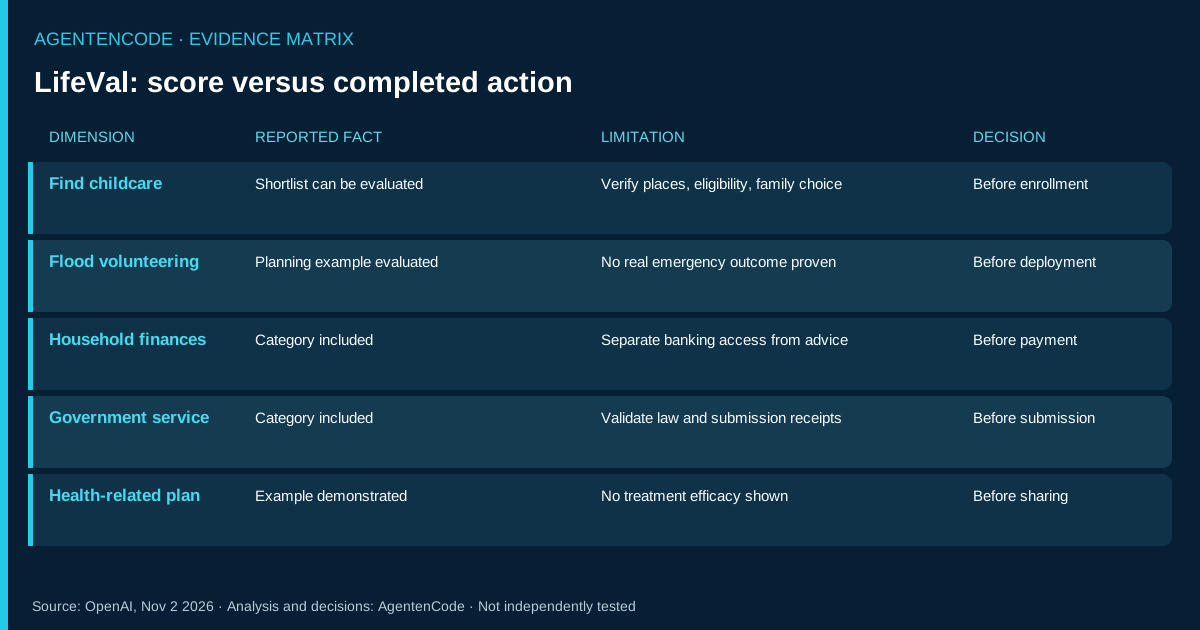
The following matrix is an original AgentenCode decision aid, not an OpenAI LifeVal scorecard. It translates reported task categories into concrete deployment gates. It is intended to make the difference between evaluated assistance and validated external actions explicit.
Recommendations and shortlists may be sensible pilot workloads under supervision. Enrollment, payments and emergency dispatch require stronger verification. A reliable autonomy claim would need evidence that the correct action actually occurred in the relevant external system with the user's informed permission.
| Case | Evidence | What remains open | Approval gate |
|---|---|---|---|
| Find childcare | Shortlist can be evaluated | Verify places, eligibility, family choice | Before enrollment |
| Flood volunteering | Planning example evaluated | No real emergency outcome proven | Before deployment |
| Household finances | Category included | Separate banking access from advice | Before payment |
| Government service | Category included | Validate law and submission receipts | Before submission |
| Health-related plan | Example demonstrated | No treatment efficacy shown | Before sharing |
How to test a real personal agent
Start with three to five narrow tasks using consent and non-sensitive or synthetic data where possible. For each, define the expected outcome, allowed tools, required approval points and conditions that stop the agent. Review both the final result and its path: source freshness, requests sent, external changes and time spent on human correction.
Then record successes, failures and interventions separately. Did a school confirm availability? Was a government form accepted? Did the system avoid unintended disclosures? Without execution logs and verified external outcomes, an evaluation percentage indicates a kind of model capability, not proven autonomy. We did not perform a LifeVal rerun or a live personal-agent trial.
Verdict: measure outcomes, not just fluency
LifeVal matters because it shifts discussion from abstract model intelligence to tasks that affect people's time, choices and responsibilities. That is a meaningful change in what gets measured, rather than a guarantee of safe autonomous execution.
The next evidence threshold is clear: show that agents complete real tasks with appropriate tools, consent, source verification and traceable outcomes. Anyone evaluating personal agents should distinguish those requirements from selected benchmark examples, however impressive the displayed percentages may appear.
Primary sources
- OpenAI, LifeVal (2 November 2026) – official first-party engineering or research publication.
Frequently asked questions
Does LifeVal prove personal AI agents can act autonomously in daily life?
No. The release describes a model evaluation with selected tasks; it does not establish universal success for real-world transactions.
Are the displayed percentages an overall success rate?
No. The published examples illustrate individual tasks. They are not a complete, independently verified operational success rate.
How many people did OpenAI survey?
OpenAI reports 3,995 respondents in an additional demographically representative survey used to identify valued everyday tasks.