
Google Vids makes personal AI avatars free—but European access remains unclear
Google opens personalized AI avatars in Vids to personal accounts at no extra charge. How creation works, why EU restrictions remain and what happens to face data.
Google brings personalized video presenters to personal accounts
On November 17, 2026, Google announced that personal avatars in Google Vids would be available to people with personal Google accounts at no additional charge. Users can build a digital likeness of themselves to deliver scripted lines across video scenes, without filming each take. Google's announcement frames this as a simpler route into video creation.
That is more consequential than a new visual filter. A reusable digital presenter could help small teams produce explainers, demonstrations and recurring updates. Yet a free feature does not mean unlimited production, and the announcement should not be read as confirmation that every country can use it immediately.
Creating an avatar starts with a phone recording
Google's workflow begins inside Google Vids on a desktop. The user scans a QR code, records a selfie and voice sample on a phone, then adds the resulting avatar to a project. Prompts can tell the avatar what to say and, where supported, how to move or appear in a scene. The same personal avatar can be reused, helping a video maintain a consistent presenter.
The convenience is obvious, but output accuracy remains a separate question. Pronunciation, expression, background visuals and factual statements still need human review. Google's product description is evidence that a feature exists, not an independent study of whether all generated presentations are accurate or natural.
A major caveat: European availability is not established
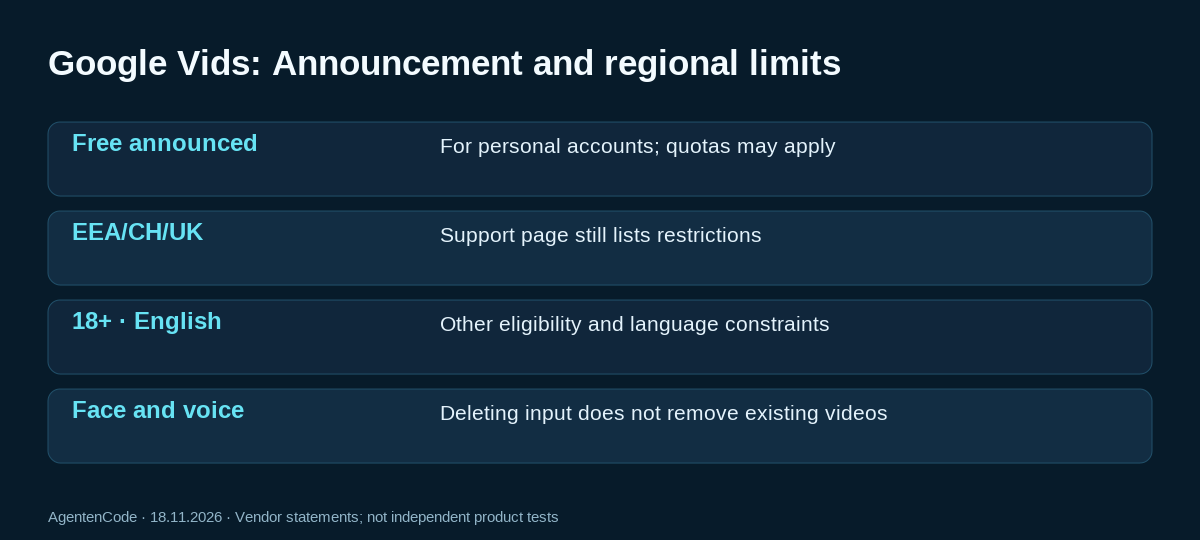
The new blog post promises access for personal Google accounts. However, Google's official personal-avatar help page still says the feature is not available in the European Economic Area, Switzerland or the United Kingdom. It also lists 18+ eligibility, English-only support and, in some sections, a requirement for an eligible Workspace plan.
Those statements are not fully aligned with the new free-access announcement. The documentation may not yet reflect every change, or the product may be rolling out by region. Either way, the evidence does not confirm general availability in Germany or the EU. A reader who cannot find the feature in their account should check eligibility rather than assume a technical fault.
Practical uses—and why some videos still need a real person
Potential uses include a short training clip, product demonstration, class explanation or recurring organizational message. A creator could update a script while retaining the same digital presenter across multiple scenes. Google Vids also offers ordinary editing and layout features that can be combined with avatar clips.
But synthetic presenters can weaken trust if audiences think the video is a real recording. For a personal apology, a sensitive expert explanation or a statement of current fact, authenticity and disclosure may matter more than convenience. Anyone publishing avatar content should distinguish creative illustration from genuine recorded testimony.
Free access does not erase monthly quotas
Google's Vids availability documentation describes monthly generation limits, credits and differences among subscriptions. Some tables still distinguish preset avatars from personalized ones for private accounts. These descriptions may need updating after the new announcement, so exact plan eligibility must be verified in the live product.
It would be misleading to claim that anyone can now create an unlimited number of full-length videos without paying. Practical questions include the allowed number of generations, length per clip, language support and whether other AI features consume a shared credit allowance. The free headline answers only one of those questions.
Your selfie and voice are sensitive inputs
A personalized presenter requires more than text instructions: the user provides recorded facial and voice information. In its account help, Google describes using the recordings for avatar creation and safety checks, while providing controls to view and delete them.
Deletion comes with a crucial distinction. Removing the source recordings prevents generating new content with that avatar and removes the recordings from Google's systems, according to the company. It does not automatically remove videos already created or published. Those files and any externally shared copies require separate attention. Users should treat the avatar as a potentially sensitive representation of their identity.
Consent and protection against impersonation
Google says personal avatars are linked to the account owner and restricted to depicting that person's own likeness. This is a meaningful stated policy against creating arbitrary impersonations. It does not prove that every abusive attempt can be prevented, or that synthetic media can never be misleading once published elsewhere.
For workplace use, obtain informed consent and define who can create, publish or remove avatar videos. If someone leaves an organization, their digital likeness should not continue to deliver new messages without authorization. Transparent labeling matters whenever an AI presenter could be mistaken for a current real-life appearance or statement.
AgentenCode view: video production becomes ordinary software
The release shows how image, voice and video generation are becoming normal features inside productivity suites. Small teams may be able to create explanatory material with less equipment and less repeated recording time. That changes the economics of short-form video, even if the creative direction and factual checking still require people.
As of November 18, 2026, Google's free-access announcement is documented. Its support material, however, leaves regional, age and language restrictions unresolved for European readers. A trustworthy assessment should separate the confirmed pricing expansion from assumptions about immediate local availability. Further context: AI agent security and permissions.
Frequently asked questions
Are personal avatars in Google Vids now free?
Google announced free access for personal Google accounts on November 17. Quotas and geographic eligibility remain separate constraints.
Can people in Germany use it now?
Google's help page still lists the EEA as an unsupported region, so general availability in Germany is not established.
Can users create avatars of other people?
Google describes account-linked personal likenesses of the owner, not a general permission to impersonate third parties.
Does deleting an avatar also remove published videos?
No. According to Google's help, source recordings can be deleted, but previously created or published videos must be managed separately.
RESEARCH & CONTEXT
Sources for this article
This analysis relies on the original publications linked below, which readers can inspect directly.
- Google Blog: Anyone can create a personal avatar of themselves in Google Vids, at no cost, 17.11.2026
- Google Docs Editors Help: Create, use and manage your personal avatar in Vids
- Google Account Help: Create, use and manage your avatar
- Google Docs Editors Help: Availability and quotas for AI features in Google Vids
Checked November 18, 2026. Vendor statements, pilot scope and preview benchmarks have not been independently reproduced or certified.
Related agents, systems and context
Product links identify the subject of a report; ecosystem links provide context, not shared feature claims.
- Background guideCosts and ROI