
Does an agent really save money or merely shift work? This evidence-first guide shows how to separate vendor prices, technical consumption, quality risks and genuine value.
Do not measure only cost per message. Measure full cost per verified acceptable outcome. Our figures are illustrative assumptions, not product quotes or customer results.
How much does an AI agent actually cost?
An AI agent does not have a universal price per answer. Depending on the product, costs may come from subscription seats, model usage, paid tools or enterprise contracts. Production workflows add integration, maintenance, permission controls, human review and the cost of failed attempts. The meaningful unit is the fully loaded cost per verified, acceptable outcome.
This reference separates source-backed guidance from a transparent editorial calculation. It does not invent current vendor prices, customer savings or independent benchmarks. Always check the current plan, region, usage limits and actual workflow requirements.
Seven cost categories every business case should include
- Licences and seats: subscriptions, minimum commitments and plan limits.
- Model usage: input/output tokens, repeated calls, routing and context size.
- Tools and infrastructure: search, browser, connectors, database, hosting and storage.
- Implementation: workflow design, permissions, testing, integration and training.
- Human work: approvals, reviews, escalation and error correction.
- Quality and security: evals, monitoring, privacy review, identity and logging.
- Failure and ongoing change: retries, outages, policy updates and maintenance.
Both OpenAI and McKinsey caution against treating token spend as total workflow cost. OpenAI: AI investments in the agentic era ↗ · McKinsey: Where AI agents pay off: Economics of agentic workflows ↗
Subscriptions, usage-based APIs and custom builds
| Approach | Useful feature | Hidden consideration |
|---|---|---|
| Packaged subscription | Fast start | Usage quotas, premium tools, data handling |
| API-driven agent | Measurable consumption | Retries, engineering and connector costs |
| Enterprise platform | Central administration | Implementation and governance overhead |
| Custom-built workflow | Fit to a specific process | Full security, testing and maintenance burden |
Individual users should explore existing entitlements before paying for a new plan. Organisations should compare complete workflows at similar quality, volume and risk — not two unrelated seat prices.
Why low token prices can still produce expensive agents
A single agent task may contain multiple model turns: retrieve context, select a tool, inspect the result, recover from an error and verify completion. That means longer context, more tool calls and more attempts can outweigh a low model-unit price.
Illustrative arithmetic: if 1,000 tasks each require six model calls at an assumed €0.03 per call, model spend is €180. If the same task now requires twelve calls, model spend doubles to €360 with no change to the nominal unit price. This is not an actual vendor quote and excludes tools, people and infrastructure.
OpenAI's cost-and-quality guidance focuses on successful outcomes rather than cheap attempts alone. OpenAI: Optimizing customer support agents for cost and quality ↗
Five metrics that prevent misleading ROI claims
| Metric | Definition | Why it matters |
|---|---|---|
| Cost per attempt | Running cost / started tasks | Tracks execution burden |
| Acceptance rate | Verified acceptable tasks / started tasks | Separates output from outcomes |
| Cost per accepted outcome | Total costs including failures / accepted tasks | Comparable quality-adjusted unit |
| Residual human time | Review, escalation and rework minutes | Reveals shifted work |
| Realised net value | Realised benefit − total costs | Shows actual value creation |
Define success before testing: correct data, allowed action, verified completion and a clear escalation path. A fluent reply is not necessarily a solved task. Include failed attempts and manual remediation in the numerator. OpenAI: Optimizing customer support agents for cost and quality ↗
Original worked example: 1,000 monthly support requests
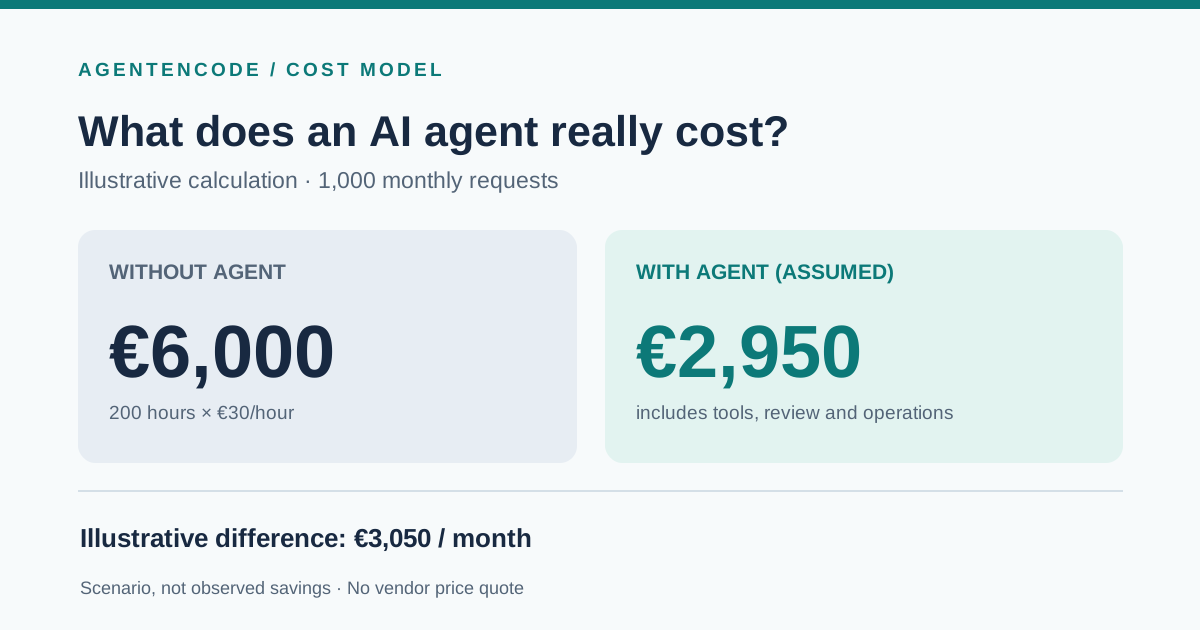
Consider 1,000 clearly scoped requests per month. Without the agent, average handling is assumed to be 12 minutes. At an illustrative internal labour rate of €30/hour, the comparison workload is 200 hours or €6,000 per month. These are chosen inputs, not an observed industry benchmark or customer result.
| Monthly component | Without agent | Agent scenario |
|---|---|---|
| Human handling and rework | €6,000 | €1,500 (3 minutes per task) |
| Models, APIs and tools | — | €450 |
| Operations and monitoring | — | €350 |
| Quality and security review | — | €250 |
| Amortised setup cost | — | €400 |
| Comparison / fully loaded cost | €6,000 | €2,950 |
The illustrative difference is €3,050 per month. Dividing it by €2,950 yields a modelled ROI of approximately 103%. This is meaningful only if capacity is genuinely redeployed, bottlenecks reduced or spending avoided. Freed-up hours do not automatically reduce payroll costs. If quality falls or manual review takes longer, the result can reverse.
How to calculate ROI without hiding the hard parts
Productivity gain is not identical to a cash return. A team may use recovered time to do more work, improve service or reduce a queue. Those benefits can be valuable, but each must be measured and named. Apply identical task complexity, quality criteria, review standards and accounting periods when comparing products.
Sensitivity analysis: when does the calculation reverse?
The worked example is attractive only under its assumed volumes and human handling times. Changing one variable at a time while keeping all other inputs fixed gives the following:
| Scenario | Fully loaded agent cost | Difference vs €6,000 |
|---|---|---|
| Base case | €2,950 | +€3,050 |
| Human work rises to 6 min per task | €4,450 | +€1,550 |
| Model/tool spend doubles | €3,400 | +€2,600 |
| Human work rises to 10 min per task | €6,450 | −€450 |
These are scenarios, not forecasts. Low task volume makes setup and other fixed costs harder to spread across accepted outcomes. Businesses should run low, expected and high-volume scenarios before buying.
AI agent costs for small businesses and individuals
A small team may not need a bespoke agent. When steps are deterministic and data structured, an ordinary workflow or existing subscription may be cheaper and more reliable. The case for agents becomes stronger where tasks require variable reasoning across multiple sources or tools and results can be independently checked.
Start with a single read-only use case: sorting documents or drafting an internal answer. Use non-sensitive test material and a small representative sample. Add rights to send messages, change records or make payments only after separate security and business approval. A personal assistant for occasional planning may deliver convenience rather than a measurable corporate ROI; that is a legitimate different kind of value.
Why quality must be defined before optimisation
A cheaper model is not cheaper in the full workflow if it creates additional incorrect answers or retries. Build a representative eval set including ambiguous requests, missing records, outdated information, permission failures, tool outages and malicious external content.
OpenAI describes tracing and grading agent workflows across the full execution, including tool calls, handoffs and guardrails. Evaluate the entire task against defined acceptance criteria rather than just judging whether the final message sounds convincing. OpenAI: Evaluate agent workflows ↗
Human oversight is both a necessary control and a genuine cost line. Removing appropriate safeguards to make a business case look attractive does not improve its quality.
A 30-day pilot with measurable outcomes
| Days | What to do | Evidence produced |
|---|---|---|
| 1–5 | Scope one workflow, record baseline handling time, quality and ownership. | Baseline and acceptance rules |
| 6–10 | Configure read-only access, tool boundaries, budgets and logs. | Controlled environment |
| 11–20 | Run representative cases; track failures, retries, human minutes and completions. | Operational data |
| 21–25 | Test exceptions, heavier loads and alternative models at equal quality. | Robustness and cost ranges |
| 26–30 | Compare fully loaded costs and actual benefits; decide to scale, revise or stop. | Decision with caveats |
Thirty days is an editorial planning example, not a universal sufficient test period. Microsoft recommends defining value before building and tracking usage, quality and business outcomes as different signals. Microsoft: Measure the ROI and business value of AI agents ↗
Copy this vendor-neutral ROI worksheet
For a fixed observation period, record at least the following inputs. Use actual measurements wherever possible.
| Field | Your value | What to validate |
|---|---|---|
| Tasks per month | ________ | Are cases comparable? |
| Previous time per task | ________ min | Measured or assumed? |
| Acceptance / resolution rate | ________ % | Who checks correctness? |
| Human time after automation | ________ min | Including failures and rework? |
| Models, APIs and licences | € ________ | All attempts included? |
| Setup allocation | € ________ | Amortisation period disclosed? |
| Security, quality and operations | € ________ | Recurring costs tracked? |
| Genuinely realised benefit | € ________ | Cash, capacity or quality? |
When not to use an AI agent
Sometimes the cheapest safe agent is no agent at all. A deterministic script can outperform an agent when all rules are known and exceptions rare. Agents are more plausible when inputs are unstructured, the sequence is variable or information must be gathered across systems — but only when added complexity remains manageable.
A project without clear data rights, a responsible owner, a quality definition or reliable recovery procedures should solve those gaps first. NIST's AI Risk Management Framework offers a useful general foundation for governance, mapping, measurement and management. NIST: AI Risk Management Framework ↗
How AgentenCode helps with vendor due diligence
The AgentenCode agent directory and AgentenFit can help identify documented use cases, integrations and relevant controls. A listed feature does not establish a particular price, service-level guarantee or outcome in your own environment.
Ask providers which plan unlocks the needed tools, how retries are charged, whether budget limits and usage exports exist, how identity and permissions work and what data residency means for your actual account. Separate documented capabilities from price quotations and operational tests.
Conclusion: optimise cost per verified result
The lowest model price is only one input. Robust task definition, fewer retries, scoped tools, realistic human review and reliable monitoring often determine whether an agent is economical.
Editorial assessment: Before launching a broad AI agent program, measure one defensible workflow end to end. If the business cannot demonstrate the baseline, acceptance rate and full cost of a small pilot, estimates for a much larger rollout should remain provisional.
Frequently asked questions about AI agent costs
Are AI agents free?
Some services offer a free tier or limited allowance, but production may still incur tool, integration, human-review and operating costs. Check current vendor conditions.
How much does an AI agent cost per month?
There is no reliable universal figure. Usage volume, tools, model choices, permissions, contract terms and human work determine the total.
Are API charges the same as total cost?
No. Implementation, failures, tool access, maintenance, security and human verification belong in the fully loaded calculation.
When is an AI agent worth the money?
When a defined workflow meets its quality requirements and genuinely realisable benefits exceed the full cost compared with an appropriate baseline.
How do you calculate AI agent ROI?
ROI equals realised benefit minus fully loaded cost, divided by fully loaded cost, multiplied by 100%. Freed-up hours are not automatically cash savings.
What is cost per successful agent task?
Divide all costs, including failures and escalations, by the number of verified acceptable outcomes in the same period.
Does a cheaper model always save money?
No. Extra retries, lower completion rates and greater human review may outweigh a lower per-call price.
Do you need to build your own agent?
Not necessarily. Packaged products and existing features may cover the task; custom development requires separate total-cost justification.
Sources and methodology
The sources below inform our cost and measurement framework. Vendor publications provide guidance and context, not independently verified AgentenCode results. All numerical examples on this page are original editorial scenarios.
- OpenAI — AI investments in the agentic era
- OpenAI — Optimizing customer support agents for cost and quality
- Microsoft — Measure the ROI and business value of AI agents
- McKinsey — Where AI agents pay off: Economics of agentic workflows
- OpenAI — Evaluate agent workflows
- OpenAI — A practical guide to building AI agents
- NIST — AI Risk Management Framework
From planning to building: Build an AI agent: step-by-step
Explore related topicsAI agents for businesses · Security and permissions · Human approval · AgentenFit