
Google CodeMender adds sandboxed exploit tests – who approves the patch?
Google has added more granular scanning and isolation options to its CodeMender preview. The meaningful improvement is the ability to contain dangerous testing and require human checks for local actions, while keeping patch review separate from a successful exploit simulation.
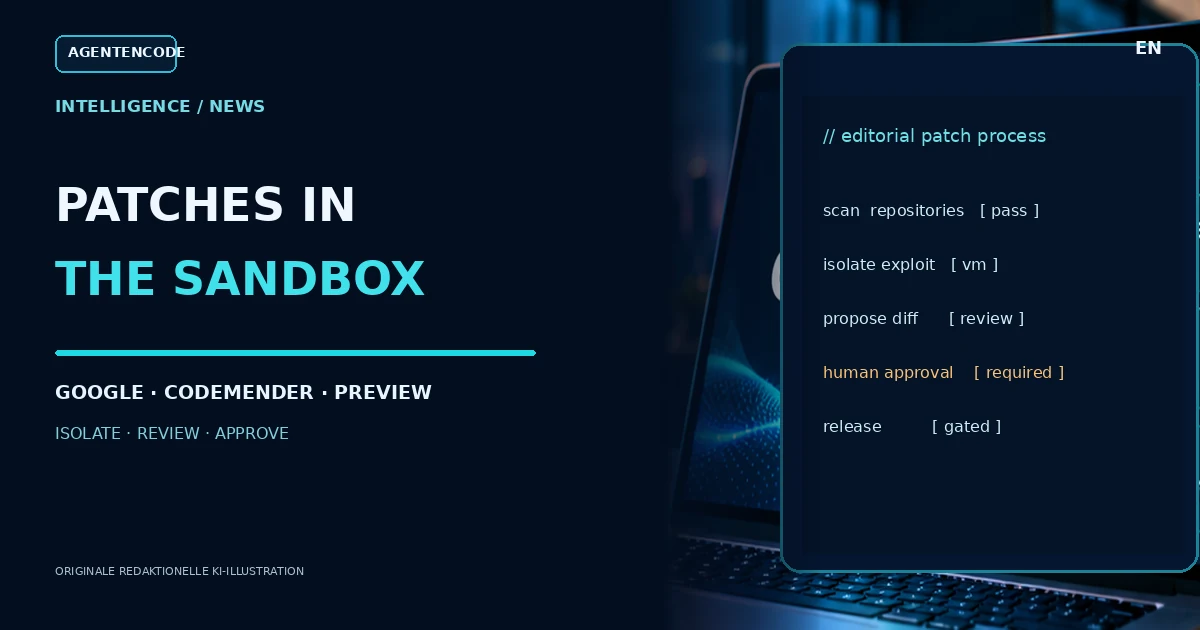
Google says CodeMender can scan folders, repositories or changed files and test exploits inside an isolated sandbox or VM. Production patch approval is a separate issue.
1. The November 4 CodeMender update
At Google Cloud Security Summit on 4 November 2026, Google described new features for CodeMender, an autonomous software-security assistant intended to find vulnerabilities, investigate exploit paths and produce tested fixes.
Google still calls CodeMender a preview. The company says the product can work with multiple models, including Gemini 4 Argon. Vendor claims about exploits and patches do not establish a reproducible success rate in an unrelated repository or customer environment.
2. Folder, repository or delta: scan scope is a governance choice
The preview now supports examining a selected folder, an entire repository or only files changed since the last scan. That gives teams useful choices between focused development feedback and broad inspection, but these modes have materially different evidentiary value.
A delta scan may reduce time and cost while missing surrounding conditions; a full scan adds coverage but is not a guarantee that every path has been exercised. AgentenCode's interpretation: report the precise scanned scope alongside every finding, and do not convert a clean subset into a statement about the full product.
3. Sandbox or VM, plus human checks for local actions
Google specifies operating-system-level sandbox and isolated virtual-machine options for vulnerability verification and exploit simulation. It also describes human-in-the-loop checks for local writes and command execution. These controls matter because a security agent must sometimes execute or reason about hostile code.
Isolation, however, is not a complete guarantee. Security teams should still assess network egress, available secrets, filesystem mounts, input data and stored artifacts. Approval to run a local command is not equivalent to permission to merge a patch into a production service.
4. AgentenCode's end-to-end patch decision map
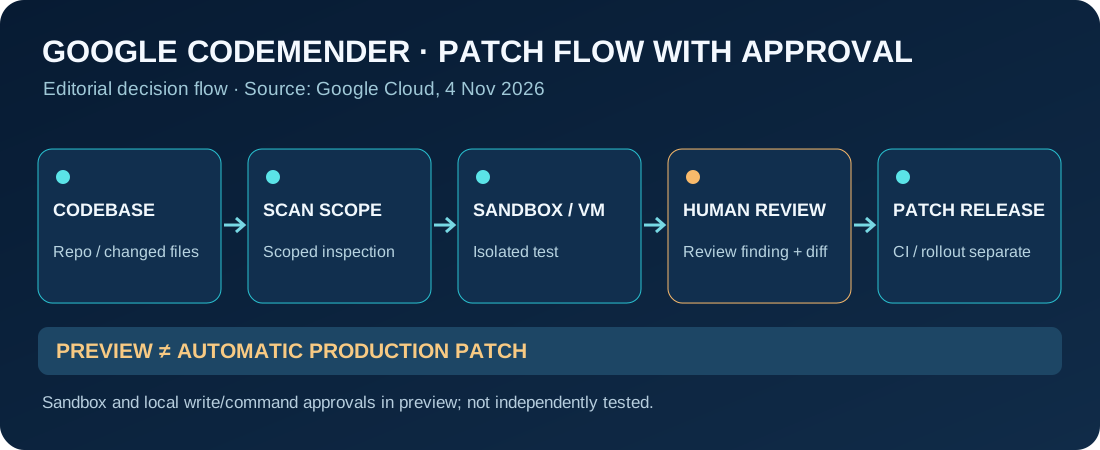
| Step | Vendor-described status | Evidence required |
|---|---|---|
| Scan scope | Folder, entire repo or delta in preview | Document paths examined and excluded |
| Exploit validation | OS sandbox or isolated VM | Inspect process, network and file limits |
| Command execution | Human-in-the-loop local check | Review actual approvals and logs |
| Patch proposal | Agent suggests code changes | Expert diff and regression review |
| Production rollout | No general automatic release proven | Independent CI, branch and rollback gates |
5. A tested fix is not automatically production-safe
A patch can close one known exploit while introducing a regression, interface incompatibility or performance problem elsewhere. A passing exploit reproduction is evidence about a selected test, not a system-wide guarantee. The review chain must examine the diff, test coverage, dependencies and deployment blast radius.
We recommend preserving the vulnerable reproducer, verifying fixes independently and keeping production changes behind existing branch protection, code review and rollback rules. These are editorial controls to apply around CodeMender, not a claim that every enterprise tenant already has the same built-in release gates.
6. How to interpret customer performance claims
Google reports preview use by hundreds of customers and quotes a Thales early evaluation suggesting vulnerability discovery time could fall by more than 95%. These are vendor and customer statements, not independently reproduced measurements. The company's PHP vulnerability example illustrates a specific contribution by Gemini 4 Argon and other models rather than a universal effectiveness rate.
A fair enterprise evaluation should include misses, false positives, manual approval time, patch regressions and a baseline process without CodeMender. Any percentage should carry a measured workload, observation window and selection criteria.
7. A useful pilot with a deliberately vulnerable repository
Start in a disposable test repository with known vulnerabilities and no production secrets. Define allowed scan paths, isolated execution and an explicit approval owner for every local write or command. Archive findings, the exploit reproducer, patch diffs and test results.
Only after a second reviewer verifies the proposal should changes enter ordinary CI. Validate tenant availability and regional requirements separately because the product is in preview. For a comparison with another coding-oriented agent, consult our Google Antigravity 2 dossier; this is not a claim that the products share the same architecture or capabilities.
8. AgentenCode assessment, FAQ and original sources
AgentenCode assessment: Sandboxed exploit validation and finer scan scope are meaningful design improvements. The deployment boundary should nevertheless remain independently governed: a generated patch is proposed evidence, not an automatic authorization to change production code.
Is CodeMender GA? No, Google describes it as a preview. Can it inspect only changed files? The announcement says yes. Does human approval of local commands prove production release approval? No; those are separate control points.
Primary sources: Google's 4 November Security Summit announcement and Google's 22 October runtime governance context. Reviewed 9 November 2026. No independent CodeMender benchmark, hands-on exploit run or security certification was performed.