
GitHub makes Copilot model policy APIs generally available
New GET and PATCH endpoints cover enterprises, teams, apps and organizations. Why coding-agent teams must still test model availability and workflows.
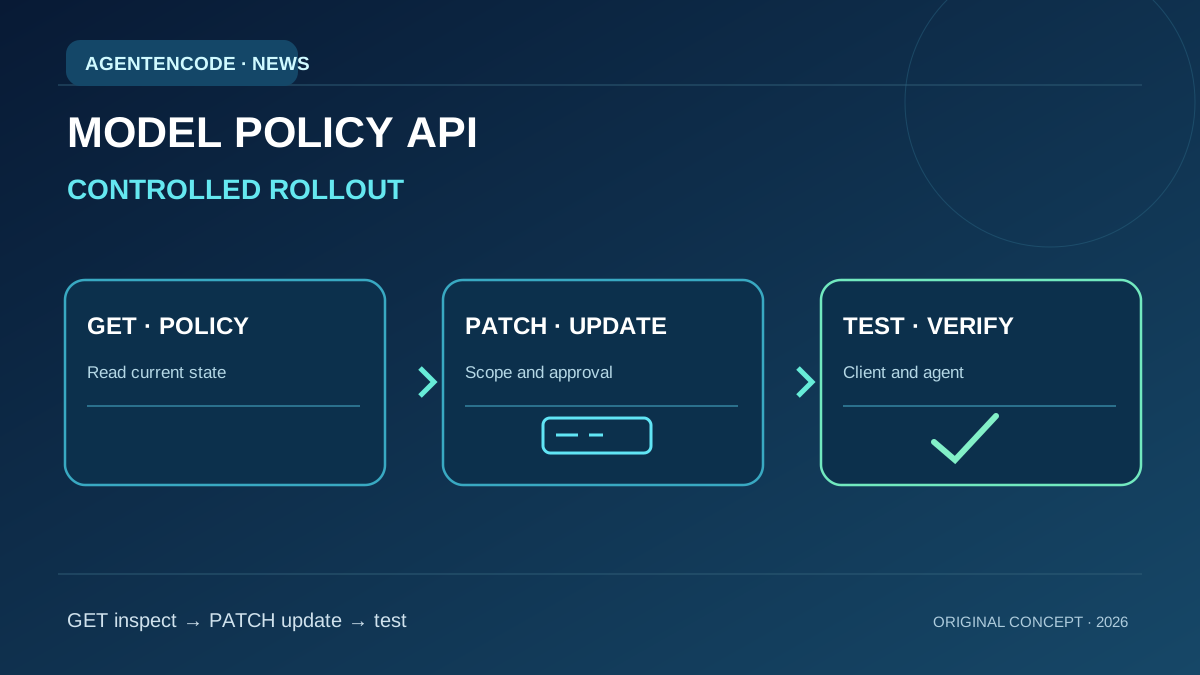
GitHub made REST endpoints for Copilot model policies generally available on October 19, 2026. Administrators can retrieve policies with GET and update them with PATCH across enterprise, enterprise team, enterprise app and organization scopes. That makes policy management easier to automate. However, a changed policy does not prove that a model is selectable in every Copilot client or that an existing agent workflow remains functional.
Administrators could manage Copilot model availability, but recurring reviews and changes spanning multiple business scopes depended more heavily on their current administrative workflows.
Four REST paths now expose read and update operations for model policy. Which scope controls access depends on enterprise delegation mode.
Four API scopes, not four independent permission switches
GitHub lists four policy endpoints: /enterprises/{enterprise}/copilot/model-policies, /enterprises/{enterprise}/teams/{team_slug}/copilot/model-policies, /enterprises/{enterprise}/copilot/apps/model-policies and /orgs/{org}/copilot/model-policies. GET and PATCH operations are generally available for all four. This makes model approval a potential input to repeatable governance workflows, especially in organizations that operate multiple teams and internally managed Copilot applications.
The scopes cannot be treated as unrelated settings. GitHub explains that enterprise policies may delegate model control to organizations in organization mode, or to teams and apps in enterprise teams mode. Administrators need to understand which level actually owns a decision. An API success response is also not proof that a specific model will be visible or usable inside an individual Copilot client.
Why the timing matters for coding agents
On the same day, GitHub confirmed that several Copilot models had been deprecated across supported experiences, including agent modes. Model availability therefore affects more than chat preferences: an organization may have instructions, workflows and review habits that assume a particular model identifier. A policy API can help inventory effective approvals and prepare changes in a controlled way. It cannot automatically adapt every prompt, tool integration or quality expectation.
A practical process separates three steps. First, record the current policies in relevant scopes with GET. Second, make a reviewed PATCH update in a limited test area using GitHub's documented request schema. Third, check model selection in a real client and run an actual agent task, observing generated changes, tool calls and reviewer effort. A successful administrative request is not a substitute for a passing end-to-end coding workflow.
The administrative API needs its own security boundary
Automation can introduce mistakes at organizational scale. Credentials allowed to alter policy should be narrowly scoped, owned and auditable. Teams should also plan for a model retirement where the suggested replacement remains blocked by a higher-level policy. A snapshot of declared settings will not tell the full story about effective access or availability in every interface.
GitHub's brief announcement establishes the endpoint families, HTTP methods and general availability. It does not provide an independent benchmark for mass migrations. Detailed permissions, accepted fields and error handling must come from the current REST documentation before anyone issues a production PATCH request. Model quality, data handling, latency and cost remain separate evaluation questions, even when a governance API makes the administrative change easy.
AgentenCode assessment
This is a management capability rather than a new model launch. Its value lies in making model policy traceable and potentially more consistent across an enterprise. But there are three different outcomes to check: the model is permitted by policy, it is presented to the intended user, and the agent workflow works with it. None automatically proves the others.
Sources and verification
Reviewed October 20 against the official GitHub October 19 Changelog. The GA status and endpoints are GitHub statements; AgentenCode did not call or modify the enterprise APIs.