
Microsoft TokenEconomizer cuts AI coding-agent costs by up to 30.9% in tests
Microsoft Research releases TokenEconomizer, an open-source plugin that reduced AI coding-agent costs by 18.4–30.9% across 277 tests. How the methods work.

Why capable coding agents still waste tokens
On November 16, 2026, Microsoft Research introduced TokenEconomizer, an open-source plugin targeting a recurring problem in agentic software engineering. Developers return to the same codebase repeatedly, yet agents often rediscover familiar build commands, unused tools and failure patterns as if the project were entirely new.
In a preliminary analysis of 60 SWE-Bench tasks, researchers found that roughly 30% of tool calls repeated an earlier action in the same repository after some history had accumulated. Of 23 tool descriptions made available, 16 were never called. Failed tasks also absorbed a disproportionate share of spending. These findings describe the studied setup, not a universal rate of waste across all agents.
Three methods without changing the underlying model
TokenEconomizer operates through interfaces the coding agent already exposes. It does not fine-tune a new model or modify the agent's underlying weights or source code. Instead, it reviews completed sessions and applies three methods: micro-skills, tool pruning and failure-loop intervention. Together, these preserve useful repository knowledge, reduce irrelevant tool definitions and redirect apparently stuck work.
The architecture matters because teams can experiment with cost control while retaining their current model and agent runtime. Each method is designed to be reversible: stale knowledge can be retired, hidden tools restored and the choice to stop a task remains with the developer. This is an experience-driven controller rather than a replacement coding agent.
Micro-skills remember how a particular repository works
A micro-skill is a short piece of repository-specific operational knowledge. It might name the reliable test command, a required preparation step or the location of generated files. According to the open-source documentation, a fact must be confirmed by three sessions before being inserted into the agent's starting context. Contradictory later evidence can retire it.
This can spare an agent repetitive discovery work, particularly in a stable codebase with recurring tasks. But learned guidance may become outdated as dependencies or scripts change. Organizations should treat it as mutable project memory, not unquestionable truth, and review what content gets extracted from development logs.
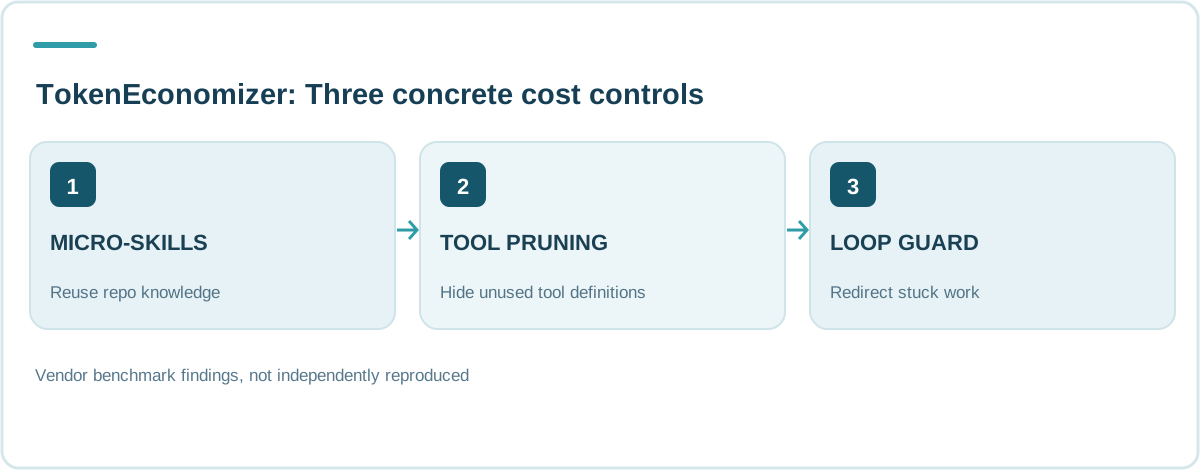
Tool pruning reduces unused definitions in context
Coding assistants often send tool descriptions repeatedly so the model can select an appropriate action. TokenEconomizer tracks which tools a repository actually uses and omits rarely relevant definitions from later sessions. Core capabilities for reading files, editing code and running commands remain available, while pruned tools can be restored.
The benefit is both a smaller context and fewer irrelevant alternatives. However, infrequently used tools can be important for rare tasks. Security investigations or unusual build errors may require a tool that ordinary sessions never use, so deployment should preserve a simple restoration mechanism and appropriate exceptions.
Failure-loop intervention offers a way out of stuck work
When a coding agent repeats unsuccessful commands, TokenEconomizer uses an additional judge model to decide whether it is genuinely stuck or still making progress. If the judge is sufficiently confident, it sends a short redirection to the agent. The open-source version does not autonomously terminate the task; it alerts the developer if the work remains stuck.
This is a practical guardrail against expensive repetition, but it is not perfect. Some complex bugs require several similar attempts, and a model-based judgment can be wrong. Teams should track actual solution quality, not just fewer model calls, when evaluating the effect of intervention.
What the 277-task evaluation actually demonstrates
Microsoft evaluated TokenEconomizer on 277 SWE-Bench tasks across six repositories, using five coding-agent and model configurations. Average cost fell by 18.4–30.9% depending on the setup. All 30 repository–configuration pairings saw lower costs, and reported calculations included the plugin's own model calls.
Pass@1 improved in four of five configurations and fell slightly in one. Microsoft also reports 16.0–21.2% savings on sequential Web-Bench tasks. These are promising research measurements, not a guarantee for every software team. Early tasks may cost more while the plugin learns, and benefits vary with project reuse and the agent's baseline behavior.
Compatibility, open-source licensing and data handling
TokenEconomizer's GitHub project is licensed under Apache 2.0. The README documents support for Claude Code, Codex, GitHub Copilot CLI and Pi, with experimental OpenCode support. It uses the agent's existing sign-in for supplemental model calls, so it does not require a separate API key. Learned information is stored locally by default in `~/.tokeneconomizer`.
Local storage does not automatically make session data harmless. Build logs, code paths and derived tips might reveal internal or confidential details. Organizations should assess plugin permissions, retention and developer-machine security before enabling automatic learning. AgentenCode has not independently audited the plugin's security or performance claims.
AgentenCode assessment: Cost per verified outcome is the metric
The significance of TokenEconomizer is that agent progress does not always require a larger model. More efficient use of prior repository knowledge may reduce repeated work while preserving successful task completion. The relevant economic metric for a production coding agent is cost per correctly and verifiably completed task, rather than the price of an individual token.
Our agent costs and ROI guide and agent evaluation reference explain how to measure this. A company pilot should compare Pass@1, corrections, elapsed time, unsafe tool behavior and actual spending against an unchanged agent. Lower token use is meaningful only when the required quality survives.
Frequently asked questions
What is TokenEconomizer?
An open-source plugin that reuses repository experience to reduce repeated tool work and costly failure loops in coding agents.
How much cost can it save?
Microsoft reports mean cost reductions of 18.4–30.9% across 277 SWE-Bench tasks; real deployments may differ.
Does it support Codex and Claude Code?
Yes. The project lists both, alongside GitHub Copilot CLI and Pi, with experimental OpenCode support.
Does it require training a new AI model?
No. The plugin runs through existing agent hooks and model access without changing the underlying model weights.
RESEARCH & CONTEXT
Sources for this article
This analysis relies on the original publications linked below, which readers can inspect directly.
- Microsoft Research — TokenEconomizer: Learning from Experience to Make AI Coding Agents More Efficient (16 November 2026)
- Microsoft / UC Berkeley — TokenEconomizer open-source repository and Apache 2.0 license
- Microsoft Research — TokenEconomizer technical paper
Checked November 17, 2026. Vendor statements, pilot scope and preview benchmarks have not been independently reproduced or certified.