
Databricks Genie: why autonomous enterprise agents need shared business knowledge
Databricks connects Genie Ontology, enterprise search and planned always-on agents. We assess the 91% benchmark, permissions and availability limits.

1. From a question-answer interface to ongoing work
Traditional assistants respond when prompted. Business operations rarely stop at one response: forecasts change, approvals remain outstanding, customers require follow-up and teams need to reconcile information across systems. Databricks wants Genie to act on longer-lived goals instead of waiting for each next question.
The announced next-generation Genie is designed to delegate work to subagents, track progress, request missing inputs and surface decisions through a priority inbox and email. Those capabilities describe the vendor's product direction. They should not be presented as independent proof of reliability in every customer environment. Databricks release, November 11.
2. Agents fail when business definitions are missing
The difficult part of enterprise analysis is often not composing SQL. Teams interpret revenue, active customers, forecasts and exceptions according to agreed rules. Those rules may be in saved queries, notebooks, dashboards or historical documents rather than an obvious database schema. An agent can execute perfectly valid SQL and still return the wrong business answer.
Genie Ontology is intended to turn that dispersed knowledge into reusable context. Agents derive candidate business meaning from the work teams already perform; domain experts and administrators maintain authoritative definitions. AgentenCode assessment: A shared context layer can reduce repeated rediscovery across agents, but also creates duties to track ownership, update definitions, handle contradictions and review access rights.
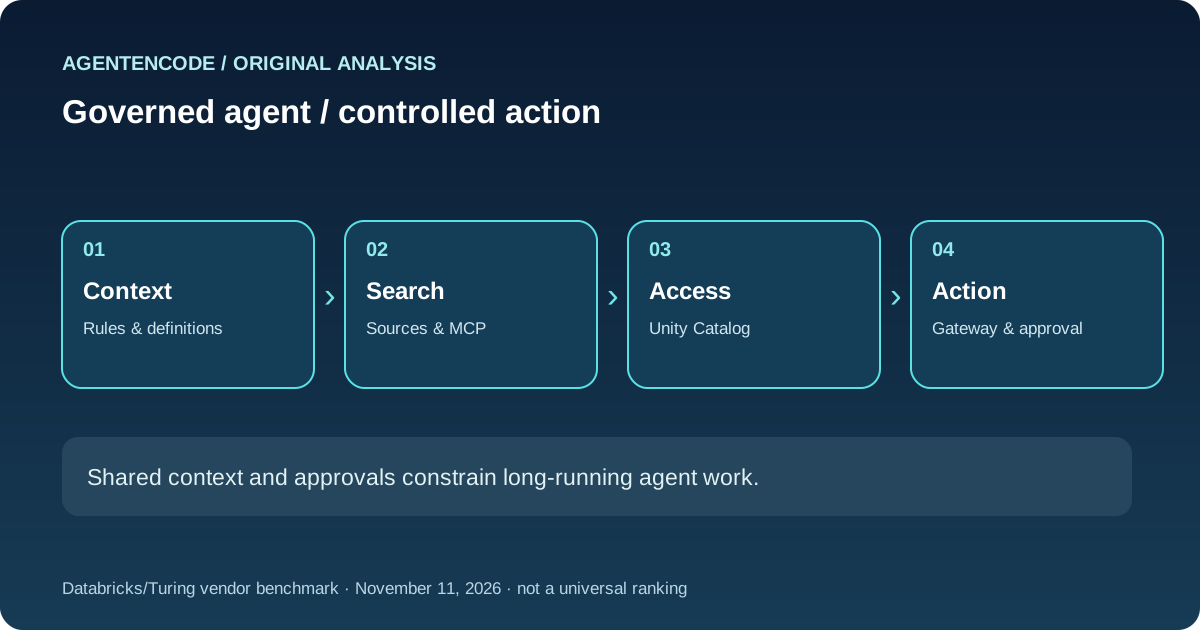
3. Four roles: ontology, search, permissions and actions
The architecture has distinct pieces. Genie Ontology records relationships, metrics, definitions and business rules. Genie Search locates relevant information across lakehouse content and applications including Google Drive, Jira, Confluence and Workday. Unity Catalog controls what users are authorized to see. Unity Gateway provides central management of tool permissions, approval policies, traces and budgets.
Databricks says its search system can combine indexed material with live MCP retrieval and SQL queries. For an always-on agent, this separation is important: retrieval provides context, access policies limit the data surface, and action policies determine what the agent may change. Even a well-cited fact cannot authorize a payment, data export or modification of a customer record without an appropriate permission or approval step.
4. What the 91% benchmark actually demonstrates
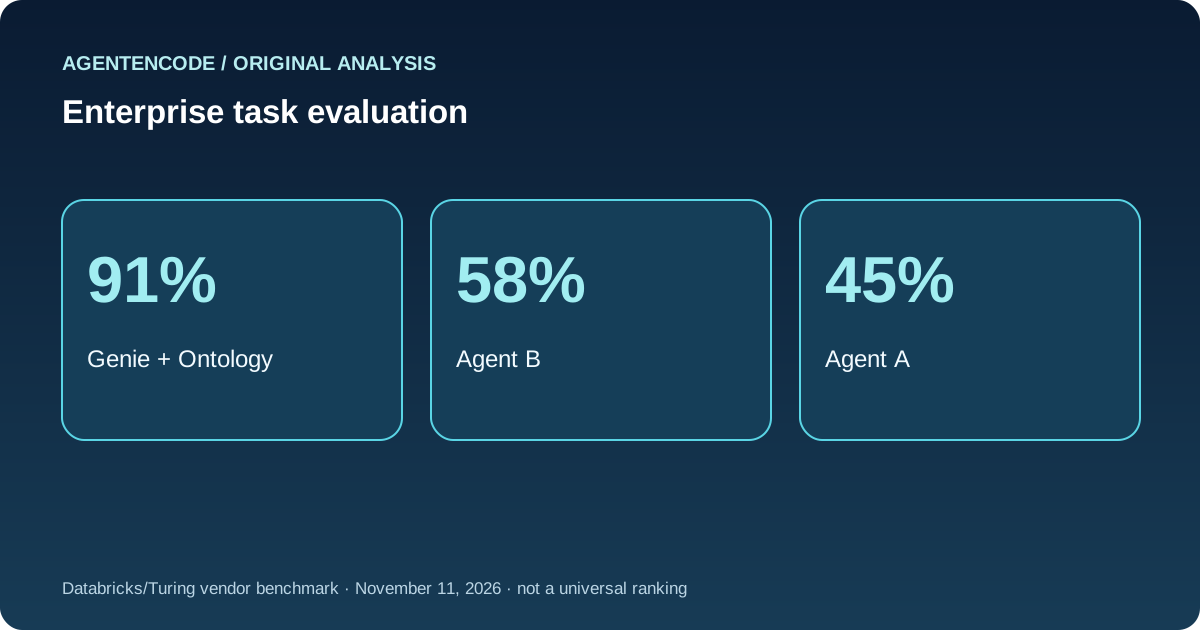
In an enterprise evaluation developed by Databricks in collaboration with Turing, Genie with Ontology reportedly passed 91% of runs, compared with 45% and 58% for two unnamed frontier agents. Average execution time was approximately 100 seconds for Genie, versus 435 and 307 seconds, respectively. The vendor reports about 432,000 average tokens per Genie run, compared with 889,000 and 1.05 million for the other systems.
This benchmark extends beyond trivial table lookups. It uses a fictional UK energy supplier with business rules spread across many artifacts; each task was run five times per agent. These results support the hypothesis that pre-extracted organizational context improves answers. They do not establish a universal agent leaderboard. The competing agents were given a different access pathway and did not receive Genie MCP; the authors also note that the gap can be smaller in new workspaces or simpler table-only tasks. Method and results.
5. Availability: GA is not the same as the new always-on preview
The launch release explicitly states that Genie and Genie Ontology are generally available. It also states that the new always-on Genie, Ontology Manager and certain new experiences will enter preview or beta programs later. Buyers should not mistake an attractive launch demonstration for entitlement to every advertised workflow today.
There is a noteworthy difference between Databricks's own sources for Genie Search: the launch press release groups it with upcoming preview/beta features, while the November product release notes list Genie Search as generally available from November 9. Feature scope, region, rollout and workspace entitlement should therefore be checked directly. A shared product name does not guarantee identical availability across clouds and accounts.
6. AgentenCode control checklist for an always-on pilot
A persistent agent can react to new facts and continue after a person closes the application. That calls for controls beyond normal chat permissions. Before enabling background actions, organizations should decide whose identity the agent uses, how long its authorization lasts, what it may look up and exactly when it has to stop or request consent.
| Area | What to verify | Risk |
|---|---|---|
| Metrics | Agree on definitions and ownership | Correct query, misleading result |
| Data access | Enforce the requester's permissions | Confidential information leaks |
| Actions | Restrict tools; approve sensitive changes | Unreviewed updates |
| Long tasks | Set time limits and a clear stop mechanism | The agent acts on stale context |
| Costs | Set budgets per team and task with alerts | Spending goes unnoticed |
| Results | Test real questions in repeated runs | Good benchmark, little practical value |
The checklist is an editorial decision aid, not an independently verified certification of every Databricks capability.
7. Shared context can also propagate shared mistakes
A central ontology creates consistency: multiple agents can draw on the same governed rules. But centralization also concentrates risk. If a metric is wrong, stale or over-shared, many agents may reproduce the same error. Governance therefore cannot stop at creating a trusted-looking page or assigning an administrator. It must be an ongoing workflow with owners, revision history, challenges to stale definitions and tests against conflicting evidence.
The interesting long-term competition may center on whose business context is best maintained, not whose foundation model generates the most fluent text. The more decisions an agent performs, the more valuable provenance, authority and up-to-date context become.
8. AgentenCode verdict: context infrastructure first, autonomous execution later
Our assessment: The most substantive part of the news is the effort to ground agent actions in a shared, governable model of how the business works. Enterprises already using Databricks may be able to reduce duplicated agent integration and context gathering. The vendor's benchmark is promising but cannot substitute for production testing of autonomous workflows.
A cautious pilot should begin with read-oriented use cases such as monitoring forecast changes and preparing approval packets. Payments, customer changes or production configuration updates require stronger approval and rollback mechanisms. The context layer is the more concrete current capability; the new always-on agent experience still needs careful availability checks and independent operational evidence.
Frequently asked questions
Is next-generation always-on Genie already generally available?
No. Databricks says Genie and Genie Ontology are GA, while the new always-on experience is intended for upcoming preview/beta programs.
Is Genie independently proven 91% accurate?
The 91% figure is from a Databricks/Turing-designed enterprise benchmark. It is not a general, independently replicated production success rate.
Can Genie access any enterprise document?
Databricks says source permissions and Unity Catalog constrain retrieval. Organizations must verify enforcement in their own configuration.
Do companies need Databricks to build governed agents?
No. Shared semantics, permission boundaries and action governance are architectural goals that can be approached in different ways. Databricks integrates them within its platform.
Sources and evidence status
- Databricks: November 11, 2026 launch announcement
- Databricks: The new Genie, November 11, 2026
- Databricks/Turing: Enterprise evaluation and method, November 11, 2026
- Databricks: November 2026 product release notes
- Evidence scope: Vendor launch materials and vendor-conducted benchmark with published methodology; no independent end-to-end replication for this article. Reviewed November 12, 2026. Recommendations are original AgentenCode editorial assessments.
RESEARCH & CONTEXT
Sources for this article
For this article, we consulted the following original publications and technical materials. You can open each source directly.
- Databricks · press release
- Databricks · technical background
- Databricks · technical background
- Databricks · technical documentation
We have not independently reproduced the claims or performance figures from these sources.