
Pope Leo XIV warns against AI rights: who is accountable for autonomous agents?
In an October 30, 2026 address, Pope Leo XIV warned that granting artificial intelligence rights or legal personhood could obscure human responsibility for harm. His demand for meaningful human oversight has immediate significance for AI agents that can already call tools, change records and initiate real-world actions. Who authorizes these systems, and who answers when something goes wrong?
Leo XIV describes machines as tools, not persons, and calls for human oversight where life and liberty are at stake. For autonomous AI agents, the key operational distinction is between the technical ability to act and legitimate authority, traceability and accountability.
Sources and limitations
- Primary sources
Original Vatican address of October 30, 2026. Read address.
- Limits of the claim
Ethical view, not new legislation; no independent runtime, liability or consciousness testing.
What Pope Leo XIV actually said
The official Vatican address of October 30 lays out five principles: AI's future is shaped by human choices; machines are tools rather than people; decisions about life, liberty and force must remain under meaningful human control; technology should serve the common good; and international institutions should enforce standards and offer remedies. The Pontifical Academy for Life documents the conference, co-organized with the Future of Life Institute. Crucially, the remarks constitute an ethical and policy position, not a newly enacted law. The Pope's concern is that harm caused through AI should not leave victims facing an unaccountable digital entity.
Consciousness, legal personhood and liability are distinct
Three different questions are often presented as one. Moral status concerns possible subjective experience or interests. Legal personhood is a status created through law and need not imply consciousness; legal entities can already have legal standing. Responsibility and liability concern the people and organizations that authorize a system and answer for its consequences. Leo objects especially to the idea that a machine's legal status might make human decision makers disappear from view. Even a narrow legal mechanism for highly autonomous systems would not itself decide whether those systems have feelings or who should provide restitution after harm.
Science still debates possible AI welfare
The Pope's philosophical and theological conviction should not be confused with a scientific proof about every possible future AI architecture. The research report Taking AI Welfare Seriously (2024) stresses uncertainty about possible AI welfare and argues for careful assessment, not for a claim that current chatbots are proven conscious. A Google DeepMind discussion of pragmatic AI personhood explores legal ideas rather than a settled law. AgentenCode's distinction is straightforward: the open research question about possible artificial experience does not remove the need to assign real-world responsibility for systems already deployed.
Our original accountability matrix for agents
Tool-using agents can edit data, interact with services and execute multi-step tasks. Capability does not establish legal authority to take every available action. Our four-row matrix separates application, concrete risk and a suitable human control checkpoint. This is an editorial governance aid, not a universally prescribed legal permission table. In practice, an organization should identify the task owner, the agent's permitted tool scope, approval thresholds, operational logs and a mechanism to stop or remedy unexpected outcomes. The stronger an action's potential impact, the more demanding the required controls may be.
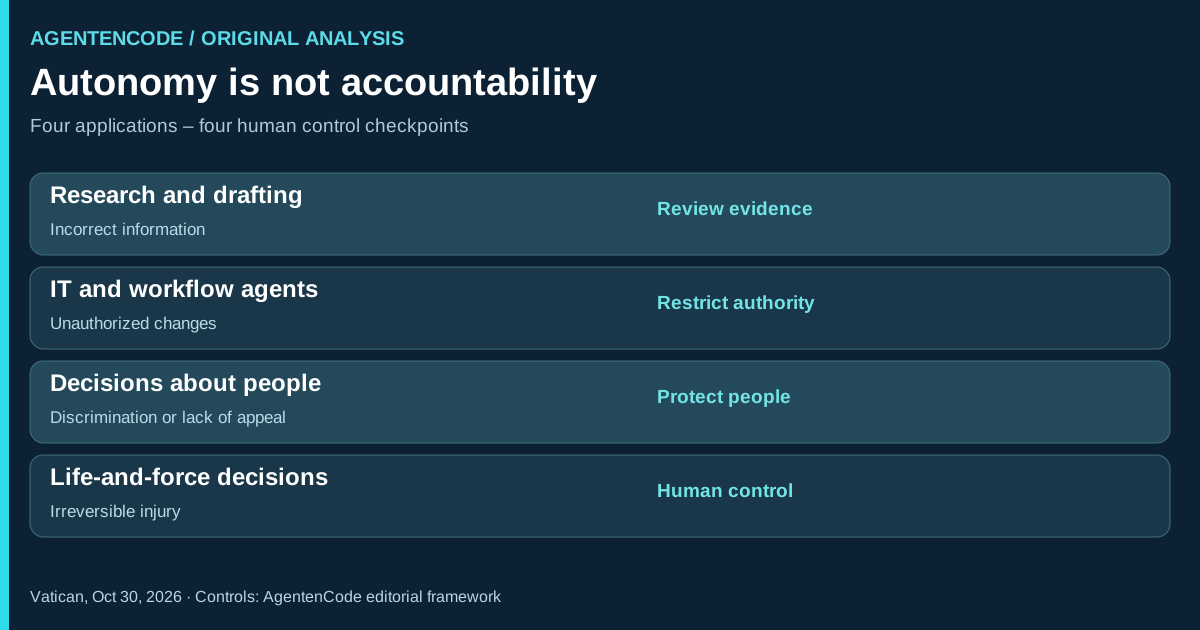
| Application | Risk | Review / control |
|---|---|---|
| Research and drafting | Incorrect information | Source review, editorial approval |
| IT and workflow agents | Unauthorized changes | Scoped permissions, logs, approval gates |
| Decisions about people | Discrimination or lack of appeal | Effective oversight, correction, remedies |
| Life-and-force decisions | Irreversible injury | Human control; papal call to ban lethal autonomous weapons |
Different agents create different risks
A research assistant raises source reliability and publication review questions. An IT or workflow agent can change records and requires scoped permissions and auditable actions. A system affecting individuals can raise fairness, challenge and remedy issues under applicable law. Life-and-force decisions are the clearest boundary in Leo's speech: they require effective human control, and he calls for steps toward a ban on lethal autonomous weapons. None of this implies that all use cases are governed by one uniform law. The relevant control should reflect the actual task, potential injury and legal framework.
What the EU AI Act and UNESCO actually say
Article 14 of the EU AI Act (Regulation EU 2024/1689) sets out human oversight requirements for systems falling within the legal category of high-risk AI; Article 26 addresses relevant deployer obligations. These do not impose universal manual approval for every low-risk agent interaction. Legal classification, exceptions and staggered application dates matter. The UNESCO Recommendation on AI Ethics (2021) provides a distinct international ethical framework rather than directly identical binding EU law. The connecting idea is the importance of accountable operators, meaningful supervision and remedies, not a blanket hostility to useful automation.
Autonomous weapons demand a separate assessment
Leo explicitly mentions targeting lists and border-control databases that may reduce people to data points. He says decisions affecting life, freedom and the use of force must remain subject to informed and effective human oversight. He also urges states meeting in Geneva in November 2026 to take steps toward a ban on lethal autonomous weapons. That is a call for future international action, not evidence that such a universal ban already exists. Readers should likewise avoid interpreting the statement as a categorical rejection of every automated workflow.
Five checks for companies – the AgentenCode conclusion
Before deploying an AI agent, ask five questions. First: who owns the system and its purpose? Second: are data and tool permissions narrowly scoped? Third: which actions can proceed automatically and which require prior human approval? Fourth: can errors be logged, stopped and corrected? Fifth: can an affected person reach a responsible party and seek a remedy? These are practical design questions, not a philosophical judgment about machine consciousness. Conclusion: more autonomous execution cannot be treated as a transfer of human accountability. See our analyses of ServiceNow in ChatGPT and GitHub Copilot Automations for related permission boundaries.
Primary sources and research
Frequently asked questions
Did Pope Leo XIV legally ban AI rights?
No. The October 30 address states an ethical policy position; it does not enact legislation.
Has science proved AI can never be conscious?
No universally accepted method settles the question for every possible artificial system. Research into AI welfare continues.
May AI agents act on their own?
They can technically perform actions through tools. Legal permissibility depends on purpose, authorization, effects and applicable rules.
What does the Pope demand on autonomous weapons?
He urges concrete steps toward banning lethal autonomous weapons and meaningful human oversight, not an assertion that such a treaty already exists.