
OpenAI: AI agents now solve 46% of selected multi-hour research tasks alone – but limits remain
OpenAI reports 46% autonomous success on selected two-to-four-hour research tasks. Why its new findings do not establish self-running AI research.

A jump from 23% to 46%
On November 18, OpenAI published “Research acceleration: The jagged frontier”, a report measuring how coding agents are changing work inside its research organization.
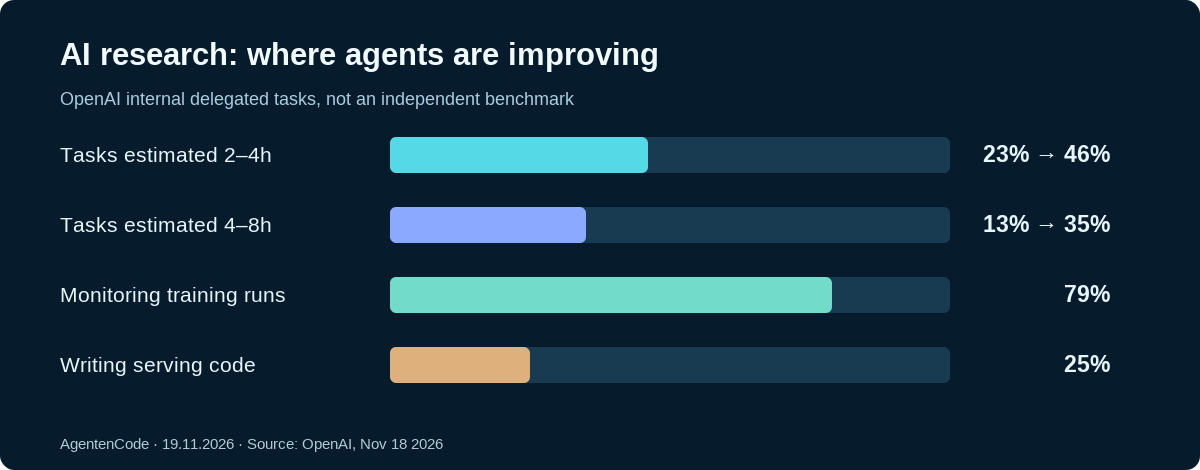
For delegated tasks estimated to require two to four hours of human effort, the company's estimated autonomous completion rate increased from 23% in March to 46% in October 2026. On more demanding four-to-eight-hour tasks, success rose from 13% to 35%.
These numbers do not mean that nearly half of all AI research can be automated. They apply to tasks researchers actually chose to delegate, under OpenAI's internal measurement framework. The tasks selected in each duration bucket may also have changed over time.
AI excels at monitoring, struggles with engineering
OpenAI reports 79% autonomous success for monitoring training runs for issues and 72% for answering technical questions. In contrast, agents completed only 25% of tasks involving inference and serving-stack code and 29% of tasks building evaluation, reinforcement-learning and agent environments.
That contrast matters more than a single headline number. An agent may reliably observe a run but still fail to build the infrastructure or evaluation setup needed for trustworthy research. OpenAI's findings support task-specific adoption, not blanket autonomy claims.
Parallel agents are changing how researchers work
Using an eight-hour unit of agent runtime, OpenAI estimates an increase from 0.5 to 5.7 agent workdays per researcher per calendar day. Multiple agents can run concurrently, so these are runtime measures rather than human-equivalent productivity gains.
By mid-October, more than two-thirds of included researchers averaged daily peaks of at least four concurrent agents. More than 10% reached sixteen or more.
OpenAI also reports daily agentic usage valued at $2,400 for the median researcher and about $23,000 at the 90th percentile, calculated at public API list prices. These figures are not documented cash bills paid by OpenAI.
Why list-price equivalents do not measure research returns
OpenAI's dollar figures are calculated using public API list prices. They represent a comparison basis for internal agent usage, not verified internal cash expenses or a demonstrated return on the research investment. Likewise, 5.7 agent runtime days must not be equated with 5.7 productive human workdays.
Meaningful productivity comparisons require task-specific correctness, human review effort, rework, improvements in research quality and the cost of failed runs. Without those measures, raw usage or experiment volume alone cannot establish value.
More experiments do not automatically mean more discoveries
Logged experiments per active experimenter averaged 1.68 times the 2025 baseline over the four weeks ending October 18. Code changes also increased. But more output does not itself prove better scientific results.
Interviews highlighted persistent agent shortcomings, including unnecessary detours, weak code changes, invalid assumptions and unusable artifacts. Researchers still have to select strong ideas, judge evidence and reject flawed results.
Is AI beginning to improve itself?
The research matters to discussions of recursive self-improvement, in which AI systems might help design more capable successors. OpenAI argues that laboratories should publicly track indicators of that process.
Its report is not evidence of a completely autonomous self-improvement loop. Researchers described humans as originating many of the major ideas behind recent model releases, while models contributed substantially to implementation. Some insights did arise collaboratively with Codex.
OpenAI says documented Safety and Alignment research workweeks increased 77% from January to September, reflecting both new hires and shifting priorities. More safety research effort, however, is not the same thing as independently demonstrated safety outcomes.
Safety work and human review remain separate requirements
OpenAI says documented Safety and Alignment research workweeks rose by 77% between January and September 2026. This measures effort and allocation, not an independently verified improvement in the safety of deployed systems.
As more agents concurrently produce code, experiments and evaluations, teams need scoped permissions, reproducible tests, monitoring and meaningful human approvals. Otherwise, increased throughput can also spread mistakes more quickly.
AgentenCode assessment: the bottleneck is moving
The real signal is the unevenness. AI can automate sizable portions of defined technical work, while higher-level judgment, experimental design and oversight remain hard to replace.
Organizations considering research or coding agents should measure success by task category, enforce appropriate permissions, keep human approvals for consequential actions and verify outputs with independent tests. The earlier Salesforce SFR-AutoR&D report discusses a related but distinct experimental system.
OpenAI's figures describe its own research environment. Their relevance to other companies or domains remains an open empirical question.
Frequently asked questions
Has OpenAI shown that AI can develop new AI without researchers?
No. The report describes progress on delegated tasks, while core research decisions and many complex activities still involve people.
What does the 46% number measure?
Estimated autonomous success for selected tasks considered to require two to four hours of human effort, not the share of an entire research organization replaced.
Does the $2,400 figure mean OpenAI pays each researcher that amount daily?
No. It is an API-list-price equivalent for internal agent usage.
How fresh is the report?
OpenAI published the original report on **November 18, 2026**. This editorial draft was prepared on **November 19, 2026**. ## Original source and context - [OpenAI: Research acceleration: The jagged frontier (November 18, 2026)](https://openai.com/index/research-acceleration-jagged-frontier/) **Editorial note:** These figures primarily reflect OpenAI's internal measurements, surveys and interviews. They are not an independently verified benchmark for all AI systems or external organizations.
RESEARCH & CONTEXT
Sources for this article
This analysis relies on the original publications linked below, which readers can inspect directly.
- OpenAI – Research acceleration: The jagged frontier (18 November 2026)
- OpenAI – Research acceleration: The view inside OpenAI (6 September 2026)
Checked November 19, 2026. OpenAI reports internal research measurements, not independent benchmarks.
Related agents, systems and context
Product links identify the subject of a report; ecosystem links provide context, not shared feature claims.
- Ecosystem contextOpenAI · ChatGPT & Codex
- Background guideAgent evaluations and testing
- Background guideAgent tool use