
Salesforce SFR-AutoR&D: when AI agents improve models through experiments
Salesforce SFR-AutoR&D runs controlled model research. We examine the reported 6.13-point nDCG@10 gain, 36% throughput improvement and 17% lower latency.

1. What Salesforce actually announced
SFR-AutoR&D is an agentic research workflow, rather than a single new general-purpose chatbot. Researchers provide a defined objective, a codebase, data constraints, evaluation criteria and a compute budget. The system is then tasked with proposing improvements, implementing them and testing their performance against a known baseline. Unsuccessful experiments are not meant to become accepted changes merely because an agent generated them.
The application is consequential: Salesforce uses embedding models in retrieval systems that help enterprise AI access information relevant to a user's request. The agents are not simply producing code snippets; they are asked to demonstrate that the code improves a measurable model property. This is the difference between automation that produces artifacts and a controlled process that can supply evidence for an engineering decision. Salesforce announcement, November 11.
2. Why retrieval is a meaningful target for agentic research
A fluent language model cannot answer a question reliably if the search layer supplies an obsolete policy, an irrelevant document or the wrong customer record. Embedding models help map queries and content into representations suitable for semantic retrieval. Improving which relevant items appear near the top can affect the quality of context passed to many downstream assistants.
Salesforce links the research work to the retrieval infrastructure used within Data Cloud and Agentforce. Improving that layer can be valuable even without replacing the language model. AgentenCode assessment: Better retrieval rankings create an opportunity for more grounded answers; they do not by themselves establish fewer hallucinations, policy compliance or improved end-to-end agent task success. Those outcomes need separate measurements.
3. Three figures that must not be combined
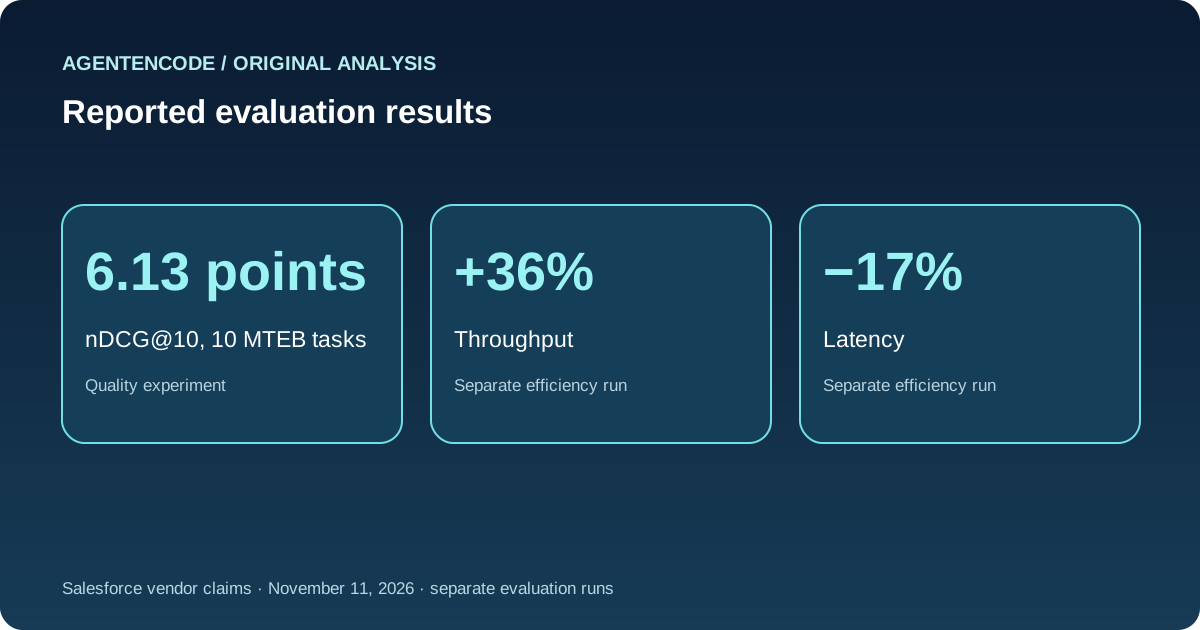
Salesforce says SFR-AutoR&D completed a research-and-training cycle in approximately 80 hours. Across ten public MTEB retrieval tasks, the reported nDCG@10 gain was 6.13 points. This ranking metric rewards placing relevant results higher among the first ten hits. The result must not be rewritten as “6.13% more accurate answers” or as a universal enterprise accuracy increase.
The company describes a different, roughly nine-hour optimization session targeting execution efficiency. It reports 36% greater throughput and 17% lower latency, while keeping retrieval quality almost unchanged. Those improvements are measured within the vendor's setup and are not interchangeable with the quality result. Readers need equivalent hardware, load patterns, baseline definitions and total cost to know whether a similar trade-off applies to their own workloads.
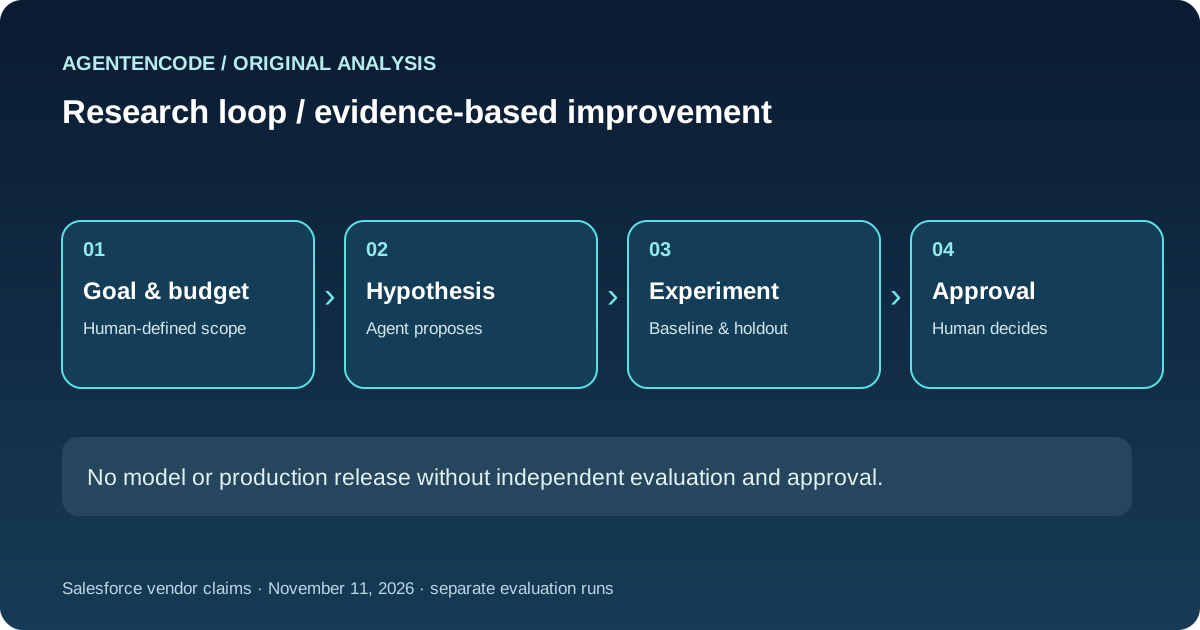
4. The controlled research loop
The structure matters more than the number of agents. A hypothesis is expressed in a form that can be implemented and measured; training code and configuration are changed; a controlled experiment is run against a baseline; held-out evaluation determines whether the candidate is retained. Repeating this process can accelerate the search across many design alternatives.
However, the loop can optimize only the objectives and measurements it is given. An improvement on public retrieval tasks could come with regressions for minority languages, niche legal terminology, rapidly changing documents or customer-specific data. Strong research governance therefore requires genuinely held-out tests, subgroup analysis, prevention of benchmark leakage, reproducible experiment artifacts and an independent decision before production promotion.
5. Where autonomous research stops
Salesforce describes agents that independently develop hypotheses and conduct controlled experiments. This supports a claim of substantial workflow automation within a defined scientific problem. It does not mean the system independently decided which problems society should study, approved the legal use of training data or deployed every successful candidate to customers.
Researchers still specify constraints, budget, evaluation and data eligibility. Salesforce says the approach has been applied to its existing embedding work and to a model derived from EmbeddingGemma 2. Availability of the resulting model variants and production clearance should not be inferred from the demonstration alone: the announcement explicitly treats product approval as a separate stage.
6. AgentenCode pilot decision framework
A responsible pilot should start with one bounded, measurable task, not with a mandate for agents to rewrite a whole model platform. Freeze the baseline and a holdout dataset before the first experiment. Set read/write scopes, compute limits and rules for human sign-off. Evaluate repeated runs and failed attempts, not just the single strongest outcome.
| Check | What to verify | Warning sign |
|---|---|---|
| Quality | Use frozen test data, nDCG@10 and real-world tasks | Development scores only |
| Speed | Compare latency and throughput under matching conditions | Different hardware or workload |
| Security | Check data sources, review code and prepare rollback | Unapproved changes |
| Cost | Count compute, failed trials and human effort | Only best-case speed reported |
| Repeatability | Repeat runs and record versions and settings | No artifacts or single best run |
This is an AgentenCode editorial framework, not a certification standard endorsed by Salesforce.
7. The unresolved economics and reliability questions
There are several missing pieces between an encouraging paper-style result and a procurement decision. How many discarded hypotheses were tried? Which libraries, infrastructure and evaluations were preconfigured? What was the compute consumption during the 80-hour cycle? How well do changes generalize to new languages and document domains? And what happens when the evaluation itself becomes the target of an overly clever optimization loop?
Agentic training systems also need strict operational boundaries. A benchmark result must never automatically grant permission to change a production model, bypass ethical dataset reviews or access new customer data. Model promotion should retain independent security testing and clear rollback procedures.
8. AgentenCode verdict: evidence-based autonomy, not one-click science
Our assessment: The promising part of SFR-AutoR&D is its insistence that autonomous proposals face measurable tests. The durable asset may not be a single agent architecture but a high-quality collection of evaluations, experiment histories and reproducible promotion decisions. That is where a genuine long-term advantage in agentic research could develop.
Teams operating mature ML retrieval infrastructure may find a restricted trial worthwhile. Organizations without stable baselines, clean data rights and evaluation staff should first establish those foundations. Improving an embedding model is not proof that an AI system can conduct arbitrary scientific research autonomously.
Frequently asked questions
Has Salesforce released a fully autonomous scientist?
No. The reported system automates elements of a predefined research loop with human-set objectives and restrictions.
Does 6.13 nDCG@10 points equal 6.13% better answer accuracy?
No. nDCG@10 measures retrieval ranking quality, not end-to-end answer accuracy.
Are 36% throughput and 17% latency gains guaranteed?
No. They are vendor-reported results from a separate optimization experiment under particular conditions.
Can enterprises immediately use all reported model improvements?
Not necessarily. Production clearance and model availability must be verified separately.
Sources and evidence status
- Salesforce AI Research: “Salesforce Releases R&D Agents That Improve Its AI Models”, November 11, 2026
- Evidence scope: Vendor research announcement with specific measured claims; no independent reproduction performed for this article. Source review: November 12, 2026. Original decision frameworks are expressly editorial analysis.
RESEARCH & CONTEXT
Sources for this article
For this article, we consulted the following original publications and technical materials. You can open each source directly.
We have not independently reproduced the claims or performance figures from these sources.