
Tool use lets an AI agent do more than generate text: it can search, run code, access data or change external systems. That capability is powerful because it creates a real action surface.
AGENTENCODE · ORIGINAL DATA / EDITORIAL ANALYSIS
What AgentenCode's own data adds
An expert reading of our source-linked registry — not an invented lab benchmark.
Our catalog currently contains 130 individual agent and platform profiles (registry snapshot: 2026-10-08). Those entries are documented products and frameworks, not independently scored performance tests.
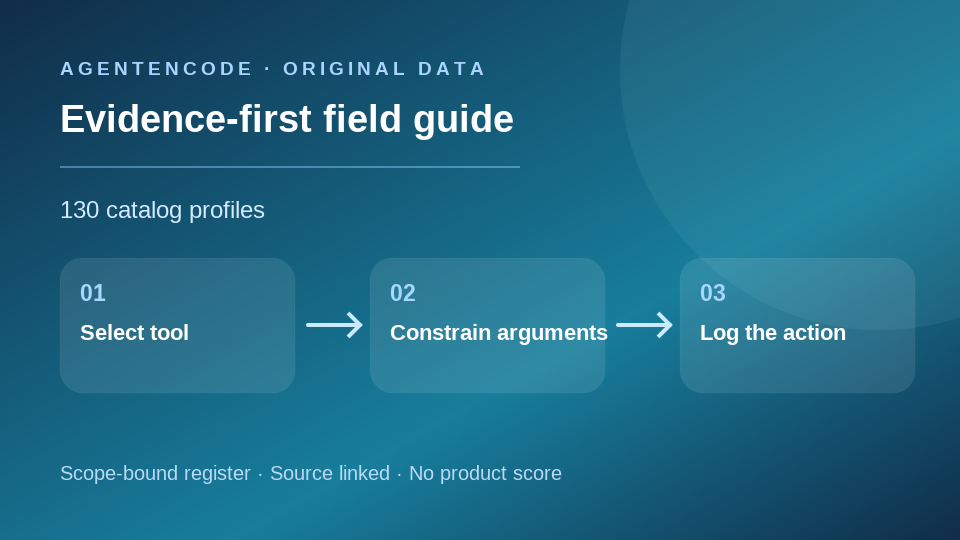
Three documented agent examples
These deliberately different profiles illustrate how application scope changes what the concept means:
Cline Cline
AgentenCode records Cline (Cline) in the Coding segment. Use the individual profile to check the exact product, plan and deployment limits rather than projecting another agent's abilities onto it.
n8n Agents n8n
AgentenCode records n8n Agents (n8n) in the Automation segment. Use the individual profile to check the exact product, plan and deployment limits rather than projecting another agent's abilities onto it.
Google Agent Development Kit Google
AgentenCode records Google Agent Development Kit (Google) in the Automation segment. Use the individual profile to check the exact product, plan and deployment limits rather than projecting another agent's abilities onto it.
Method: the named profiles come from the AgentenCode catalog (snapshot 2026-10-08). Protocol relations, where shown, come from the explicit AgentenGraph relation set (snapshot 2026-10-05). This is editorial interpretation of primary-source-backed records, not independent hands-on testing, formal certification, proof of production deployment or an exhaustive market census. Unknown does not mean false. Read methodology →.
Tool calling
The model receives structured descriptions of available tools and can request one with specific arguments. The application then decides whether the call is valid, authorized and safe to execute.
The model should not be trusted as the only validator. Schemas, allowlists and permission checks belong in the tool layer.
Tool results
After execution, the result returns to the agent as new context. The agent may use it to finish the task or choose another action.
Tool output can be wrong, incomplete or maliciously influenced. External results should therefore be treated as data rather than automatically trusted instructions.
Permissions
A read-only calendar tool and a tool that can delete cloud resources have very different risk. Permissions should match the use case and be narrow enough to limit the blast radius of an error.
Human approval can add another control around high-impact calls, but it does not replace least privilege.
MCP and APIs
Tools can be implemented through ordinary APIs, local functions, MCP servers or other integration mechanisms. The interface changes, but the governance questions remain the same.
MCP can standardize discovery and invocation, while classic APIs can be simpler for narrow deterministic integrations.
How to evaluate tool use
Look for documentation of tool scope, credentials, approval, logging, retry behavior and error handling. A long tool list is not automatically an advantage if the agent receives more authority than the task requires.
AgentenCode separates tool capability from governance controls so users can see both what an agent can do and what evidence exists about how those actions are constrained.
Frequently asked questions
Does tool use make a system an agent?
Tool use is a common agent capability, but agency also involves goal-driven multi-step control and state.
Can tools expose sensitive data?
Yes. Tool permissions and credentials determine which data and actions become available to the agent.
Is MCP required for tool use?
No. Agents can use ordinary APIs or framework-specific tool interfaces as well.