
DeepMind AI agents verify quantum algorithms with Lean – what 290× really means
DeepMind's Gemini 4 agents find quantum programs with up to 290× lower modeled costs. The Lean proofs, five results and real-world limits explained.
Key takeaway
Google DeepMind and Google Quantum AI report that collaborating teams of Gemini 4 Carbon agents found new quantum programs and provided formal proofs of correctness and resource requirements in Lean 4. The largest reported improvement, 290×, concerns a particular fixed-point arcsine arithmetic routine. Three scientific simulation applications achieved approximately 11.8×, 8× and 2.5× lower modeled resource costs.
The consequential advance is not a model making confident claims about quantum computing. Agents had to submit mathematically checkable programs and proofs against fixed problem descriptions, and a separate verifier guarded against modifying those descriptions to make a submission easier.
This is not evidence that current physical quantum computers execute these workloads 290 times faster. Nor is it a demonstrated fusion-energy, chemistry or drug-development breakthrough on laboratory equipment.
Primary source: Google DeepMind – Finding faster quantum algorithms with agents and formal verification (23 Nov 2026)
The problem: quantum programs are difficult to test
A normal coding assistant can improve software and run a test suite. Large quantum algorithms are a different engineering problem. Classical simulation becomes impractical at the relevant size, while present-day quantum devices cannot execute many of the fault-tolerant programs researchers hope to use in the future.
The team therefore built a formal environment in which a proposed circuit can be assessed against an explicit mathematical specification. The original research is available as Discovering formally verified quantum programs with AI, arXiv:2611.09822v3; DeepMind summarized the results on November 23.
The new workflow combines algorithm discovery with proof checking at a scale where exhaustive empirical tests are not an option.
How the multi-agent research process works
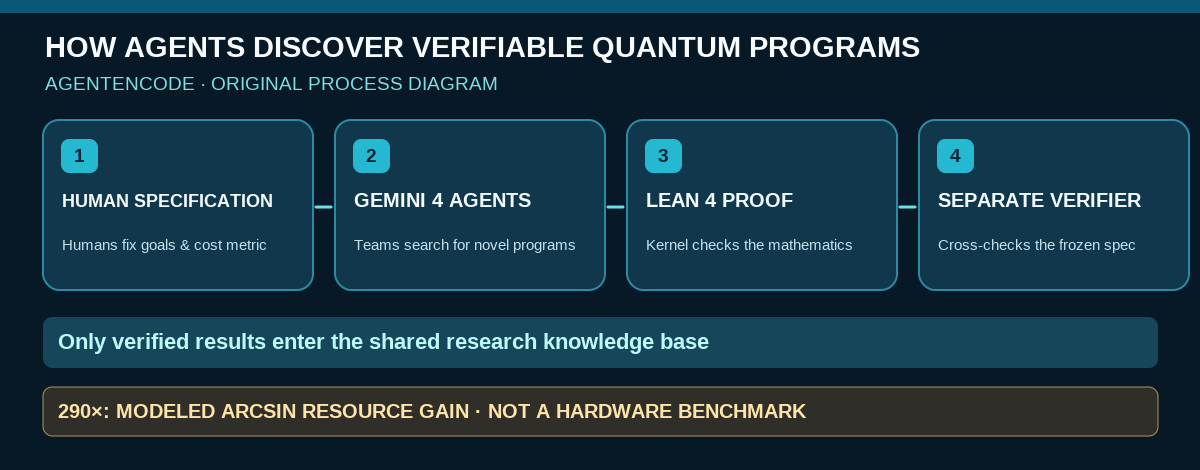
Researchers specify the objective. Human experts decide what the quantum program must accomplish, which error limits matter and how resources will be counted. The requirements are expressed in a Lean library grounded in quantum Hoare logic.
Agents search independently. Multiple teams explore alternative constructions. The large autonomous discovery runs described in the paper used Gemini 4 Carbon, but different researchers could configure their teams differently.
Proofs face two checks. Agents must submit the candidate program, proofs of its behavior and a resource bound. Lean validates the logical derivation. Separately, a verifier checks submitted work against the original frozen specification, rejecting unauthorized alterations to definitions, theorems or axioms. This matters because a capable coding agent could otherwise weaken the statement it is supposed to prove.
Shared work accumulates carefully. Teams maintain a wiki of validated solutions, reusable lemmas and reviewed failed approaches. Agents also hold cross-team discussions approximately every four hours. Unverified ideas can be discussed, but they are not counted as established discoveries without passing the formal gate.
AgentenCode assessment: The innovation is a credible division of responsibility. Agent systems are free to generate ideas; the acceptance criteria remain outside their control. That principle is likely more transferable to other agentic research settings than any single quantum speedup figure.
Background reading: AI knowledge
Five reported improvements and their proper scope
| Quantum program | Reported improvement | Interpretation |
|---|---|---|
| Fixed-point arcsine arithmetic | 290× resource-cost reduction | One specialized building block under a defined approximation and baseline, not a whole-machine speedup |
| Fusion alpha-particle stopping-power simulation | 11.8× lower modeled cost | DeepMind also reports logical qubits falling from 5,650 to 4,338 |
| Photochemical molecular dynamics | 8× lower modeled cost | A specific modeled light-sensitive molecule and Hamiltonian |
| Cytochrome P450 enzyme simulation | 2.5× lower modeled cost | Logical qubit requirement reportedly falls from 481 to 333 |
| Parallel Grover search | up to 2.57× fewer rounds | A particular multi-target, parallel-oracle search setting |
These numbers cannot be aggregated into one general-purpose efficiency gain. For several fault-tolerant applications, researchers score circuits by logical qubits multiplied by costly T-gate operations, a logical spacetime resource metric. Actual hardware expenditures depend on physical architecture, error correction, control overhead and other implementation choices. The paper's abstract rounds the fusion result to about 12×; the DeepMind blog specifies 11.8× for the highlighted case.
What Lean verifies, and the boundary of the proof
Lean is a formal proof assistant rather than another model grading output quality by intuition. Its small kernel verifies whether a proposed mathematical derivation follows from accepted rules. The newly released library formalizes quantum programs, classical control, measurements and resource counting, including quantum Hoare-logic statements about permitted state transitions.
An independent comparator within the research workflow additionally rejects modifications to the frozen task definition. This creates a stronger defense against reward hacking than merely asking another AI agent whether a solution looks correct.
But formal correctness is conditional. A valid proof establishes the specified mathematical property within the chosen model and assumptions. It does not guarantee that a specification covers every relevant physical effect, that the algorithm can be implemented at the projected cost, or that it will deliver an economically useful result on a real quantum processor.
The public Lean 4 repository includes a core library and specifications, and points to a separate discoveries branch. Public artifacts improve auditability; this editorial analysis has not independently built or rerun the proofs.
Why agent builders should pay attention
One compelling pattern is the distinction between generated ideas and accepted evidence. Teams can explore novel optimizations, share intermediate reasoning and learn from dead ends without allowing an unverified suggestion to become the authoritative answer.
There is also a persistent-memory lesson. A shared wiki can preserve both validated results and specific reasons proposals failed. Fresh agent teams then begin with the best checked candidate instead of repeating the same unsuccessful search. The difference between a formally proved lemma and a promising note is explicit.
Applying this approach to software safety, formalized operational policies or constrained optimization is a plausible direction, not an outcome demonstrated by the quantum paper itself.
What the headline does not establish
The work does not show a physical quantum computer operating 290 times faster, a practical fusion reactor being built, or drug candidates being validated experimentally. It also does not make the agent teams independent of human expertise: researchers chose tasks, wrote and vetted formal goals, and interpreted the results.
A mathematical specification may omit an important real-world condition. An implementation can deviate from what was modeled. Even a favorable logical gate-count estimate may change after physical error-correction and control costs are included.
Finally, an internally separate verification process is not the same thing as independent third-party replication. The reported results are a research team's paper and released code, not a new externally reproduced hardware benchmark.
AgentenCode verdict
This is a substantial, unusually inspectable research result rather than evidence of immediately usable commercial quantum advantage. The agent architecture is arguably the bigger story: high-volume creative search combined with immutable specifications, a trusted proof checker and reusable, source-traceable shared knowledge.
Its immediate commercial payoff is uncertain. Its relevance to building trustworthy autonomous research agents is high because it demonstrates a concrete operating model in which agents contribute new solutions without being allowed to define success after the fact.
Frequently asked questions
Did agents discover the algorithms without humans?
Agents conducted significant searches and generated candidate programs. Humans still framed problems, selected models and tools, supplied specifications and oversaw interpretation.
Does 290× mean quantum hardware is 290 times faster?
No. The headline improvement concerns a fixed-point arithmetic subroutine under specific mathematical resource accounting.
What makes the results formally verified?
Lean checks explicit proofs of behavior and modeled cost. A separate comparator checks that agent submissions did not alter the underlying problem definitions.
Have the results run on today's quantum hardware?
The study relies on formal proofs and modeled resource estimates for workloads too large for current full-scale execution.
Can others inspect the proof framework?
Yes, Google DeepMind has released a Lean library, specifications and associated discovery artifacts. We have not independently reproduced the build.
RESEARCH & CONTEXT
Sources for this article
This analysis relies on the original publications linked below, which readers can inspect directly.
- Google DeepMind – Finding faster quantum algorithms with agents and formal verification (23 Nov 2026)
- Shirobokov et al. – Discovering formally verified quantum programs with AI (arXiv:2611.09822v3, 16 Nov 2026)
- Google DeepMind – Open-source Lean 4 quantum computation library
Reviewed November 23, 2026. Vendor claims and research results are attributed; future real-world performance is not assumed.
Related agents, systems and context
Product links identify the subject of a report; ecosystem links provide context, not shared feature claims.
- Background guideCosts and ROI