
Meta Muse Spaces: Personal agent-built mini-apps that stay current
Meta is adding Spaces to its Muse personal agent app. Describe a tracker, planner or project view and Muse generates an interactive experience that can be edited and pinned within the app. Connected services can refresh information in the background. The shift is from one-off chat replies to persistent agent-built interfaces with connected data. That creates a new need for data provenance, permission controls and error visibility—not just attractive UI generation.
The actual announcement: an app-like surface, not another answer
Meta's November 6 announcement, “Design the Muse App, Just for You,” describes Spaces as customizable experiences embedded inside Muse. Meta's examples include holiday gift trackers, travel planning, trivia games, an order dashboard for a small business and a freelance client hub. A Space is not just a screenshot: users can check items off, edit notes, ask Muse to alter the design and return to it later.
Users can pin Spaces in the sidebar or main tabs, hide them or rearrange them. According to Meta, Spaces launch wherever Muse itself is available. Meta describes sharing Spaces with other users as something it is exploring; this is not an announced generally available shared-workspace feature.
Why the change matters for agents
A conventional chatbot returns a response. A Space creates a durable interface attached to an ongoing job. Success therefore moves beyond answer quality: does the interface display the right state, has it refreshed correctly, and was the agent authorized to use each underlying data source?
A travel planner might aggregate flights and reservations over several days. If one of those records changes inside a connected app, the Space is designed to update. That is promising. However, the announcement provides no measured reliability percentage for background updates and no exhaustive compatibility matrix for every service, country and workflow. A marketing demonstration is not evidence of reliable synchronization in every real scenario.
The hard part: from account permissions to user-visible state
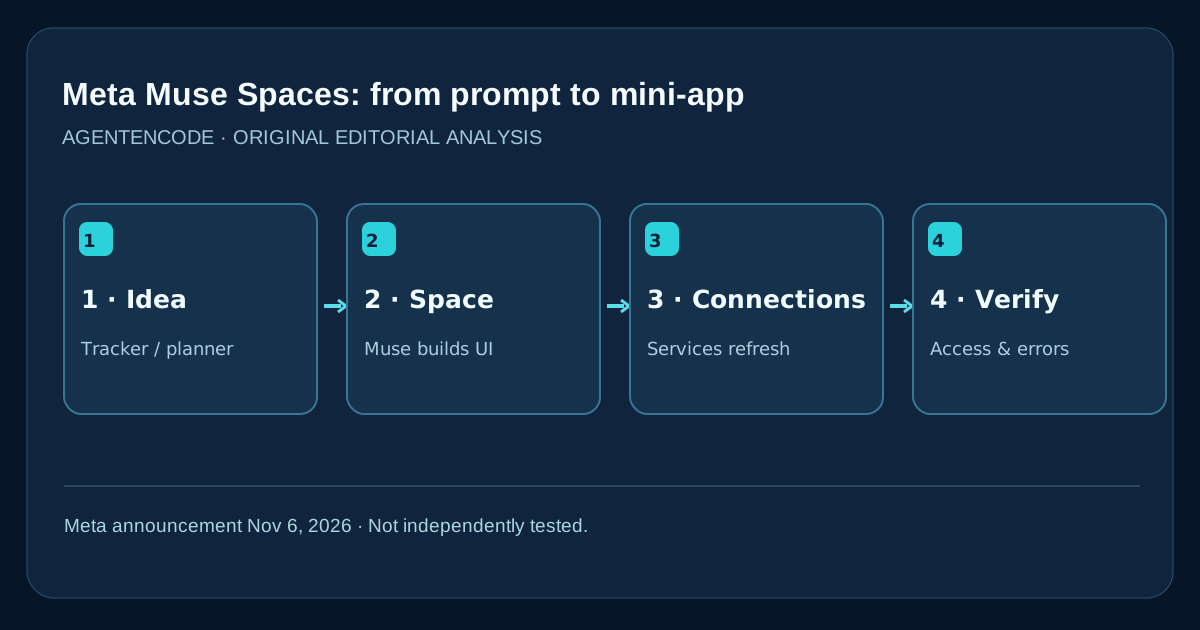
A connected Space depends on several independent operations: a service produces records, the connector is authorized to read them, Muse interprets the result, and the generated view renders it. Errors can occur at each stage: missing permissions, stale records, duplicates, incorrect prioritization or omitted changes.
AgentenCode analysis: The most useful extra metadata is often mundane: which source supplied a value, when it was last refreshed and whether the last sync failed. An always-looking-current dashboard can be misleading if its content is actually stale. Meta's initial announcement does not establish that every Space currently exposes this entire audit trail.
Original AgentenCode decision matrix
| Use case | Potential benefit | Necessary check | Editorial verdict |
|---|---|---|---|
| Personal gift or task tracker | Persistent list without repeated prompting | Save/edit/recovery behavior | Suitable pilot |
| Travel planner using calendar | Unify scheduling information | Source and last-refresh visibility | Pilot with cross-check |
| Small-business order hub | Consolidate connected services | Access scope, duplicates and privacy | Controlled pilot only |
| Customer and invoice dashboard | Track work in one view | Permission review and traceability | No unchecked automation |
| Autonomous payment or legal approval | Not demonstrated here | Separate authorization and controls | No-go based on this announcement |
This is an original editorial framework, not a Meta warranty or third-party technical test. It translates the concept into testable operating conditions.
Muse Spaces versus Cursor Live Apps and scheduled automation
Cursor Live Apps, covered separately by AgentenCode, focuses on building and publishing deployable web apps, with hosting, optional databases and an explicit publish step. Muse Spaces are embedded, personal surfaces inside an existing agent app. This may reduce setup friction, but also ties the experience to the Muse environment. Traditional automation, meanwhile, can execute time-based workflows with no generated UI at all.
The selection should follow the workflow. A personal checklist favors fast setup and persistence. A regulated team process needs export, rights enforcement, recovery and accountable deployment. The first Muse Spaces announcement does not provide complete evidence for enterprise auditability, migration or fine-grained administration.
A real pilot beats a beautiful demo
Build one deliberately simple Space: a ten-task project tracker and two calendar entries. Connect a supported calendar, edit a date in the original service and measure when it appears inside Muse. Revoke the connector and look for a clear failure indication. Then redesign the layout twice and confirm that existing records persist.
Also ask: Which apps are actually supported in my region? Can every connection be revoked? Is there a clear edit history? What happens during a sync failure? Can I export my data? These answers require hands-on product verification and current documentation, not extrapolation from the launch post.
The larger shift: agents as persistent software experiences
The enduring trend is conversation turning into stateful software. Consumer agents increasingly compete with spreadsheets, dashboards and small SaaS tools, not just search engines. Building a surface is becoming easier; trustworthy data handling, permissions, reliability and lifecycle governance remain the harder parts.
AgentenCode verdict: Muse Spaces offers a compelling product direction for personal agents. Its long-term value will depend on whether a created Space remains correct and useful days later—not just whether the first generation looks impressive.
FAQ
What is a Muse Space? An interactive, editable experience generated inside the Muse app from a user's description, such as a tracker or planner.
Can connected services keep it updated? Meta says connected apps can refresh Spaces in the background. Reliability and latency are not independently established by that claim.
Can Spaces be collaboratively edited? Meta says it is exploring sharing; the first announcement does not claim generally available collaboration.
Is Spaces available worldwide? Meta says it is available wherever Muse is available, which is not a guarantee for every region or device.
Does this replace enterprise software? The announcement does not prove the required governance, migration and audit capabilities for sensitive processes.
Sources and editorial method
- Primary source: Meta Newsroom, “Design the Muse App, Just for You,” November 6, 2026.
- Background: Meta, “Introducing Muse: The World’s First Personal AI Agent Built for Everyone,” September 8, 2026.
- Product details are Meta's claims; risk matrix and operating recommendations are AgentenCode's analysis. No independent feature benchmark, privacy audit or global-availability verification.
Sources and limitations
Vendor claims and original editorial conclusions are distinct. No independent product test or security certification.