
EU AI summit in Dublin: sovereignty, investment and safety on the agenda
EU leaders meet in Dublin to discuss AI sovereignty, compute capacity, investment and safety. We distinguish the official agenda from confirmed decisions.
Why EU leaders are meeting about AI
On November 13, 2026, European Union leaders gather in Dublin for an informal meeting with artificial intelligence as its first dedicated strategic focus at leaders' level. The official meeting page frames the discussion around competitiveness, technological dependence, safety and trust.
This is not a product launch or a legislative vote. The published documents establish what leaders intend to debate, not a new AI law, a completed funding deal or a measurable increase in European computing capacity.
Sovereignty involves more than training a homegrown model
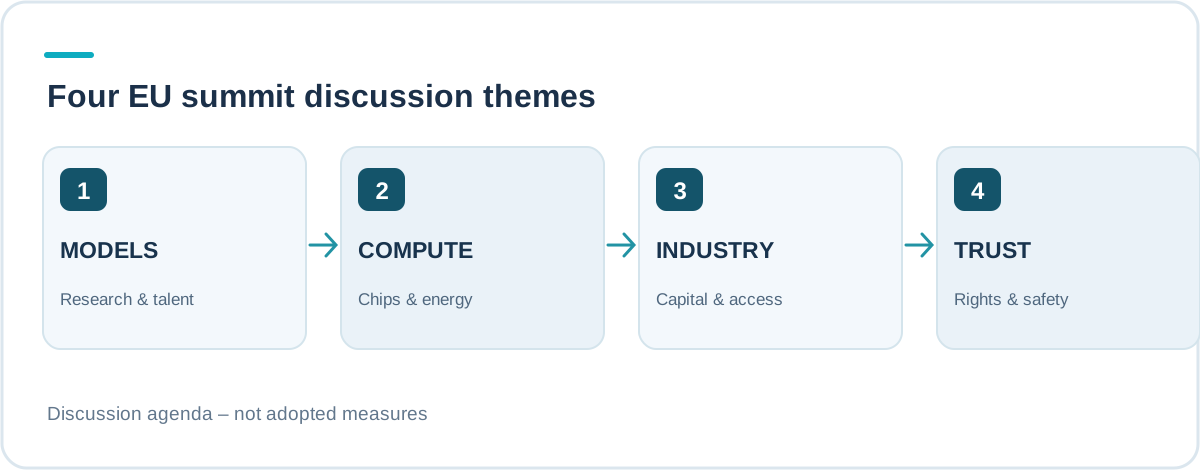
Europe has strong research institutions and AI businesses, but the European Council's steering note describes dependence on providers outside the bloc for semiconductors, cloud infrastructure, computing and foundation models. That is a structural challenge for businesses that want to control where data runs and how applications can be moved.
Strategic autonomy does not necessarily require every component to be manufactured in Europe. Interoperable infrastructure, standards, access to competitive compute and genuine switching options can make a practical difference. The balance between public investment and private partnership is a policy choice still being debated.
Compute, power and capital are linked
Modern AI consumes advanced chips, networking, energy and skilled operation. In his invitation to EU leaders, European Council President António Costa emphasizes affordable clean energy and investment at scale as ingredients for competitiveness.
A planned facility is not the same as low-cost accessible computing. Users will care about real availability, per-request cost, data residency and whether smaller firms can obtain capacity. The Dublin discussion is an opportunity to set priorities rather than proof that these problems are resolved.
Innovation and societal risks in one conversation
The European Council says it invited Mistral AI CEO Arthur Mensch and AI researcher Geoffrey Hinton. Mensch is scheduled to address competition and Europe's AI position; Hinton is to discuss safety, rights, children, democratic processes, work and cybersecurity.
Both perspectives matter. Adoption may improve productivity and European industrial capacity, but increasingly capable systems raise questions about concentration, error, accountability and misuse. A useful policy outcome would show how innovation and safeguards can reinforce rather than automatically cancel one another.
What European organizations should monitor
Companies should ask where their data is processed, how hard it would be to move between AI providers, which actions require human approval and what happens when capacity becomes scarce. These questions extend from routine AI classification to autonomous AI agents.
Teams need not wait for a summit communiqué to document vendors, permissions, incident procedures and evaluation results. Existing legal obligations continue to apply; the AgentenCode EU evidence layer helps distinguish specific documented practices from generic compliance promises.
AgentenCode assessment: distinguish debate from deliverables
Our assessment is that this gathering shows AI has become a cross-cutting European competitiveness and security issue. A summit by itself, however, does not create new compute or prove the success of a policy. Progress would be measured through funding, capacity, access terms, implementation timetables and independent audits.
At this editorial cutoff, the official sources linked below establish the agenda and steering questions, not a verified final package of new AI decisions. We do not present proposals as adopted measures. Related background is available in our news analyses and security guide.
Frequently asked questions
Did the EU pass a new AI law at the Dublin meeting?
The official materials cited here document an informal strategic discussion, not adoption of a new AI regulation.
Is the agenda only about chatbots?
No. It includes chips, compute, energy, industrial adoption, jobs, safety, fundamental rights and cybersecurity.
What can companies do today?
Map AI dependencies, controls and evidence, while monitoring future official measures. A meeting agenda creates no new legal duty on its own.
RESEARCH & CONTEXT
Sources for this article
This analysis relies on the original publications linked below, which readers can inspect directly.
- European Council – Informal meeting of leaders, Dublin, 13 November 2026
- European Council – Steering Note on Artificial Intelligence (3 November 2026)
- European Council – Invitation by President António Costa (3 November 2026)
Checked November 13, 2026. Vendor claims are identified and political discussion topics are not treated as adopted measures.