
Cognition and McKinsey team up to put Devin's coding-agent ROI to the test
Cognition and McKinsey announce a Devin alliance as survey results show mixed AI productivity gains. Why verified outcomes, costs and workflow changes matter.

An alliance focused on business value, not agent activity
On November 16, 2026, Cognition, the company behind the autonomous coding agent Devin, announced an alliance with McKinsey & Company. The two organizations intend to help enterprise clients select valuable engineering projects, measure baseline costs and delivery quality, and redesign workflows so completed agent work can be tied to measurable business results.
This is not the launch of a new universal Devin model or a guarantee that adopting an agent will improve every developer team. Cognition provides the engineering agent platform, while McKinsey supports project choice, operating-model changes and outcome measurement. Results still depend on implementation and the specific business work assigned.
A survey of 334 leaders shows uneven productivity gains
The companies cite a Q2 2026 McKinsey survey of 334 product and engineering leaders. Respondents in the top-performing quarter reported more than double productivity, while about 30% of the surveyed organizations reported declining productivity. Those differences are an important reminder that adding AI to a team can coincide with very different results.
These are reported survey outcomes, not a randomized proof of the causal impact of Devin or any particular assistant. Work mixes, baseline measures and organizational changes vary. The sensible conclusion is that meaningful comparisons must evaluate deliverables and their quality, not simply confirm that coding-agent seats were purchased.
Devin executes engineering work, while people own the result
Devin is designed to investigate repositories, plan code changes, modify files, run tests and return reviewable work within an authorized environment. The McKinsey alliance aims to integrate that execution into existing engineering workflows, project management and software-delivery standards.
A pull request is not a finished business result. Teams still need accurate specifications, reproducible tests, security reviews and ownership of the resulting change. Repository, ticketing and CI permissions should be scoped to each use case rather than granting agents unrestricted access in the name of autonomy.
Comarch offers a concrete—but unfinished—modernization example
Cognition points to European software company Comarch, where Devin is helping with the modernization of the approximately 20-year-old ERP XL product. The company has described an ambitious 18-month target for the project. McKinsey is working with the organization to redesign engineering practices and extend adoption.
An 18-month target should not be presented as a project already completed within that period. Updating complex ERP software demands separate validation of data migration, existing integrations, application behavior and security. The example illustrates a proposed deployment strategy rather than independently established success across all enterprise legacy applications.
How to measure return on coding-agent spending
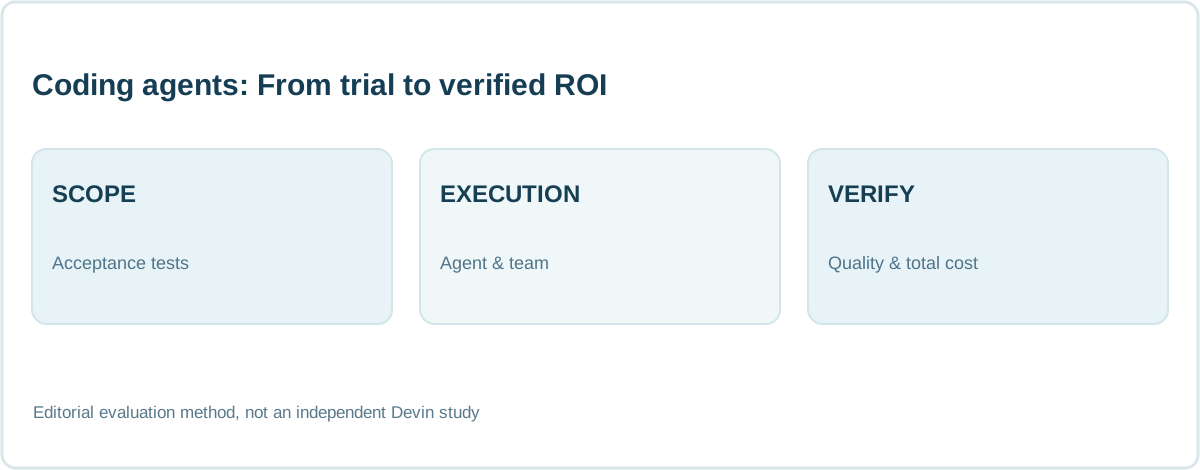
A useful assessment records how much the same project would have cost without the agent and what counts as acceptable delivery. It then compares total completion time, human requirements work, reviews, corrections, tests, runtime fees and unexpected incidents. The numerator is genuine delivered value, not tokens or automatically generated lines of code.
An agent that writes thousands of lines may have little impact on a blocked product launch, whereas resolving a small high-priority production bug can have substantial value. For credible ROI, compare fully accepted engineering outcomes per unit of total cost, including failures and retries rather than discarding them from the result.
What an enterprise pilot should test in its first months
Select a bounded set of valuable tasks with established acceptance criteria. Record baseline performance before the agent is introduced, then test comparable bug fixes, migration tasks and maintenance work with the same quality expectations. Count review time, rework and incomplete runs instead of reporting only successful demonstrations.
The team should retain control of source-code access, secrets, deployment approvals and compliance processes. Strong evaluation includes difficult and negative examples as well as ordinary tasks. Scale to more engineering groups only after benefits and failure handling have been demonstrated on the actual work.
Regulated and European enterprises have additional constraints
The companies explicitly target enterprise customers across the United States and Europe, where large organizations often operate decades-old codebases across multiple providers and teams. Agent deployment must fit existing identity systems, change-control procedures, vendor contracts and local data-protection expectations.
An alliance between a software vendor and consulting company is not a compliance certification. Organizations still need evidence of appropriate data flows, logging, security controls and a workable escalation path for ambiguous or consequential changes.
AgentenCode assessment: The result is the unit of value
The strategic significance of this agreement is that the market is being asked to move beyond high-volume AI coding demos. If coding agents are to become a real engineering workforce, their value must be measured by correct, maintainable changes that passed human and automated review, not simply by how much code was produced.
Our agent cost and ROI reference and agent evaluations guide explain how to make such comparisons. Cognition and McKinsey offer one approach to measuring the economics of autonomous engineering. The outcome must still be established independently in every enterprise deployment.
Frequently asked questions
What did Cognition and McKinsey announce?
An enterprise alliance to connect Devin coding-agent work with project prioritization, workflow redesign and measurable engineering outcomes.
Do coding agents automatically double productivity?
No. The cited survey reports gains above 2x among the top quarter and declines at roughly 30% of respondents; individual outcomes vary.
Did Devin already complete Comarch's modernization in 18 months?
No completed 18-month outcome is established by the announcement; that timeframe is a stated project goal.
What should companies measure?
Successful and accepted tasks, total cost, elapsed time, review effort and quality—rather than just lines of code or tokens.
RESEARCH & CONTEXT
Sources for this article
This analysis relies on the original publications linked below, which readers can inspect directly.
- Cognition via Business Wire — Cognition and McKinsey Form Alliance (16 Nov 2026)
- Cognition Original-Press release on Yahoo Finance (Business Wire syndication)
- McKinsey — Getting real about AI: How AI agents are changing the economics of software engineering (16 Oct 2026)
- The Next Web — Cognition and McKinsey team up to sell Devin to big firms (16 Nov 2026)
Checked November 17, 2026. Vendor statements, pilot scope and preview benchmarks have not been independently reproduced or certified.