
Critical PHP patches: What AI found and why updates matter now
Two critical PHP vulnerabilities can enable unauthenticated remote code execution in affected deployments. PHP has released fixes; OpenAI and Wiz describe AI-assisted discovery and coordinated disclosure.
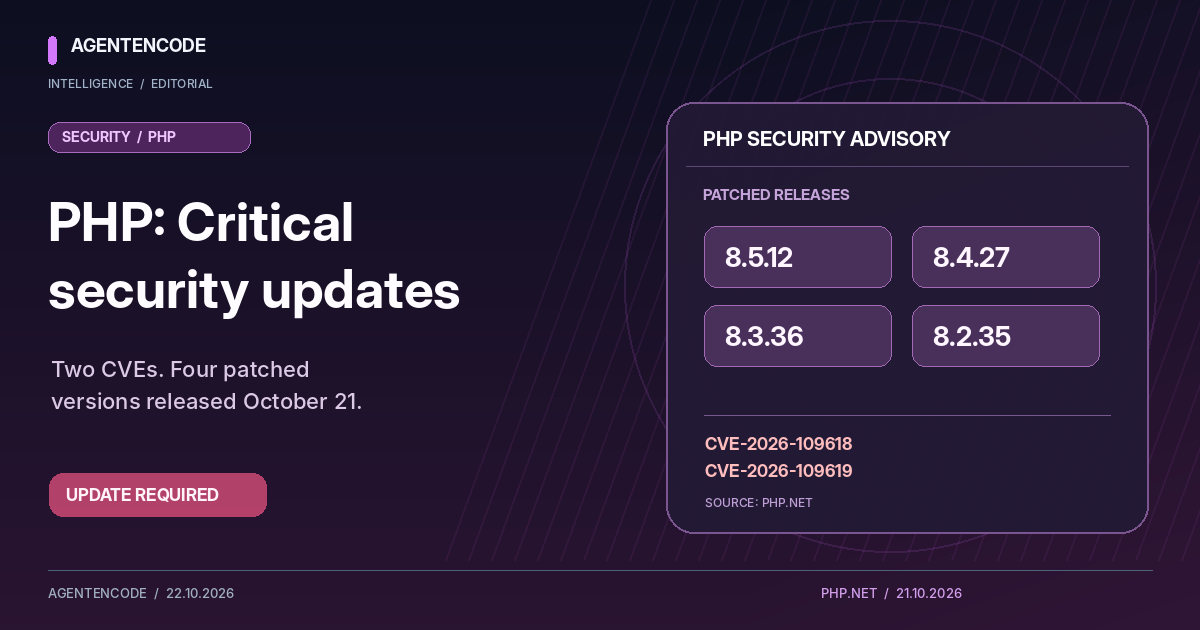
On October 21, 2026, the PHP project released security fixes for CVE-2026-109618 and CVE-2026-109619 in PHP 8.5.12, 8.4.27, 8.3.36 and 8.2.35. The maintainers say there are no complete mitigations and urge affected operators to upgrade.
CLAIM-LEVEL EVIDENCE
What is sourced and what remains open
Separate official records, vendor claims and unresolved questions.
- Primary source
PHP fixed releases are documented
PHP maintainers list four fixed release versions and both CVEs.
- Vendor claim
AI-assisted discovery and coordination
OpenAI describes Calif/GPT-5.6 Sol; Wiz describes independent research.
Source: OpenAI – Coordinated disclosure via Patch the Planet ↗
- Primary source
No complete workaround
PHP's advisory says operators must update.
- Open question
Global remediation is not measured
Neither release establishes a verified worldwide patch coverage rate.
First-party source is not an independent effectiveness test. Methodology →
What PHP maintainers actually confirmed
A vulnerability in a web runtime can undermine applications that have otherwise followed secure coding practices. PHP's maintainers issued emergency security guidance on October 21, 2026 for two critical flaws, CVE-2026-109618 and CVE-2026-109619. The advisory describes internal memory and state-handling problems that may permit unauthenticated remote code execution under affected conditions. That is potentially serious for infrastructure using PHP across content management systems and custom applications. The immediate operational story is not an abstract claim that AI has solved cybersecurity. It is that server operators have vendor-supported fixes to apply right now.
The role of AI in vulnerability discovery
The fixed upstream versions are PHP 8.5.12, 8.4.27, 8.3.36 and 8.2.35, depending on the installation's maintained branch. PHP's advisory addresses web-facing environments such as PHP-FPM, Apache mod_php, php-cgi, FrankenPHP and LiteSpeed, with special concern for the mod_php configuration. It says no complete mitigation substitutes for updating. Operators should not confuse the version of WordPress or another PHP application with the PHP interpreter actually running the request. Distribution-provided backports can also affect how a patched package is identified, so official package vendor advisories belong in the verification process.
Patch the Planet and coordinated disclosure
OpenAI says a researcher known as Calif used GPT-5.6 Sol to identify one critical issue in its Patch the Planet initiative. Wiz says its researchers also uncovered the flaws independently and coordinated reporting, while the PHP maintainers led the fixes and release. That division of responsibility matters. A frontier model may help explore unusual failure states or accelerate review, but a vendor announcement is not independent proof that an autonomous agent discovered every flaw unaided, created production-safe patches, and rolled them out to the internet. Human experts still establish reproducibility, severity and compatibility of a fix.
A concrete checklist for operators
The follow-through is what makes Patch the Planet relevant beyond a single incident. OpenAI describes coordination among maintainers, researchers and providers, including help preparing protections before public disclosure. Infrastructure operators may need temporary filters, cloud vendors may need to distribute mitigations, and maintainers must test patches across versions. Disclosure timing is a difficult trade-off: revealing a flaw too early can accelerate exploitation; withholding a necessary advisory delays defenders. The announcements do not establish how many affected machines have already updated, nor do they prove that every interim control blocks the two underlying bugs.
Why detection alone is not a defense
Operations teams should map all PHP execution paths, containers and images; compare them with the relevant PHP and operating-system security notices; and prioritize a tested upgrade. Then confirm runtime versions rather than configuration-file intentions, run regression tests, retain incident logs and investigate suspicious activity where warranted. AI coding agents may assist with inventory and test plans only under explicit permissions and human change approval. The broader lesson is that more powerful vulnerability-discovery tools raise the bar for the entire response system, from maintainers to service providers to final customers. Faster discoveries without trustworthy deployment evidence are not yet safer software.
EDITORIAL ASSESSMENT · NO INDEPENDENT TEST
AgentenCode perspective
The breakthrough is not merely that a capable model can assist security research. It is the possibility of shortening the defender's full response cycle—validation, human-approved fixes, rollout and proof that systems are actually patched.
Original sources
- PHP Security Advisory – 21 October 2026 ↗
- OpenAI – Coordinated disclosure via Patch the Planet ↗
- Wiz Research – PHP2Shell ↗
Source publications: October 21, 2026. Article reviewed: October 22, 2026.
Frequently asked questions
Which PHP versions include the security fixes?
PHP 8.5.12, 8.4.27, 8.3.36 and 8.2.35, depending on the release branch.
Is a WAF rule sufficient without patching?
No complete mitigation is identified by PHP's maintainers. Updating remains the recommended response.
Did an autonomous AI agent fix everything?
No such end-to-end claim is supported. OpenAI describes AI-assisted discovery, Wiz its independent research and PHP maintainers led the releases.