
Anthropic: How agent memory learns from dreaming and wikis
A system that remembers everything is not necessarily a more reliable AI agent. Raw notes can become outdated, incorrect summaries can turn into persistent rules, and a sprawling knowledge base can consume more time than the task itself. Anthropic has now described a layered approach to Claude's persistent memory: searchable source transcripts, selective notes, linked knowledge wikis, and an offline maintenance process called dreaming that can review and revise what the agent retains.

Persistent memory is not a context window
Anthropic defines agent memory as knowledge gained from earlier interactions and tasks that remains available between sessions. That is separate from model-weight updates, a single session's context, or conversation compaction. Its model distinguishes an original searchable transcript layer, agent-written notes, navigational representations such as wikis, and a small collection of context inserted at the start of future sessions.
AgentenCode analysis: This distinction creates a path to provenance. A remembered rule should be traceable to its original evidence. If a summary replaces its source, agents risk treating their own prior inference as a verified fact.
A benchmark where memory demonstrably changes performance
In Anthropic's CL-Bench 1.0 database task, an agent answers questions in separate sessions, sees the correct answer after each attempt, and can preserve learned rules in a directory for later questions. The memory directory—not the continuing conversation—is what bridges sessions.
| Model | Stateless mean reward | With memory | Score difference |
|---|---|---|---|
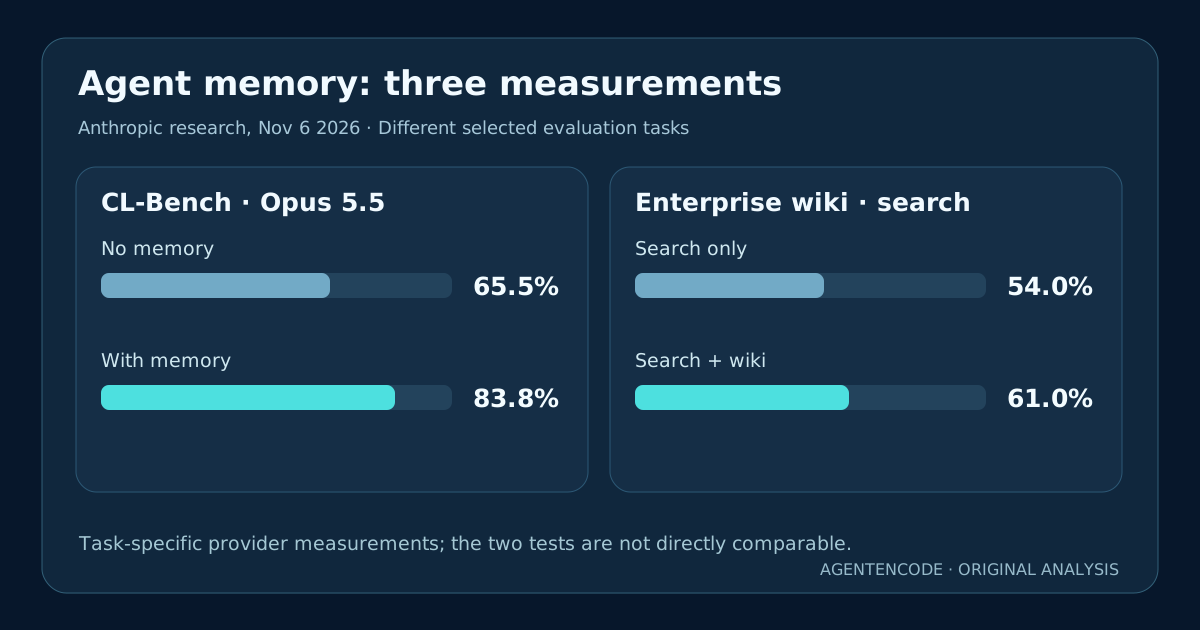
| Claude Opus 5.5 | 0.655 | 0.838 | +0.183 |
| Claude Sonnet 5.5 | 0.644 | 0.833 | +0.189 |
| Claude Opus 5 | 0.564 | 0.828 | +0.264 |
| Claude Sonnet 4.6 | 0.330 | 0.364 | +0.034 |
These are fractions of average grading reward in one task, not percentages of business workflows fully completed. The weaker model's small gain matters: adding a directory called “memory” is insufficient. Stronger models more often write checked rules, evidence for those rules, and warnings about mistakes instead of storing untested guesses.
The paradox: Too many memories can make agents worse
Anthropic compared individual runs of two models playing Pokémon Red after approximately 10,000 steps. Sonnet 3.7 had produced 413 files across 225 folders and had won one badge. Fable 5 had written nine files in two folders plus one global note and won four badges.
These are individual runs with different models, not a controlled proof that fewer files cause better outcomes. They illustrate a real operating cost: archiving every short-lived game state produces stale information and expensive searches. Anthropic observed periods when the older model spent its activity managing memory instead of progressing through the task.
The useful metric is therefore not “number of facts saved.” Teams should measure relevance, freshness, retrieval cost and the effect on subsequent decisions.
What dreaming actually does
In this research, dreaming means additional processing of previous transcripts and memory artifacts. It can correct mistakes, merge redundant notes, repair references, create wiki pages and select a small amount of context to preload in later sessions. It is not consciousness or training the model's weights.
Anthropic describes a navigation example: Claude had misremembered which side of a cave a landmark was on. During dreaming, it revisited the actual session transcript and corrected the note. The corrected-memory run made progress, while reported comparison runs without correction did not. This is a vivid experimental example, not evidence that dreaming reliably cures all erroneous memory.
Linked wikis help on dispersed evidence
Anthropic used roughly 350,000 files and 420 million tokens from an enterprise corpus to test wiki construction over as many as 128 sessions. For one 25-question evaluation, combined wiki-plus-search performance moved from 54% to 61% as the wiki grew, while search alone scored 53%. The vendor also reports about 20,000 fewer tokens per question in that comparison.
On a separate merger-document question task, an agent using the wiki met 87% of selected criteria versus 73% with search alone. Yet the research also reports tasks with no clear gain from a wiki, and even a case where wiki text exceeded the original source corpus. A dense index can become a second unmanageable archive.
Editorial interpretation: The payoff appears when a decision requires synthesizing evidence across documents. If one exact passage answers a question, direct retrieval may be cheaper and more reliable.
The hidden failure: Concurrent writes
Multiple agents writing to a shared table of contract terms lost data in Anthropic's example; only 41 of 57 required facts survived. After assigning one contract page per agent and preserving exact relevant language, all 57 of 57 facts survived in that evaluation.
This is a coordination and data-model problem, not simply a prompting issue. A production memory store needs ownership, versioning, provenance and conflict handling when multiple agents write simultaneously. The test result does not amount to a universal guarantee that parallel-agent memory is safe.
Original AgentenCode evidence and approval matrix
| Memory layer | Value | Risk | Minimum control |
|---|---|---|---|
| Original transcripts | Source for later audits | Sensitive content retention | Access and deletion policy |
| Agent-written notes | Fast re-use | False or stale conclusions | Timestamps and source links |
| Linked wiki | Synthesis and navigation | Invented links, redundancy | Link and evidence checks |
| Offline consolidation | Smaller working context | Repeated false assumptions | Audit trail and sampling |
| Preloaded context | Fast resumption | Error injected into every task | Strict size and trust gate |
| Parallel writers | Scale knowledge creation | Lost updates | Ownership and version control |
This is AgentenCode's editorial operating matrix, not an Anthropic certification.
How to evaluate it in an enterprise pilot
Compare identical repeated tasks across three configurations: no persistent memory, source-linked notes, and notes plus periodic review/wiki building. Record outcome scores, memory errors, repair times, token and compute costs, conflicts and evidence traceability. Include tasks where relevant facts change over time so old knowledge must be corrected rather than merely retrieved.
Also test how a user can inspect, correct and delete retained information. These are operating and privacy concerns, not measured conclusions of the cited benchmarks.
FAQ
Does dreaming retrain Claude's weights? No. It processes transcripts and memory artifacts after sessions.
Is 83.8% Claude's general success rate? No. 0.838 is a mean reward on a particular CL-Bench database task with memory.
When is a wiki better than search? Primarily when a task requires combining information scattered across documents.
Can dreaming guarantee correct memories? No; the research includes positive examples and limitations, not a universal correction guarantee.
Why are parallel agents risky? Concurrent updates to shared memory files can silently erase validated information.
Bottom line: Memory needs evidence, not just storage
The real advance is a distinction between an original event, provisional note, checked knowledge and appropriately authorized re-use. Long-running agents need a way to maintain that chain. The ideal memory is not the largest archive; it is a reliable, revisable basis for future action.
Primary source and method
- Anthropic Engineering, The components of agent memory, November 6, 2026
- Vendor-reported experiments are differentiated from AgentenCode's operational recommendations. No independent benchmark replication, inspection of user memory, or deployment/security certification was performed.
Source and evaluation limits
Vendor disclosures and original interpretation are distinguished. No independent benchmark, access or security validation is claimed.