
Alibaba launches Qwen4-Max with a million-token context window and lower-cost claims
Alibaba launches Qwen4-Max with 2.4 trillion total parameters and 1M-token context. What it can do, how cost claims were measured and why weights matter.
A new flagship in the global AI race
On November 16, 2026, Alibaba released Qwen4-Max, a flagship language and multimodal AI model featuring 2.4 trillion total parameters and a one-million-token context window. Alibaba positions it for text, image understanding, professional work and tool-using applications. The official announcement also describes a new architecture designed to reduce the computing cost of difficult tasks.
The announcement matters outside developer circles because long documents, complex spreadsheets and sizeable software projects often exceed the practical capacity of ordinary assistants. A model that can ingest more context may reduce tedious manual splitting. But a large number of parameters and tokens does not establish that it will interpret every passage correctly.
What one million tokens could change
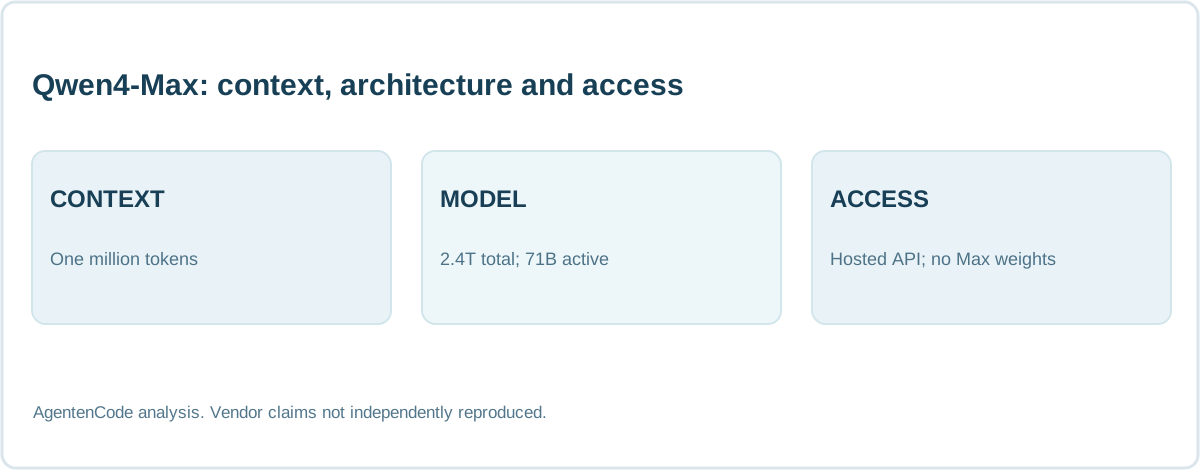
With a 1M-token context window, Qwen4-Max can in principle receive exceptionally long collections of text and code within a single request, subject to product limits. Alibaba's documentation also describes visual understanding, structured outputs and tool calling, extending its potential uses to complex multi-step applications.
The meaningful test is not whether a document fits, but whether the model accurately connects details throughout it. A contract comparison should cite the right clauses; a code analysis should not confuse versions of the same function. Long-context evaluations need to test retrieval and consistency at the beginning, middle and end rather than reward the maximum advertised input length.
How the mixture-of-experts architecture works
Alibaba describes Qwen4-Max as a sparse mixture-of-experts model. Of its 2.4 trillion total parameters, roughly 71 billion are activated per token. In simplified terms, the system chooses specialized portions of the network instead of applying the whole model on every step. That approach can improve the relationship between total capacity and inference cost.
The total parameter count should not be equated with a direct intelligence score. Training, architecture, evaluation settings and the application itself have a greater influence on usefulness. A technical comparison needs accuracy, latency, hardware cost and energy consumption, not just a headline model size.
The cost claim has a specific benchmark behind it
Alibaba reports that Qwen4-Max improved over Qwen3.8-Max on its proprietary Work360 benchmark, covering tasks from 721 specialized fields. At High reasoning effort it reportedly uses fewer tokens and delivers average task costs roughly 60 percent lower than the predecessor under the benchmark's specified conditions.
That number is not a universal price cut or a verified saving for every customer. The reporting at SecondSource notes that Work360 is an Alibaba-created evaluation and does not isolate every source of the savings. Buyers should measure accepted deliverables per dollar, including failed attempts, reviews and retrieval charges, instead of projecting a benchmark average directly onto their bill.
The enterprise demos are ambitious but limited evidence
Alibaba presents examples of manufacturing design assistance, due-diligence document review and long-running scientific workflows. One showcase describes a 48-hour process combining molecular design, synthesis and feedback for a proposed cooling fluid. The company also discusses handling many professional tools within a single end-to-end job.
Those demonstrations illustrate where the product is headed, but they are not independent proof of reliability in ordinary factories or laboratories. Outcomes can depend on prepared datasets, controlled tools and expert supervision. The evidence standard should be reproducible measurements, cited inputs, clear approvals and disclosure of unsuccessful trials.
A hosted API is different from open model weights
The Qwen name is strongly associated with openly distributed models. However, Qwen4-Max is currently offered through QwenCloud, an API and other Alibaba services. The launch explicitly says smaller open-weight Qwen4 models are coming, but does not provide a public download of Qwen4-Max flagship weights.
Anyone planning local deployment or independent fine-tuning should not confuse API access with a permissive model-weight license. Hosted models involve provider decisions on availability, regions, pricing and retention. If Alibaba later releases its flagship weights, that should be treated as a separate development rather than assumed from the brand.
What European organizations need to assess
Before using a hosted AI service with private data, organizations should verify data residency, retention, access logging, deletion controls and contractual protections. The larger the context window, the easier it becomes to send many sensitive records together, which can magnify governance mistakes. Users need to know which sources are authorized and which external tools can receive outputs.
Practical evaluations should include realistic German and English documents, contradictions, numerical verification, misleading tool outputs and requirements for citations. The strongest system is not necessarily the one with the largest input window, but the one that completes approved tasks with traceable evidence and acceptable cost. Our evaluation guide discusses this distinction.
AgentenCode view: efficiency joins capability as a deciding factor
Qwen4-Max points toward a broader competition over intelligence per completed task, long-context performance and how much control buyers retain over a model. Alibaba is combining a very large expert architecture with strong claims about efficiency and professional use, while offering the flagship as a service rather than an open-weight release.
Independent testing remains essential. As of November 17, the hosted model's launch is established, but its broad cost advantages and performance across other people's workflows are not. Those facts should be kept distinct from the possibility of a future weight release or from isolated marketing demonstrations.
Frequently asked questions
What is Qwen4-Max?
Alibaba's new flagship Qwen4 multimodal model, with a one-million-token context window and sparse mixture-of-experts architecture.
Are all 2.4 trillion parameters active at once?
No. Alibaba reports 2.4 trillion total parameters and around 71 billion active per token.
Can I download and self-host Qwen4-Max weights?
The launch offers hosted access and does not announce a public flagship weight release. Smaller Qwen4 open-weight models are promised separately.
Does it cut all AI costs by about 60 percent?
No. The figure refers to Alibaba's Work360 benchmark compared with its predecessor, not a guaranteed customer saving.
RESEARCH & CONTEXT
Sources for this article
This analysis relies on the original publications linked below, which readers can inspect directly.
- Alibaba Cloud: Alibaba Unveils Qwen4-Max (16.11.2026)
- Alibaba Cloud Model Studio: Model releases and updates (16.11.2026)
- Alibaba Cloud: Qwen4-Max enterprise launch and examples (17.11.2026)
- SecondSource: Qwen4-Max released without flagship open weights (16.11.2026)
- TechNode: Alibaba Qwen4-Max launch and pricing (16.11.2026)
Checked November 17, 2026. Vendor statements, pilot scope and preview benchmarks have not been independently reproduced or certified.