
Anthropic lets companies self-host Claude Managed Agents: Who controls the data?
Anthropic's self-hosted Managed Agents can run the control plane, sessions and sandboxes on company infrastructure. Model calls remain external; access and limits explained.
Why this is more than another agent feature
Production AI agents do not only generate text: they execute commands, operate on files, maintain sessions and sometimes handle privileged tools. That makes the location of the control plane and storage just as important as the model itself.
Anthropic's documentation now describes self-hosted Claude Managed Agents, allowing organizations to operate the service and the sandboxes on their own infrastructure. It is an enterprise deployment option rather than a downloadable local copy of the Claude chat product.
Three distinct layers
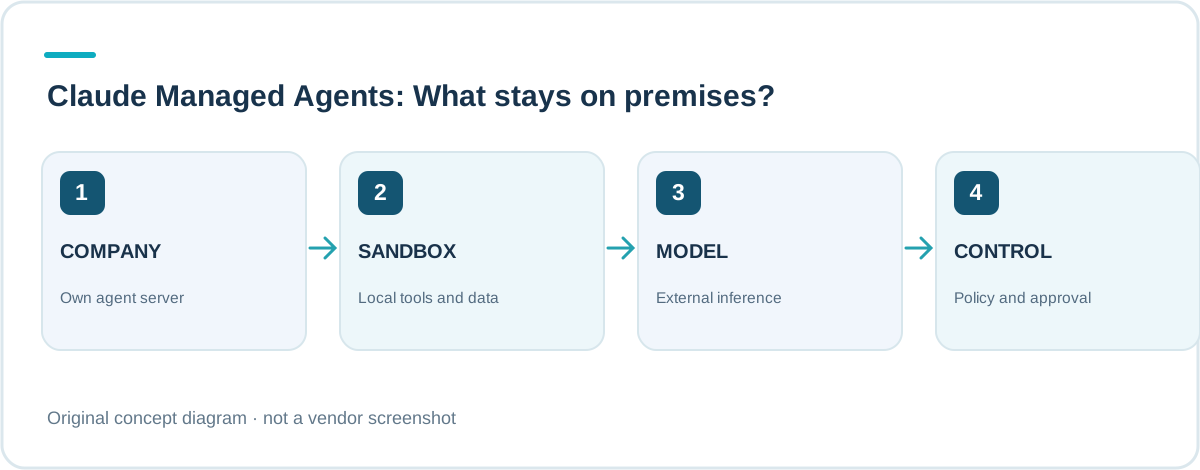
The design separates tool-execution sandboxes, a service running the agent loop and retaining session records, and a model inference provider. Hosted Managed Agents used Anthropic-managed components; self-hosted sandboxes moved just the first layer.
With fully self-hosted Managed Agents, the organization operates both service and workers. The underlying model remains at Anthropic or a configured cloud/model gateway. Self-hosting the orchestration service does not mean self-hosting Claude weights.
Which data remains under company control
Agent definitions, histories, session state, credentials and memory resources can sit in company-managed systems. Anthropic documents connections to enterprise identity services, private secret managers and explicit agent identities.
But every model call can transmit conversation history, tool arguments and tool results to the selected inference provider. Data-residency and retention assessments must therefore cover both the self-hosted server and external model processing.
Not the same as self-hosted sandboxes
A self-hosted sandbox keeps file and command execution in your own infrastructure while the hosted service still coordinates the agent. Fully self-hosted Managed Agents moves the server and its database too.
Anthropic provides a Docker Compose quickstart for exploration but explicitly warns that the development stack is unsuitable for production. Production deployments need hardened authentication, network boundaries and a supported orchestration setup.
Important limitations of the private deployment
The official comparison lists missing hosted-service features including webhooks, scheduled deployments and Dreams. Dynamic multi-agent workflows and advisor support are not fully available; predefined coordinator-style workflows have narrower capabilities.
Existing hosted resources are not migrated automatically. Users must recreate agents, skills, credentials and memory stores, and historical sessions are not copied. The operational implications may outweigh the convenience of owning the stack.
Security moves into the customer's hands
A self-hosted worker's Bash commands execute with the worker's privileges. Isolation comes from the environment—containers, virtual machines, disposable workspaces and strict identity boundaries—not from the model prompt.
Teams should start with low-risk test workloads, restrict egress, keep auditable logs and gate destructive actions behind a human approval. Our agent security guide explains the risks of prompt injection and excessive privileges.
Access and commercial reality
The self-hosted quickstart asks organizations to request the release archive from their Anthropic account team. That is not an open general-availability download for anyone with an API key.
Costs must include provider inference, server and worker operations, storage, network traffic and administrative effort. Organizations should verify contractual and regulatory requirements rather than assuming a self-hosted service automatically makes every data flow local.
AgentenCode verdict: A new control boundary
Self-hosting the control plane is a meaningful governance option for long-running agents, especially in regulated or sensitive environments where session and credential ownership matters.
It also increases responsibility. Effective multi-agent systems require independent checks, bounded permissions, incident handling and evidence-based monitoring. Self-hosting alone delivers none of those guarantees.
Frequently asked questions
Does Claude itself run on my own servers?
No. The agent service and sandboxes can be self-hosted while inference uses Anthropic or another configured external provider.
Can session history and secrets remain under our administration?
Yes. The self-hosted stack supports owned storage and optional secret-management integrations, but provider-bound model inputs still require review.
Does migration preserve hosted sessions?
No. Anthropic documents separate resource recreation, absent hosted history migration and several unsupported features.
Is there open public access?
The release archive requires a request to an Anthropic account team; access and terms must be confirmed directly.
RESEARCH & CONTEXT
Sources for this article
This analysis relies on the original publications linked below, which readers can inspect directly.
- Anthropic Platform – Self-hosted Claude Managed Agents (provider documentation)
- Anthropic Platform – Differences from the hosted service
- Anthropic Platform – Self-hosted quickstart and access requirements
Checked November 14, 2026. Vendor statements, pilot scope and preview benchmarks have not been independently reproduced or certified.