
Genesys AI agent: What 42% human-free resolutions really mean
The Genesys Trademark Global case reports 42% of agent-handled requests resolved without staff. We separate vendor metrics, permissions and measurable outcomes.
Short answer: Genesys reports that 42% of interactions handled by its Agentic Virtual Agent at Trademark Global end without employee assistance. The vendor also reports 91% success for warranty claims and a 111% increase in referral-code usage. These October 29 customer-case numbers do not share a denominator and do not provide independently audited sample sizes or causal controls. Their real significance is the workflow: a customer conversation can progress into a permitted enterprise action, with context transferred to a person when needed.
Sources and limitations
- Primary source
- Vendor metrics, not a test
Vendor case announcement dated October 29, 2026. No independent case audit, causal benchmark, tenant access or hands-on testing.
1. What the October 29 announcement establishes
This is a reported customer deployment, not the launch of a brand-new Genesys agent. According to Genesys, Trademark Global sells more than 8,000 products across brands and outside retailers. A shopper may discover a product on one website, buy through another channel and contact the brand for warranty service later. That fragmented journey is a useful test of the difference between a conversational assistant and an action-capable agent.
The vendor describes AVA helping with order checks, product troubleshooting and warranty submissions. When a case needs a person, AVA transfers collected context; a distinct Genesys Agent Copilot can assist the employee. The arrangement therefore combines automated handling and escalation. It does not establish that the entire support operation is autonomous.
2. Three reported numbers – three different measurements
| Vendor figure | Specific reference population | What it does not demonstrate |
|---|---|---|
| 42% | Interactions handled by the agent and completed without human assistance | Not 42% of all company contacts, nor proof of correctness or customer satisfaction |
| 91% | Reported success rate for warranty claims | No disclosed independent audit, case count, appeal rate or outcome definition |
| +111% | Increase in referral-code usage following agentic shopping support | Not a 111-percentage-point increase, attributable revenue gain or controlled causal result |
AgentenCode assessment: Do not multiply or combine these figures. Their denominators and time horizons differ, and the published press release does not provide complete definitions. “Resolved” might hide subsequent repeat contact. The critical missing information is: eligible cases, baseline and comparison window, wrong decisions, escalations, refunds reversed, repeat contacts, customer sentiment and economic contribution.
Referral-code usage is a behavioral proxy, not a verified profit figure. A comparative evaluation should look at net value and control for traffic, campaigns, seasonality and channel mix rather than assuming the agent caused the entire change.
3. The operational boundary of an agent
A traditional support bot provides information. An action-taking service agent can, if authorized, read order context, consult a policy, invoke a defined enterprise action and return a status. For illustration: identify the customer, locate the matching purchase, check warranty eligibility, request missing evidence, invoke an approved action and hand off if the case is outside policy.
That sequence is an AgentenCode illustrative operating model, not an independently observed Trademark Global run. It highlights the crucial security distinction: having access to a customer message does not itself grant permission to access an order, modify an address or issue a refund. Identity, purpose limitation, system entitlements and contextual authorization still matter.
4. Permissions and tools: what Genesys actually documents
The official AI Studio permissions reference distinguishes actions for creating, editing, viewing, previewing and versioning agentic virtual agents. This documents configurable role permissions, not proof of a mandatory per-transaction approval process in the customer's environment.
In the tool-setup reference, agent tools are connected to selected Data Actions. Pre-instructions, inputs, validation checks, output handling and error behaviors are configurable. These controls make scoped operation possible, but their actual effectiveness depends on tenant configuration, external APIs and authorization rules.
Our new Genesys dossier, AI-0155, records two source-scoped pieces of evidence among 36 canonical Trust controls. That expresses documentation coverage. It is neither a security grade nor a GDPR certification, a complete audit assertion, or evidence about Trademark Global's specific implementation.
5. Editorial action and approval matrix
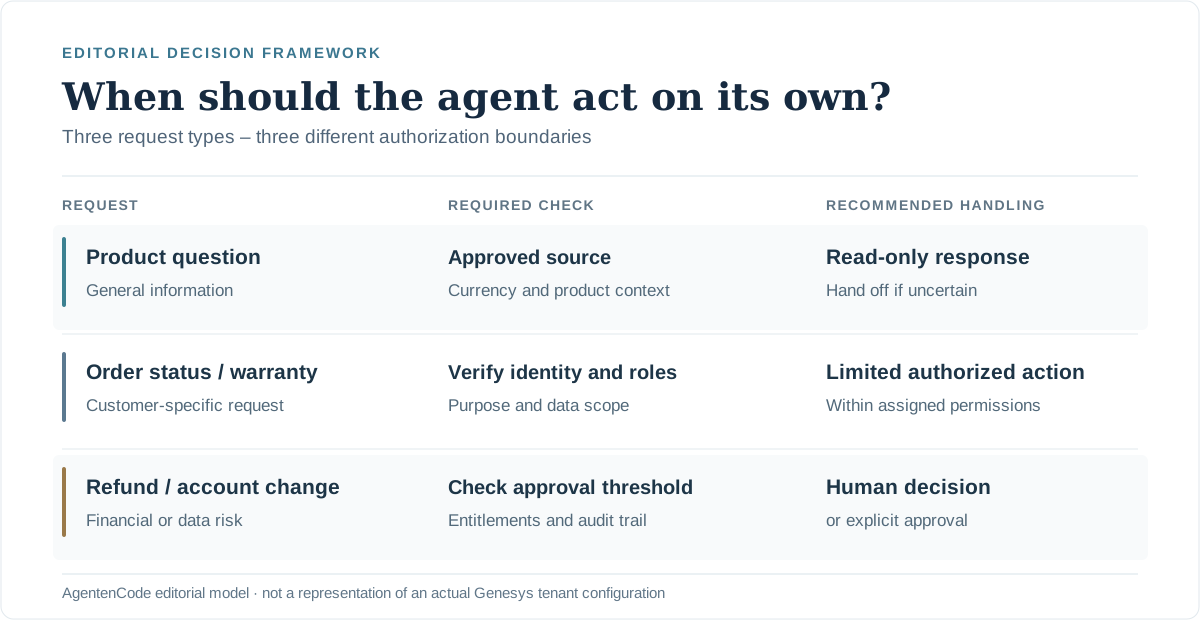
The table below is our decision-support model, not a description of Trademark Global's configured permissions.
| User request | Potential automation tier | Pre-production test |
|---|---|---|
| Generic product information | Answer from approved knowledge | Currency, matching SKU and source attribution |
| Order status | Read-only access after authentication | Identity, separation of accounts and data minimization |
| Warranty request | Prepare a case, verify policy, execute only within scope | Eligibility, fraud, evidence, logging and escalation |
| Refund or shipping-address change | Draft for approval or route to staff | Financial risk, authorization, rollback and thresholds |
| Disputed or sensitive complaint | Structured human handover | Correct context without excess personal data |
A deployment should not optimize for containment rate alone. Evaluate correct end-to-end completion, unauthorized outcomes, repeat contacts, escalation, appeal handling, customer feedback, latency and cost per correctly resolved case. A fast resolution metric is misleading if employees must later undo erroneous agent decisions.
6. Availability, integrations and roadmap
The Trademark Global case demonstrates the described deployment for that organization. It does not mean every Genesys tenant has the same rights, licensed capabilities, language support or regional availability.
Genesys's September 2026 product update distinguishes then-available capabilities from planned items. A2A interoperability and AI-assisted authoring were projected for its fiscal fourth quarter (November 1, 2026–January 31, 2027). Without a definitive subsequent GA notice, these should not be presented as generally available today.
Per-tenant contracts, pricing, regions, integration permissions and data-processing commitments must be checked directly. A provider case announcement is not a substitute for a scoped proof of concept or a procurement assessment.
7. A practical pilot gate for enterprises
A sensible first pilot uses one narrow, measurable request type. Record the existing baseline; authorize only required read/write actions; enforce separation between informational and financially sensitive steps; test malformed inputs and ambiguous identity; sample completed cases independently; measure reversals, customer callbacks and staff workload; and compare actual cost and risk per correct resolution.
Go if the process can be audited, exceptions are routed safely and the results are repeatable against a defined baseline. Stop if cross-retailer identity is unresolved, excessive write privileges cannot be constrained, actions cannot be traced or the measurement denominator changes between periods. One controlled pilot yields more evidence than a broad demo.
8. What AgentenCode concludes
The reported deployment gives a concrete example of why enterprise agents are becoming more than chatbot interfaces: their value depends on converting an eligible intent into a permitted, correctly completed action, while preserving a safe human fallback. The 42% number is a useful vendor signal but is not a cross-industry autonomy benchmark.
The key procurement question remains whether the organization can independently measure correct task outcomes, security exceptions and total process cost. Our Genesys agent dossier documents the current source scope and open Trust questions. We have not run the product or verified the customer's production data.
9. FAQ
Did Genesys launch this agent on November 5, 2026? No. This article evaluates a customer-case announcement dated October 29. The agent existed before that.
Does 42% mean 42% of all Trademark Global service contacts? No. The vendor defines it as interactions handled by the agent.
Is the 91% warranty figure independently audited? No independent methodology, sample size or appeals analysis is disclosed in the cited release.
Can this agent automatically edit orders and approve refunds? Genesys documents configurable Data Actions. The customer's specific action permissions and approval flow cannot be inferred from the announcement.
Does “2/36 Trust evidence” mean unsafe? No. It means two control fields have source-scoped documentation; the other 34 have not been established in our evidence map. Unknown is not false.
Sources and methodology
- Genesys/Trademark Global customer announcement, October 29, 2026
- Genesys Cloud AI Studio permissions
- Genesys Cloud tool configuration
- Genesys product update / availability, September 2, 2026
- AgentenCode: Genesys agent dossier
Method: Read the dated vendor customer announcement, preserve denominators, compare primary product documentation, disclose missing controls, distinguish shipped capability from roadmap and do not fabricate independent measurements, product access or customer-account tests. Artwork: original AI editorial illustration, not a brand screenshot or an authentic photo of the reported customer; original explanatory data graphic accompanies it.