

Agent profile · Service & sales
Genesys Cloud Agentic Virtual Agent
Provider: Genesys
Genesys Cloud Agentic Virtual Agent handles multistep customer-service requests via configured data actions and Architect voice/digital flows. Access depends on tenant enablement, licensing and roles.
Original evidence-based decision map
Genesys Cloud Agentic Virtual Agent — rollout and governance decisions
What vendor documentation establishes about tool scope, enterprise access and human control.
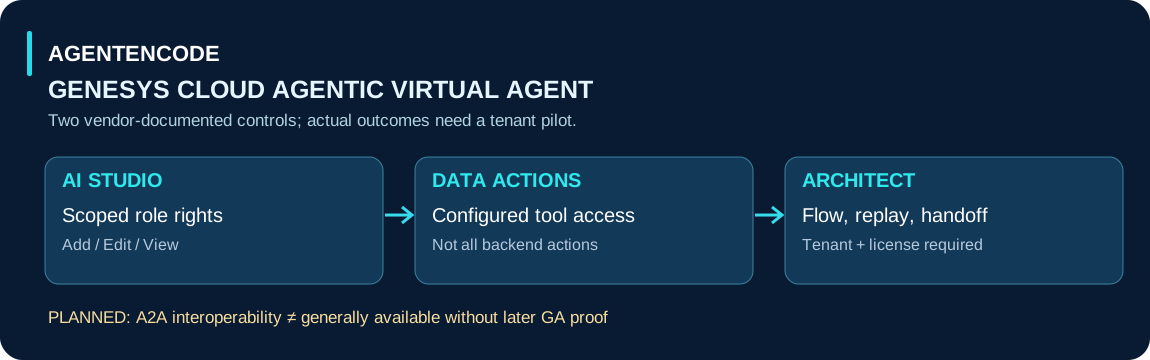
Overview & direct answer
Direct answer: What is Genesys Cloud Agentic Virtual Agent?
Genesys Cloud Agentic Virtual Agent is a customer-service AI agent inside the Genesys Cloud platform. Genesys says it can manage multistep requests over voice and digital channels, use knowledge sources, execute configured Data Actions and connect to workflows through Genesys Architect. The product is marketed as Large Action Model (LAM) powered. Its useful operational boundary is not the label “autonomous,” but which tools and data the enterprise has specifically permitted.
This is a source-scoped editorial profile, not an independent hands-on agent test. Genesys documentation requires the organization to enable Virtual Agent and assign the necessary AI Studio permissions. Staff configure, preview and publish an agent before invoking it from an Architect flow. Those steps describe configuration capability; they do not independently establish that a customer's permissions, approvals or downstream outcomes are correctly governed (official setup guide).
AgentenCode view: A small pilot with well-defined customer outcomes and allowed actions is appropriate. Universal access, a fixed price per request, guaranteed data residency and independently measured resolution rates remain unverified.
Features & operating model
Genesys describes an agent that interprets a customer goal, plans the next step, calls authorized knowledge and data-action tools, and can hand off when necessary. In AI Studio, enterprise teams configure the role and guidelines, allowed tools, knowledge, start and exit behavior, and guardrails. These are not unlimited API privileges: actual Data Actions are configured and linked to the agent within the tenant (vendor tool setup documentation).
Production deployment is a separate step. A published AI Studio agent is called from Architect voice or digital flows that have Virtual Agent enabled. The test preview therefore is not the same thing as approving the assistant to speak to customers or edit business systems. Genesys troubleshooting guidance describes flow execution history, replay, tool-call outcomes, latency, guardrail statuses, exit reasons and human handoffs. We have not independently validated those features in a customer environment (Architect testing and replay docs).
In September 2026, Genesys described the APT-2 reasoning model, new development tools and Deepgram integration as available. It announced deeper A2A interoperability, native voice improvements and AI-assisted authoring as expected later in its fiscal year. That future-tense roadmap must not be turned into an assertion that every current account has those capabilities (September status announcement).
Use cases & pilot design
An initial use case should be a narrow service workflow with a clear customer objective, known exception handling and a limited number of authorized backend actions. For example, a rental provider could use a knowledge source to identify equipment, query availability through an approved backend integration and pass the context to a human agent if the request remains ambiguous. Changing a reservation or customer contract would require separately verified permissions and approval rules. This is an illustrative pilot design, not a case we have observed live.
Teams should test three classes of interaction: an ordinary request that should complete successfully, one with missing or conflicting customer information, and one that should be blocked because a sensitive action is not authorized. A separate state verifier should confirm whether a ticket, record update or transaction actually occurred. Fluent conversation alone does not prove that the customer's goal was achieved.
Genesys' central product claim is the ability to connect natural voice/digital contact with workflow actions in enterprise systems (official Genesys capability page). The available languages, regions, channels, permissions and underlying integrations must still be checked for the customer's tenant and purchased services.
Access, pricing & limitations
Access: Genesys' AI Studio documentation describes an existing authoring workflow, while the setup guide explicitly requires Virtual Agent to be enabled and the right permissions granted. The September 21 release notes identify Genesys Cloud CX 4 and CX AI Experience license contexts, and additional regional deployments including Singapore, Osaka and Mexico. That is not a guarantee that every market or account has identical functionality (Genesys regional release notes).
Pricing: AI Studio documentation refers to AI Experience token-based charging. The exact contract price, token rate, Voice-provider fee, minimum volume, and regional commitments are not confirmed by the primary material used for this profile. We therefore avoid a made-up monthly subscription price. Enterprise buyers should obtain an actual offer tied to expected transaction and call volumes.
Roadmap: Genesys' September update projected general availability for improved native voice, A2A interoperability and AI-assisted authoring in the firm's fiscal fourth quarter (November 2026–January 2027). In the absence of a later, definitive GA release notice, we keep those capabilities explicitly marked as planned rather than guaranteed in all existing accounts.
Privacy, security & trust
Genesys documents granular AI Studio permissions for creating, editing, viewing and versioning agentic virtual agents. We map this only to the platform-role scope: it does not show which role any enterprise assigned in practice, or prove that those permissions resisted a security test (Genesys AI Studio permissions).
Our second scoped claim records the configured Data Action tool list: an authorized studio user adds selected tools to the virtual agent. This does not prove that every tool call requires a human approval, that downstream service-account scopes are minimal or that all connected services have equivalent protection (Genesys tool configuration).
Genesys also documents flow replay for examining tool failures and guardrail blocks. We do not equate replay visibility with independently verified enterprise audit logs, SIEM export, retention policies, data residency, SOC 2 coverage or legal compliance. Those topics require their own primary documents and precise contract/region scope. See AgentenTrust and our methodology.
Comparison & selection
Relevant service-agent alternatives already in our directory include NiCE Cognigy AI Agents, Decagon AI Concierge and Intercom Fin. All address customer-service automation; none can be fairly ranked for accuracy or cost from marketing descriptions alone.
| Decision | Source-documented scope | Test before adoption |
|---|---|---|
| Tool selection | AI Studio Data Actions | Least-privilege downstream service accounts |
| Role rights | AI Studio Add/Edit/View and version permissions | Real tenant permission assignments |
| Execution | Virtual Agent-enabled Architect flow | Verified final state and human handoff |
| Roadmap | External A2A projected for later release | Today's GA and region-specific access |
| Costs | AI Experience/licensing requirements | Contract, volume and token budget |
Compare the tools on identical service cases, approval constraints, actual integration costs, verifiable outcomes and incident behavior. AgentenCode offers AgentenFit, AgentenCheck and agent comparison as structured decision aids.
In-depth analysis
Our editorial analysis: Genesys positions this product as an action layer within an existing enterprise contact-center platform. The potentially material improvement is not another chat interface. It is the connection between customer intent, permitted tool execution and a documented business outcome. That same link creates the risk boundary: a model authorized to change customer, financial or booking data requires enforceable identity and authorization rules and independent outcome checks.
For operations teams the decisive metric should be correctly completed requests under explicitly allowed permissions, rather than the number of conversations or the fluency of replies. Architect replay can expose the agent path, but a downstream system still needs to confirm that the intended state change happened. A persuasive response with no successful backend transaction must not be counted as resolution. A blocked tool attempt should provide an incident and escalation route.
Claims about hundreds of integrations and MCP-compatible tools refer to an expanding vendor ecosystem, not the number of trusted tools actually enabled in an enterprise's specific account. An informed buyer should request the exact authorized Data Actions, role map, relevant data types, approval controls, auditability, deletion options and recovery procedures in writing before trusting operational autonomy.
A compact trial might cover: one standard request, a voice or multilingual variation, incomplete customer information, a refused sensitive action and a human handoff. For each, record the real target-system state, permitted tool and user context, failure handling, and external costs. That is our suggested test design, not a test AgentenCode performed. Failure to reproduce a vendor claim in the selected tenant should be documented rather than silently treated as product-wide absence.
Frequently asked questions
FAQ: Genesys Cloud Agentic Virtual Agent
Is Genesys Cloud Agentic Virtual Agent available?
Genesys documents production authoring in AI Studio, subject to tenant Virtual Agent enablement, licenses, regions and appropriate permissions. Later roadmap features are not automatically generally available.
Can the agent modify customer data?
Configured Data Actions can support backend tasks. Whether a particular write is allowed depends on tenant-specific service rights, tool configuration and approval rules.
Does it support voice and digital channels?
Genesys describes both. Relevant languages, voice services, licensing and regions still require confirmation for the actual account.
How much does it cost?
There is no universally verifiable monthly price from the primary sources reviewed here. AI Experience licensing, tokens, voice providers and contract conditions must be checked with Genesys.
Is A2A interoperability generally available?
September 2026 vendor guidance projected wider A2A availability in a later fiscal quarter. We do not infer current GA without a subsequent definitive notice.
Has AgentenCode tested this product independently?
No. The profile is a source-scoped editorial assessment; no live agent account, penetration test or independent privacy audit was performed.
Primary sources & changes
Eight original vendor sources and limits
Editorial source review: 5 November 2026. Statements are scoped to documented product capabilities, plans, permissions, markets and release status. This is not a full security, contract or functionality audit; unknown controls remain unknown, and roadmap announcements are not treated as a production feature.
- Genesys – Agentic virtual agent — https://www.genesys.com/capabilities/virtual-agents
- Genesys – product overview — https://www.genesys.com/resources/genesys-cloud-agentic-virtual-agent-overview
- Genesys – release, September 2026 — https://www.genesys.com/company/newsroom/announcements/genesys-enhances-agentic-virtual-agent-amid-growing-enterprise-adoption
- Genesys – create an agentic virtual agent — https://help.genesys.cloud/articles/create-an-agentic-virtual-agent/
- Genesys – AI Studio permissions — https://help.genesys.cloud/articles/ai-studio-permissions/
- Genesys – set up data-action tools — https://help.genesys.cloud/articles/set-up-tools-for-an-agentic-virtual-agent/
- Genesys – test and troubleshoot — https://help.genesys.cloud/articles/test-and-troubleshoot-agentic-virtual-agents/
- Genesys – September 21 release notes — https://help.genesys.cloud/432984/
Evidence review on Nov 5, 2026; no independent runtime, security or contract audit.