
Runway Praxis-1 turns video intelligence into robot actions – and opens the weights
Runway releases Praxis-1 under Apache 2.0: video-based AI predicts physical robot actions. We examine measured success rates and important limits.
From video generation to physical motion
On November 11, Runway made Praxis-1 publicly available as an open-weight world action model. The company is better known for generating video, yet here it applies related video pretraining to predicting how robots can move through the real world.
The model was first announced in September; November's news is the public release of weights and inference and training code under Apache 2.0. The reported performance figures are vendor results, not independent AgentenCode replications.
Predicting what the robot will see next
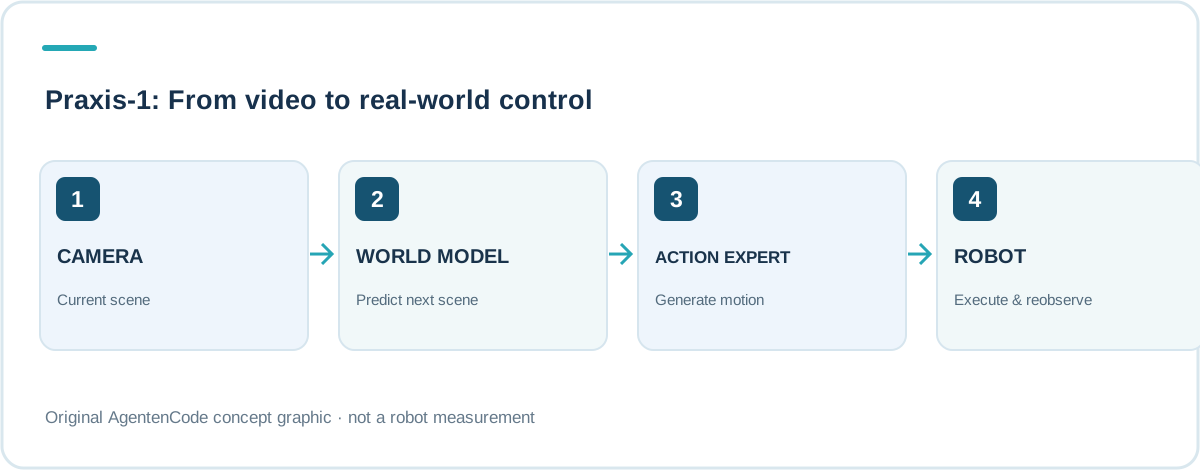
The technical report describes an input consisting of a task instruction, recent camera observations and the robot's current pose. A video backbone imagines the next scene, while an action expert predicts physical movements that accompany that future.
Control proceeds in short chunks: 24 action rows at 15 Hz represent 1.6 seconds of motion. After a chunk executes, new camera frames update the next prediction. This feedback loop still needs separate robot-level collision control, safety limits and human authority.
A large model with specialized active experts
Praxis-1 uses a roughly 27-billion-parameter mixture-of-experts diffusion model. Its video core and action expert are shared across setups, with additional robot-specific input and output projections to map different joints and cameras.
The bf16 weights occupy around 54.4 GB and the reference research environment uses an 80-GB accelerator. A model of this size is not a consumer-ready robot app; integration requires cameras, reliable robot I/O and substantial compute.
The headline benchmark still shows many failures
On NVIDIA's RoboLab-120 benchmark, Runway reports 555 successes over 1,200 attempts, or 46.2%, ahead of another open model, FLUX 3 Action, at 42.9%. In a head-to-head comparison on a real Franka arm, the company reported 88 successful episodes out of 100 compared with 80 for the alternative.
These figures are noteworthy but also reveal limits: more than half of the RoboLab attempts fail. Robot performance changes with objects, task wording and environments. The tests are not evidence that Praxis-1 can reliably perform arbitrary household chores.
Transferring skills across robotic bodies
Runway demonstrates adaptation to different robotic embodiments, from a single Franka arm to dual-arm systems. Device-specific projections and fine-tuning allow a common model to work with other camera layouts and joint spaces. The hope is to reduce dependence on expensive, narrowly collected teleoperation demonstrations.
The research report documents failures involving look-alike objects, vague instructions and long multi-step sequences. Safety validation should measure these failure modes directly, rather than treating successful demonstration clips as comprehensive proof.
Weights, code and commercial licensing
Runway makes the model checkpoints, inference implementation and fine-tuning tools available through its public release, with GitHub and Hugging Face access and Apache 2.0 licensing. LoRA adaptation offers a lighter-weight route to new robot tasks without training every parameter from scratch.
Commercial rights under a software license do not waive safety obligations, training-data rights, or hardware certification. Teams need controlled deployments, logging, interruption mechanisms and rigorous testing before running a physical robot around people.
Planning and motion should be separate
An interesting future architecture would let a broader reasoning system break a request into bounded steps while a faster action policy executes each controlled movement. Runway describes this kind of pairing as future work, not as a feature already making autonomous household robots generally reliable.
For multi-agent systems, the lesson is to separate abstract goals from hardware safety. An imagined video is not a safety certificate, and policies need hard execution limits that an instruction model cannot silently override.
AgentenCode verdict: Generative AI crosses into robotics
Praxis-1 is unusually important because it makes the link between video-based world prediction and real-world manipulation concrete and reproducible. An open release enables researchers to scrutinize its claims and adapt the technology to additional robots.
It is not yet a universally capable robot brain. Robustness, handoff, collisions, data transfer and reliability over long sequences remain open engineering questions. Real pilots should report success and failure rates per task, not just compelling highlights.
Frequently asked questions
Is Praxis-1 just a text-to-video model?
No. It uses video-world prediction to compute robot actions, with openly released weights and code from November 11.
Is the release commercially usable?
Runway says weights and related code use Apache 2.0, subject to normal licence and deployment responsibilities.
How reliable is it?
Runway reports 46.2% success on 1,200 RoboLab-120 trials, so substantial failures remain.
Can it control any robot out of the box?
No. Robot-specific fine-tuning, camera integration, accelerator resources and physical safety checks are required.
RESEARCH & CONTEXT
Sources for this article
This analysis relies on the original publications linked below, which readers can inspect directly.
- Runway – Praxis-1 open-weights availability, 11 November 2026
- Runway Research – Praxis-1 technical report and measured limitations
- Runway – Praxis-1 open inference and fine-tuning code
- Runway – Praxis-1 model collection
Checked November 15, 2026. Vendor statements, pilot scope and preview benchmarks have not been independently reproduced or certified.