
Stanford Memorilla gives language models a 16-token memory for huge document archives
Stanford's Memorilla turns large document archives into 16 query-specific memory tokens. We explain compression claims, benchmark results and limitations.

A compact memory instead of an endless chat
Large language models struggle when conversations or reference libraries keep growing. Feeding everything into every prompt is expensive; searching for text passages can miss weakly connected facts. Stanford's Memorilla project explores a learned memory layer that reads a persistent embedding store and produces a small, query-specific memory for the answering model.
The paper first appeared in October 2026. What is newly attracting attention in November is its openly accessible code, checkpoints and practical evaluations. This is a research prototype rather than the launch of a hosted consumer memory service.
What 16 memory tokens actually represent
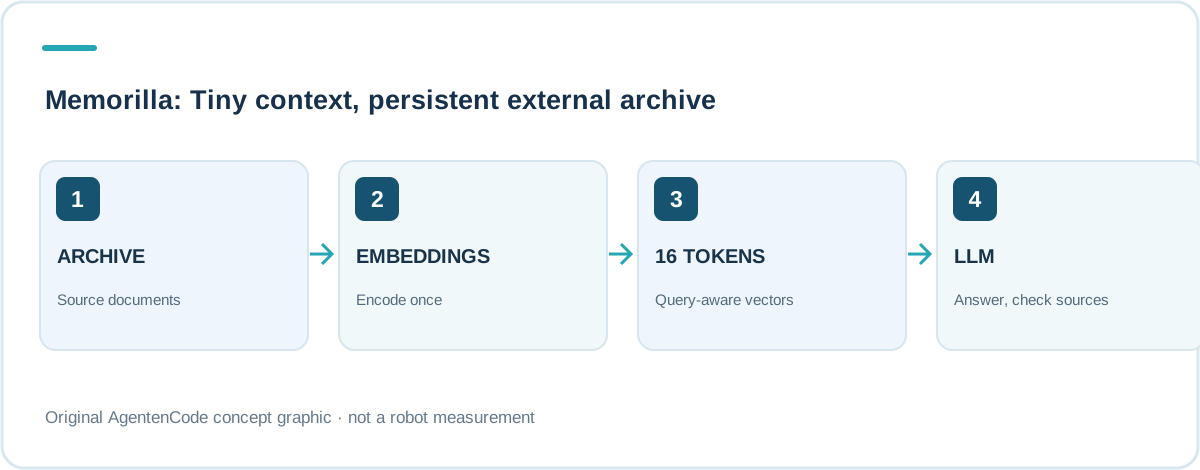
A fixed encoder embeds each document once and stores the vectors. When a question arrives, trained memory slots attend over the entire collection and produce 16 continuous tokens in the frozen answer model's input embedding space. Unlike standard retrieval-augmented generation, this need not place literal source passages in the answer model's prompt.
The 16 tokens are not 16 words and the underlying document store does not disappear. They are learned numerical representations tailored to the question. Compression refers to the small context passed to the language model, not lossless archiving of all documents.
More accurate with far less document context
On FactKG, the authors report 84.33% accuracy with Memorilla versus 80.43% for the same Qwen3-8B given all source documents as context, using 108 times fewer document tokens. Their system leads the chosen baselines on five of eight tasks.
For NarrativeQA, they report more than 4,000-fold document-token compression in a specific comparison. That striking number is dataset-specific, not a promise of perfect recall at a universal 4,000× ratio. The results have not been independently reproduced by AgentenCode.
A 27-times latency result has conditions
The Stanford project page reports 0.74 seconds end-to-end for 512 documents versus 19.9 seconds with full-context inference on one H100-80GB accelerator, roughly a 27-fold difference in that setup. Documents must still be embedded in advance and the separate memory layer trained.
This is not a direct benchmark against every optimized retrieval solution. GPU price, pre-processing, data updates and concurrency can change the effective cost. The reference system runs with CUDA, Python 3.11 and Qwen-based frozen encoder and decoder rather than a simple CPU-only install.
An experiment in agents learning from history
An assistant that works over many sessions needs to remember previous attempts without endlessly repeating them. In the TextWorld study, an agent using eight memory tokens improved average success from 18.6% with full-turn history to 24.2%, as reported by the authors.
These are simulated text-game results, not proof that an assistant remembers every user preference or follows all permissions reliably. Stored memories can preserve obsolete or inaccurate information. Multi-agent systems need scoped storage and accountable deletion as much as they need recall.
Where compressed memory loses
Highly compressed representations can obscure precise names, quotations, amounts or important negative qualifiers. The authors themselves report that other methods outperform Memorilla on some datasets, including certain medical QA and long-document tests.
For verifiable references, the original source text should remain available. A hybrid design that uses latent memory to identify relevant issues and exact retrieval to confirm quotations may be safer than relying solely on compressed memory.
A frozen model with a trainable side network
The open Stanford repository pairs a frozen Qwen3-Embedding-4B encoder and Qwen3-8B answer model with a separately trained memory module of around 194 million parameters. New documents can be embedded individually, avoiding full retraining of the language model whenever new facts arrive.
Training recipes, checkpoints and evaluation code are available, but deployment still needs accelerators, data controls and maintenance. Saving private conversations also raises consent, retention and access-control questions that the memory architecture itself does not solve.
AgentenCode verdict: Smarter recall, not magical memory
Memorilla illustrates a compelling alternative to ever-larger context windows: retrieval and integration of knowledge through a small number of trained latent tokens. Some benchmarks suggest substantial gains without changing the underlying answer model.
Practical adoption will require independent replication, stress tests on rare facts, long-term memory correction and the ability to trace an answer back to original documents. It is unusually interesting open research, not a guarantee that an AI will never forget.
Frequently asked questions
Does Memorilla literally store an archive in 16 words?
No. It produces 16 query-dependent latent vectors while external document embeddings remain stored.
Was the original paper released on November 15?
No. The paper first appeared in October 2026; its open implementation and recent coverage are current in November.
Does it retrain the base language model?
No, the described experiments freeze the encoder and decoder and train a separate smaller memory module.
Does it eliminate retrieval-augmented generation?
No. Exact source verification and recoverable quotations still often require direct document retrieval.
RESEARCH & CONTEXT
Sources for this article
This analysis relies on the original publications linked below, which readers can inspect directly.
- Stanford – Memorilla project and release resources
- Memorilla research paper, arXiv:2610.21375 (first posted October 2026)
- Stanford SNAP – Open training and inference implementation
- Memorilla – PersonalizationV4 research benchmark and attribution
Checked November 15, 2026. Vendor statements, pilot scope and preview benchmarks have not been independently reproduced or certified.