
Claude in Copilot: Microsoft promises EU processing—but not yet today
Microsoft promises EU Data Boundary processing for Claude by the end of 2026. Current admin docs still flag an exclusion and default EU opt-out.

On November 5, 2026, Microsoft announced that Claude models in Copilot will move into its EU Data Boundary by the end of 2026. This is a future commitment, not evidence that the move is complete today. Current Microsoft Learn guidance still says Claude models are excluded from the EU Data Boundary, with access disabled by default for EU/EFTA organizations. The operational decision concerns three separate scopes: model choice, where prompts are processed, and what an agent can do.
Source status
- Original announcement
- Verification limits
Microsoft roadmap and admin documentation only; no access to a customer tenant, no traced regional processing, and no independent compliance audit.
What Microsoft actually announced
Microsoft's November 5 update promises to bring Anthropic's Claude models into its EU Data Boundary for eligible Copilot experiences, including Copilot Cowork, by the end of 2026. It is meaningful for European organizations that want model choice without abandoning established data-processing commitments. The exact date and customer-specific availability have not yet been confirmed in the announcement.
This is not a new launch of Copilot Cowork and not a guarantee that every model, integration, region or subscription inherits the same processing rules. See Microsoft's dated announcement.
The gap between roadmap and current documentation
Microsoft Learn currently states that Claude models deployed across Copilot, Copilot Studio and related offers remain excluded from the EU Data Boundary and, where applicable, in-country processing commitments. Access is off by default in the EU/EFTA and the UK. The announcement is therefore about a coming change of scope, not proof that the old exception has already disappeared.
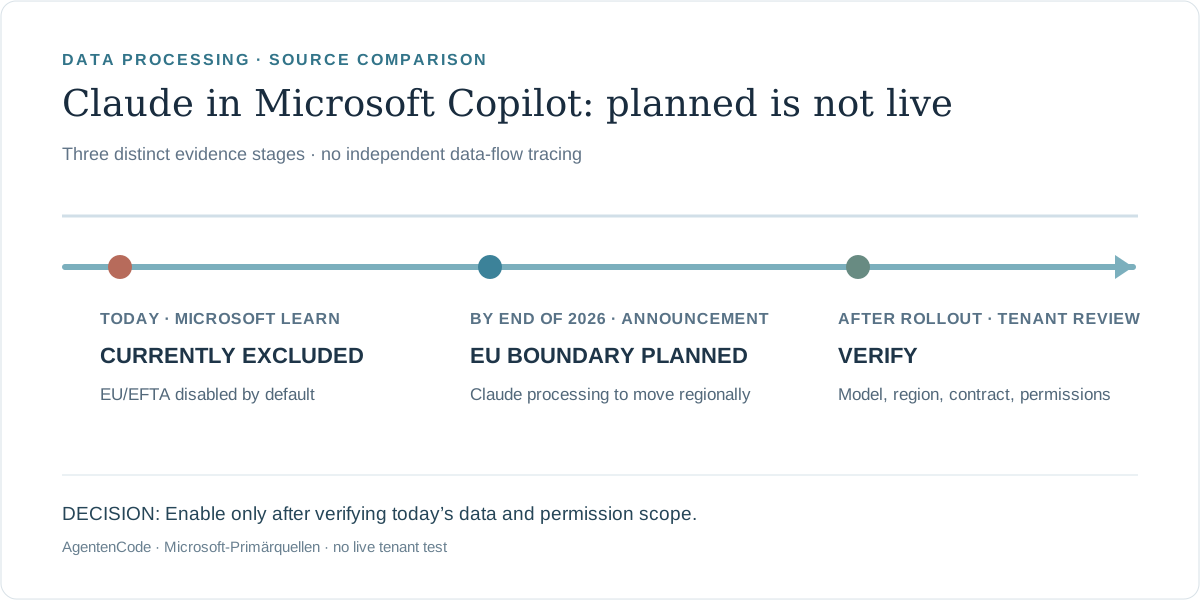
The November promise explicitly addresses the EU and EFTA. Do not silently extend it to UK processing simply because the existing opt-in policy mentions the UK.
Three statuses, three different decisions
| Status | Evidence | Admin decision |
|---|---|---|
| Current documentation | Claude remains excluded; EU/EFTA access disabled by default | Review data scope and opt-in before enabling access |
| End-2026 commitment | Claude processing to move within the EU Data Boundary for eligible Copilot experiences | Do not mark the migration completed before verification |
| Tenant-specific unknowns | Model versions, rollout, contracts, access rights and additional costs | Validate the actual deployed configuration |
What this means for agents and tool permissions
Copilot Cowork can carry out multi-step work with connected business context. Model hosting and tool authorization are fundamentally different questions: a model can execute regionally while the surrounding agent has excessive write permissions or unnecessary access to sensitive files.
Microsoft says administrators can enable Claude for all users or selected groups and that existing users should be moved into the EU Data Boundary automatically once the new processing becomes available. That still leaves separate controls for connected applications, sensitive actions, audit records and any other model-specific commercial terms. Copilot Studio makers select the model when creating agents.
Four checks before enabling Claude in the EU
- Verify rollout: Is this exact model version already regionally processed, or is it still covered only by a commitment?
- Review admin policy: Who can opt users into Anthropic models, and is the default set to no users?
- Inspect the processing contract: Regional data commitment, in-country requirements, subcontracting and exclusions may differ.
- Test action permissions: Separate model access from connector scopes, write operations, logging and approvals.
Microsoft's Flex Routing guidance also shows that eligible Copilot tenants may permit out-of-boundary inference in defined situations. That is a distinct setting, not proof about Claude's future implementation, but it illustrates why broad promises like “all AI data always remains in Europe” need scrutiny.
What remains uncertain
The announcement does not specify a definitive roll-out date for every tenant or a complete list of covered model variants and licenses. An EU Data Boundary commitment does not independently establish GDPR compliance: access purpose, retention, processors, security controls and lawful basis still matter.
Microsoft says eligible Microsoft 365 EU/EFTA customers receive the EU Data Boundary commitment under their existing terms without separate purchase of that commitment. This does not establish that all Copilot, Claude or Cowork functions are free or included in every plan.
Conclusion, FAQ and sources
AgentenCode assessment: More model choice under a well-defined regional governance framework could materially improve agent adoption in regulated organizations. The benefit becomes operational only when the processing change is verifiable for a customer's actual model and deployment.
FAQ
Is Claude processing inside the EU Data Boundary today? Current Microsoft Learn documentation still says excluded; the company targets the end of 2026.
Is Claude enabled by default for EU customers? No, the documented EU/EFTA default is disabled.
Does EU hosting automatically make an agent GDPR-compliant? No; data flows, contracts, permissions and technical checks remain necessary.
Primary sources and method
- Microsoft Copilot Blog, November 5, 2026
- Microsoft Learn, Claude models and opt-in policy
- Microsoft Learn, EU/EFTA Flex Routing
- AgentenCode: Microsoft 365 Copilot Cowork
Method: Compared Microsoft's dated statement with live vendor technical documentation. No tenant access, region trace, independent legal audit or product performance test. Cover: original AI editorial illustration, not a photograph of a Microsoft facility.