
Daydream launches an AI fashion agent that shops for you—buying still needs approval
Daydream's new fashion AI agent builds outfits, monitors discounts and prepares checkout through iOS or text. Purchases require approval; US rollout limits matter.
A fashion search engine grows into a persistent assistant
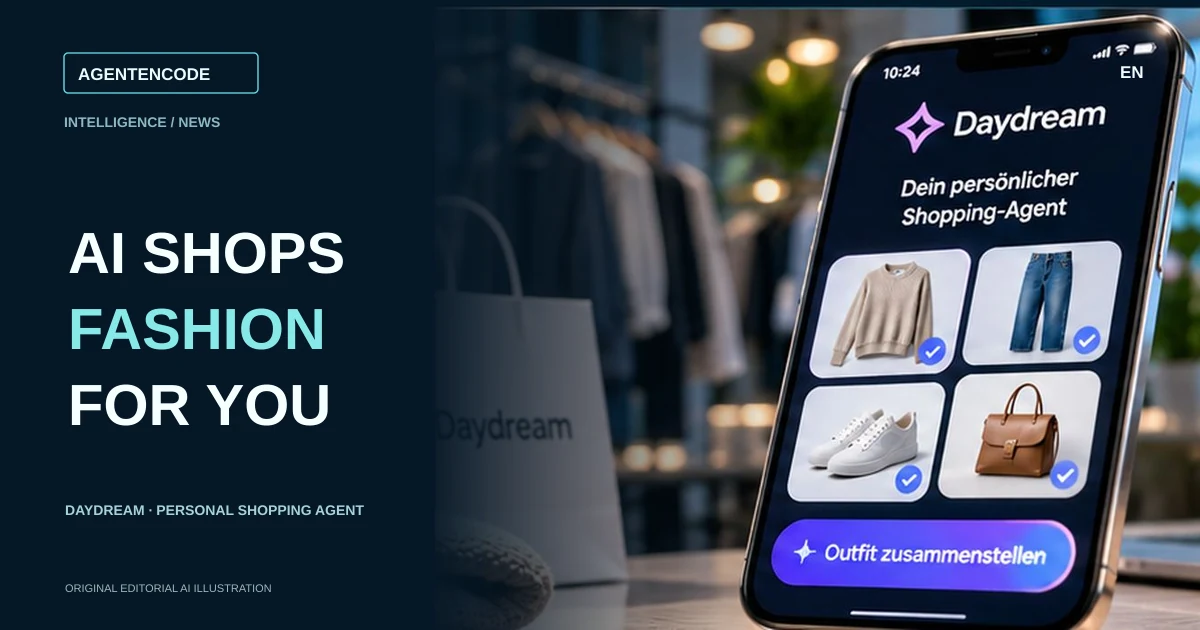
On November 17, 2026, Daydream announced a new consumer AI agent for shopping and styling. Rather than only returning search results, the product aims to handle a longer task: understand an occasion, select items, build a coordinated outfit, enable virtual try-on and guide the shopper through checkout. Daydream says the agent is available in its iOS app and via text message. Read the original announcement and explore profiles in the Agent Finder.
This is interesting beyond fashion. Shopping requires preferences, price comparison, changing inventory and a real payment decision. A tool that gives advice is an assistant; one that remembers a goal and continues work in the background begins to act like a delegated agent. The challenge is maintaining control while the workflow becomes less manual.
What the service claims to do
Daydream says the agent searches a catalog spanning more than 10,000 brands. People can describe what they need or submit an inspiration image, and the service should suggest individual pieces or a complete look. Recommendations can incorporate budget, fit preferences and a personal Style Passport, then adapt to feedback during a conversation.
The launch also describes a persistent clothing rack to save options, plus a virtual try-on experience based on a photo provided by the user. These are declared product capabilities, not results of an independent reliability study. Fit, availability and whether suggested items truly work together still need evaluation in real use.
The key change is work that continues in the background
The company says the agent can monitor discounts and product changes, send periodic fashion updates and continue looking for requested items. That moves the experience beyond one search session toward an ongoing task. A shopper might specify a budget and size and receive a later notification when a suitable piece becomes available.
Well-designed persistent tasks need tight boundaries. Users should know what the agent is tracking, when it will stop, how often it may notify them and whether preferences can be edited or removed. Without those controls, an assistant can drift into a stream of irrelevant commercial prompts.
Checkout is agentic, but not unrestricted
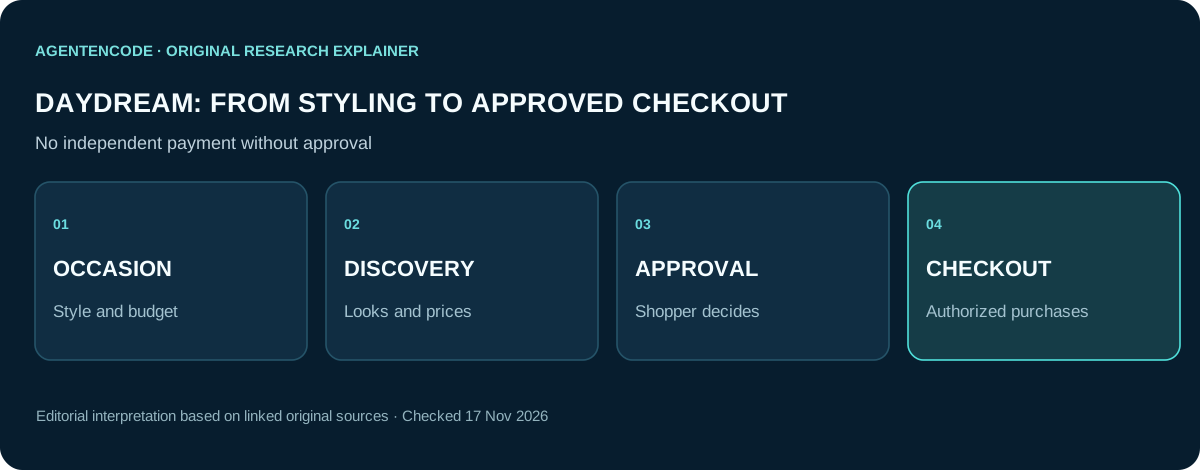
Daydream's announcement describes checkout with participating retail partners, but it also says the shopper must approve the purchase. The agent can assemble a look and prepare the payment flow; that does not establish permission to buy any attractive item without an explicit decision.
Vogue's independent reporting makes the same distinction. The phrase 'shopping while you sleep' applies mainly to background discovery and deal monitoring. It should not be rewritten as evidence that the product has unrestricted access to a user's money. Clear approval boundaries are central to trustworthy consumer agents.
Personalization introduces a larger data footprint
Daydream describes optional closet and calendar connections to recommend clothing for events and avoid duplicating what someone already owns. Its virtual try-on feature also relies on a submitted photo. These inputs may improve usefulness, but they involve more intimate context than a generic product search.
Users should inspect what is shared, how permissions can be revoked and whether stored images or preferences can be deleted. A vendor announcement cannot substitute for an independent privacy and security assessment. Claims about personalization should be kept separate from claims about data protection.
Catalog scale and usage figures need context
Daydream says more than two million shoppers have used its platform since its 2025 debut. Vogue reports roughly 350 retail and brand partners and about three million products. These are reported platform figures, not independently audited conversions or sales generated by the new agent.
Vogue also notes that the company does not disclose how many of those shoppers return or complete purchases. Meaningful measures will be accuracy of suggestions, acceptable return rates, full prices after shipping and taxes, time saved and the quality of purchase decisions after authorization.
Rollout and the wider shopping-agent race
The launch is positioned around Daydream's US consumer business. The company names its iOS app and texting as entry points but does not establish broad availability in Germany or throughout Europe. Global assistants and major retailers are developing overlapping shopping features; it remains uncertain whether a fashion specialist will build lasting advantage through domain-specific knowledge.
For international buyers, differences in merchant coverage, delivery, returns, consumer protection and taxes matter as much as model capability. A US announcement should not be interpreted as a worldwide checkout launch. Any regional rollout must be confirmed separately.
AgentenCode assessment: delegation needs clear limits
Daydream offers a concrete glimpse of consumer AI agents moving from advice to multi-step, persistent work. The system aims to remember a need, keep searching and prepare an action rather than simply answer a prompt. That is the real product transition behind the attention-grabbing promise of shopping while the user sleeps.
The strongest design choice is retaining human authorization for purchases. Good shopping agents also need explicit budgets, clear vendor relationships, privacy controls and an audit trail of what they did. Daydream's launch is newsworthy, but it is not independent proof that autonomous fashion shopping outperforms human selection.
Frequently asked questions
Can Daydream spend money without the shopper's approval?
Daydream says purchases require shopper approval. Background searches and discount monitoring are different from completed checkouts.
Where is the agent available?
The company names the Daydream iOS app and text messaging. The current rollout focuses on US shoppers; broad European availability is not established.
Does the product offer virtual try-on?
Daydream describes virtual try-on using an uploaded photo; AgentenCode has not independently tested accuracy.
What makes it an agent rather than ordinary search?
It aims to remember preferences, assemble looks and monitor products over time, then prepare checkout within user-defined approval boundaries.
RESEARCH & CONTEXT
Sources for this article
This analysis relies on the original publications linked below, which readers can inspect directly.
- Daydream, 17.11.2026 – Launches Autonomous Agent for Fashion Shopping, Styling and Checkout (Original-Pressemitteilung)
- Vogue Business, 17.11.2026 – Daydream’s New AI Agent Can Shop for You While You Sleep (unabhängige Einordnung)
- Daydream – offizielle Produktseite
Checked November 17, 2026. Vendor statements, pilot scope and preview benchmarks have not been independently reproduced or certified.