
OpenAI brings computer-use agents to healthcare: New results for clinical workflows
OpenAI expands healthcare computer-use agents and reports new clinical and administrative tests. What the 94.3% HealthAdminBench score, safety reviews and access limits mean.

Computer use crosses the boundaries between healthcare systems
On November 16, 2026, OpenAI published new findings on computer-use agents for healthcare teams. Agents operating in an authorized environment can read screens, click, type and move between software applications rather than only produce text recommendations. The aim is to help clinicians and administrators prepare work across disconnected health systems.
Electronic health records, scheduling tools and payer portals often require staff to repeat data entry and check patient information manually. An agent may reduce this burden, but a technical ability to operate a user interface is not blanket authorization to access every clinical record. Clinical responsibility and required human approvals remain central.
The MRI example: From patient chart to authorization draft
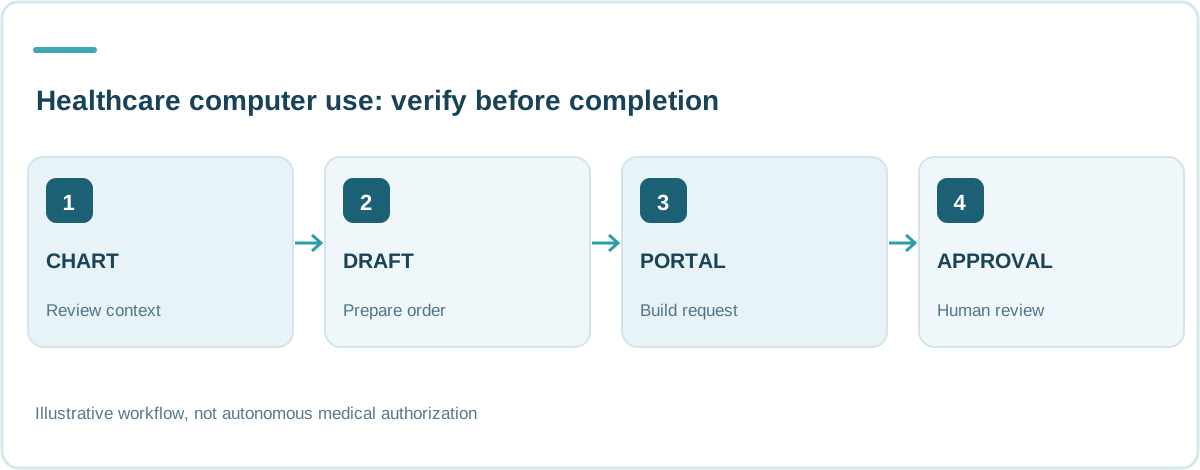
In an OpenAI demonstration using synthetic patient data, a patient asks about an MRI for back pain. An agent reviews consultation notes, previous imaging and physical therapy details. It drafts an order, an unsigned note and a patient response for a clinician to inspect. This is preparation, not the autonomous signing of a medical order.
A subsequent agent step uses the same material to prepare a prior authorization request in an insurer's portal, with review by an authorization specialist. The demo shows a plausible cross-application workflow; it does not prove that arbitrary medical cases can be handled autonomously, safely and without errors.
What the 94.3% HealthAdminBench result actually measures
On HealthAdminBench, a benchmark developed by Stanford researchers for administrative tasks, OpenAI reports 94.3% of available rubric points for GPT-6 Astra and 91.8% for GPT-6 Luna. Tasks include prior authorizations, appeals and medical equipment orders. Both models were evaluated at maximum reasoning effort.
These are rubric scores, not percentages of entirely successful real-world administrative cases. OpenAI also reports an average model cost of 8.5 US cents per task for Luna, 98% lower than Astra in that comparison. Infrastructure, integration, approval processes and human corrections are not necessarily included in the reported per-task model cost.
Clinical safety and usefulness were evaluated separately
In a separate evaluation of clinician inbox tasks, 99% of 325 reviewed tasks performed with GPT-6 Astra were judged clinically safe. In 93% of 646 assessments, physicians rated the outputs very or extremely helpful. Reviewers inspected actions along with drafted notes, orders and patient messages.
Those are not generalized production success rates. The safety judgment concerns plausible patient harm in selected evaluated workflows. It does not establish that all clinical decisions are safe, that every workflow is correct or that an agent can replace medical professionals. The capacity for qualified staff to review, edit and reject outputs remains necessary.
CVS Health, Cigna, Abridge and Ambience: Distinct stages of use
OpenAI names CVS Health, Cigna Healthcare, Abridge and Ambience among organizations exploring or applying computer-use agents. The reported use cases span document movement, referrals, discharge planning and gathering information across clinical applications. A companion OpenAI announcement also details improved clinical search and more than 20 healthcare plugins.
A demonstration, a limited pilot and a production workflow have different evidentiary value. Public statements about individual partners should not be interpreted as proof that each integration is deployed across an entire healthcare organization. Independent assessments need real task outcomes, failure rates, review burden and the limits imposed on the agent.
Protected health information demands enforced controls
OpenAI describes role-based access controls, audit logs and configurable approval steps. Healthcare administrators can determine which environments an agent can use and which actions require human review. Workflows involving protected health information may need eligible services covered by a Business Associate Agreement (BAA) and the required security and retention settings to support HIPAA compliance.
This does not constitute universal HIPAA certification for arbitrary connected apps, nor does it establish compliance with the European GDPR. High-impact steps such as issuing medical orders, changing sensitive records or communicating medical decisions need separate policy enforcement and appropriate clinical oversight.
Availability depends on product and institutional configuration
OpenAI describes access through ChatGPT for Healthcare, ChatGPT for Clinicians and the OpenAI API, including suitable experiences in ChatGPT Work and Codex. Healthcare search improvements and additional plugins are also announced. Actual access varies with account eligibility, workspace administration, product settings and region.
The free individual clinician product is described for eligible verified U.S. clinicians, not as a globally available entitlement. Technical deployment also depends on permitted integration points in the underlying hospital and insurance systems. Organizations should verify pricing, availability and data requirements for their intended environment.
AgentenCode assessment: Verified work matters more than screen automation
Healthcare administration is a demanding proving ground for computer use because agents must handle changing interfaces, cross-check sensitive records and distinguish between drafts and irreversible steps. A successful agent workflow should be judged by accurate final state, traceable actions and safe handling of uncertainty—not by the fact that it clicked through a portal.
Our evergreen guide to computer use and browser agents explains the difference between screenshot control, structured browser automation and APIs. In healthcare, permissions and qualified human responsibility are particularly important. A verified safe outcome matters more than an impressive automated demonstration.
Frequently asked questions
What did OpenAI announce on November 16, 2026?
New evaluations and healthcare examples for computer-use agents, better medical information retrieval and more than 20 healthcare plugins.
Is the 94.3% result an agent task completion rate?
No. It is the proportion of HealthAdminBench rubric points earned by GPT-6 Astra in defined administrative evaluations.
Can these agents autonomously authorize medical decisions?
The described workflows involve administrative preparation and clinician or specialist review. Consequential clinical decisions need appropriate professional oversight.
Are the tools available worldwide and automatically compliant?
No. Access depends on product eligibility, region and settings. HIPAA workflows require eligible services, a BAA and appropriate controls; other regulatory requirements must be assessed separately.
RESEARCH & CONTEXT
Sources for this article
This analysis relies on the original publications linked below, which readers can inspect directly.
- OpenAI — Advancing computer-use agents for healthcare teams (16 November 2026)
- OpenAI — More ways to move care forward with ChatGPT for Healthcare (16 November 2026)
- Stanford HAI — Measuring What Medical AI Can Actually Do: benchmarking approach
Checked November 16, 2026. Vendor statements, pilot scope and preview benchmarks have not been independently reproduced or certified.