
Google makes Gemini Tasks free: AI can run errands, but the rollout excludes Europe
Google expands free Gemini Tasks across six markets. The agent handles multistep work, while payments, email and calling have US-only restrictions. What users should know.
An AI task agent reaches free users in six markets
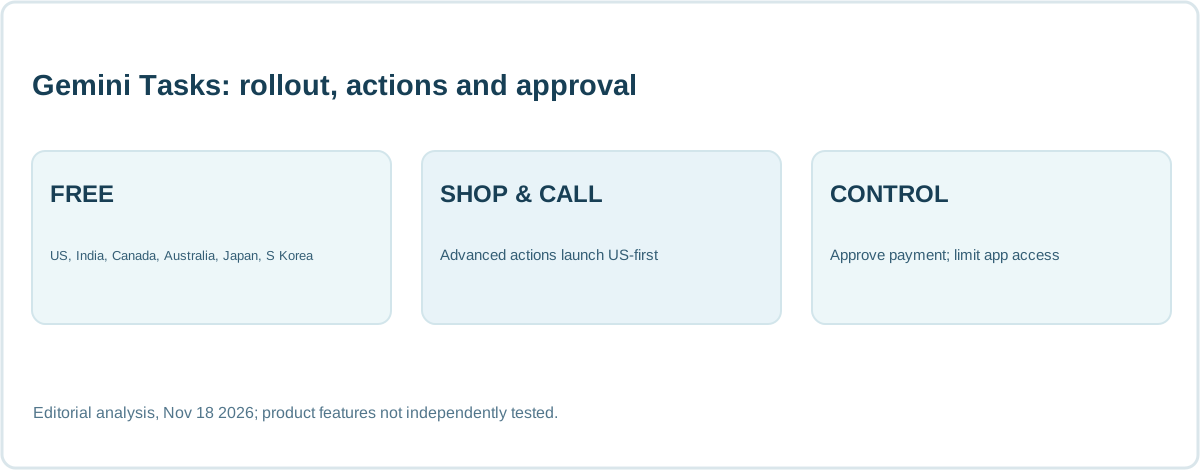
Google announced on November 17, 2026 that Tasks in Gemini is rolling out at no charge to users in the United States, India, Canada, Australia, Japan and South Korea. It uses Gemini 4 Hydrogen and is intended to keep working on multistep requests after the user has moved on. Google describes the potential audience as hundreds of millions of people, a scale claim about distribution rather than a measure of completed tasks.
Europe is not included in this initial free rollout. Google's product announcement and release notes both state the six-country scope. The launch should therefore not be confused with worldwide free access or with the release of every advanced capability to every account.
What changes when Gemini runs a task instead of answering?
A conventional chatbot returns text. Tasks in Gemini is designed to take a goal through several steps: compiling travel bookings into an itinerary, converting dates in school documents into calendar items, comparing documents, or preparing recurring briefings. The user should be able to give instructions and receive a result without manually coordinating every intermediate app.
The difference is consequential. An agent must read input, choose actions and write results back to connected tools. A misplaced appointment or an incorrectly interpreted PDF can affect real schedules. The meaningful measure is whether the end-to-end result is correct and recoverable, rather than whether the response sounds natural.
Shopping through Google Pay still requires authorization
Google is introducing a Google Pay checkout flow that lets people specify an item and maximum price, monitor offers and review a staged purchase. It says the final transaction requires explicit one-tap and device approval. The launch describes digital-payment tokens and a virtual-card flow designed to reduce exposure of the actual card number to merchants.
This checkout feature has a narrower scope than the general Tasks rollout: it is launching in English for US adults with personal Google accounts on web and mobile. Google's references to Mastercard, Visa and the Agent Payments Protocol do not establish availability in every country or at every shop. An agent finding a product does not mean money moves automatically.
Calling businesses and controlling Gemini by text
Google shows Gemini calling car-service businesses to find appointment slots and preparing the result for a calendar. The company is also expanding ways to text the assistant on a phone or forward email threads and PDFs to [email protected], turning messages into instructions for background tasks. A user can continue a task with follow-up texts rather than return to the main app.
These channels have important restrictions. Texting requires an eligible US phone number, a personal account and adult status; email forwarding and the advanced calling rollout also begin in the United States. Google says its calling agent identifies itself as AI and can be declined by businesses. It is inaccurate to describe these as generally available services for German or EU users.
What the security design can and cannot do
Google says tasks run through Agent Compute Engine, using a hardware-isolated virtual machine dedicated to an account. It also describes filters for prompt injection, Safe Browsing and user controls for disconnecting apps or deleting history. These are concrete design choices for separating an agent's browsing and tool use from other users.
Isolation is not the same as perfect judgment. A malicious webpage can contain misleading instructions, permission prompts can be misunderstood and a task can fail at its final step. Google explicitly acknowledges such limitations. Users should grant only needed access, inspect the output of connected applications and keep consequential changes reversible.
Approvals must stay tied to the action
Google says the assistant is designed to pause before critical actions such as purchasing, while allowing certain low-risk recurring actions to be marked as always permitted. That distinction matters. Adding a grocery item to a cart is not equivalent to charging a card, and checking a business's hours is not the same as making a booking.
A useful personal experiment begins with calendar drafts or travel summaries, not high-value transactions. Inspect which files the agent accessed, the changes it made and whether it can be stopped or corrected. For purchasing, sensitive communication and permanent account changes, a separate, intelligible confirmation should remain part of the workflow. Our AI agent security guide covers the broader issues.
Why free access changes the competition
Google's free distribution gives a much larger group access to a product that aims to replace fragments of ordinary app workflows. Gmail, Calendar, Maps, Wallet and shopping services already give Google a strong surrounding ecosystem. Competition is shifting from answers per prompt to reliably completed chores, potentially changing which standalone consumer utilities people use.
Yet lower entry cost does not establish market success. Independent evidence will need to show completion rates, errors, time savings, abandoned workflows and spending outcomes. The company has not announced a general date for Germany or the rest of Europe to receive this free offering. Language, accounts and region-specific conditions matter.
AgentenCode assessment: background agency is the story
The central change is that a consumer AI assistant can be delegated a continuing job, not merely asked a question. It may coordinate third-party services, retrieve personal context and request approval for consequential actions. That expands usefulness but also makes permission design and auditability essential.
As of November 18, 2026, the free launch is confirmed in six named markets; several headline features remain US-specific, and EU launch details are not established. A careful evaluation should focus on actual task completion and the traceability of each action rather than the marketing language around autonomy.
Frequently asked questions
Is Gemini Tasks free in Germany yet?
No. The announced free rollout names the US, India, Canada, Australia, Japan and South Korea, without a confirmed German launch date.
Can the assistant buy things without asking?
Google says the new checkout needs explicit approval. Monitoring a product or preparing a cart is not itself a completed purchase.
Are texting, forwarded email and business calls available globally?
No. The newly announced messaging, email forwarding and advanced calling channels have narrower US-first eligibility requirements.
Does the isolated virtual machine guarantee safety?
No. Google describes multiple safeguards, but errors, misleading web content and risky permissions remain possible.
RESEARCH & CONTEXT
Sources for this article
This analysis relies on the original publications linked below, which readers can inspect directly.
- Google: Put Gemini to work for you, 17 November 2026
- Google Gemini Apps Release Notes: Tasks in Gemini now available free, 17 November 2026
- The Verge: Google's Spark AI agent becomes Tasks — and now it's free, 17 November 2026
Checked November 18, 2026. Vendor statements, pilot scope and preview benchmarks have not been independently reproduced or certified.