
Glean and Onyx Security add a runtime governance layer for AI agents
Glean and Onyx announce agent inventory, permission monitoring and runtime controls. What the beta claims, and what enterprise buyers still need to verify.

A new partnership, with a qualified rollout
On November 16, 2026, Onyx Security and Glean announced an integration that aims to add security and governance capabilities around Glean's enterprise AI agent platform. The companies describe inventory, permission-change monitoring, risk ownership and runtime interventions.
An important qualification: Glean itself labels the Onyx Secure AI Control Plane connector as Beta. A press release does not establish universal production availability or independent security efficacy.
The original Onyx Security announcement describes the proposed integration. Vendor statements have not been independently security-tested.
The Glean platform's role
Glean contributes enterprise context, an agent platform and connections to organizational data and tools. The effectiveness of a workflow still depends on the access controls of each source system and the distinction between user and agent identities.
Having relevant context is not the same as being authorized to use or disclose it. Every tool action must remain within approved scope.
What Onyx proposes to add
Onyx presents its secure AI control plane as an independent layer for discovering agents, assigning owners, classifying risk and enforcing policies. Glean's own connector listing names agent inventory, posture management, runtime visibility and detection.
These are described capabilities rather than verified proof that every third-party agent or deployment environment will be covered.
Where runtime enforcement actually matters
The companies describe controls over prompts, model responses and tool execution, including blocking unsafe requests or redirecting unintended actions. Effective prevention depends on the exact integration point, tool path, event timing and available telemetry.
Checking a policy before a tool call is not equivalent to stopping an external process after an action has begun. Buyers should insist on a concrete enforcement map for their own workflows.
An AgentenCode four-part due-diligence matrix
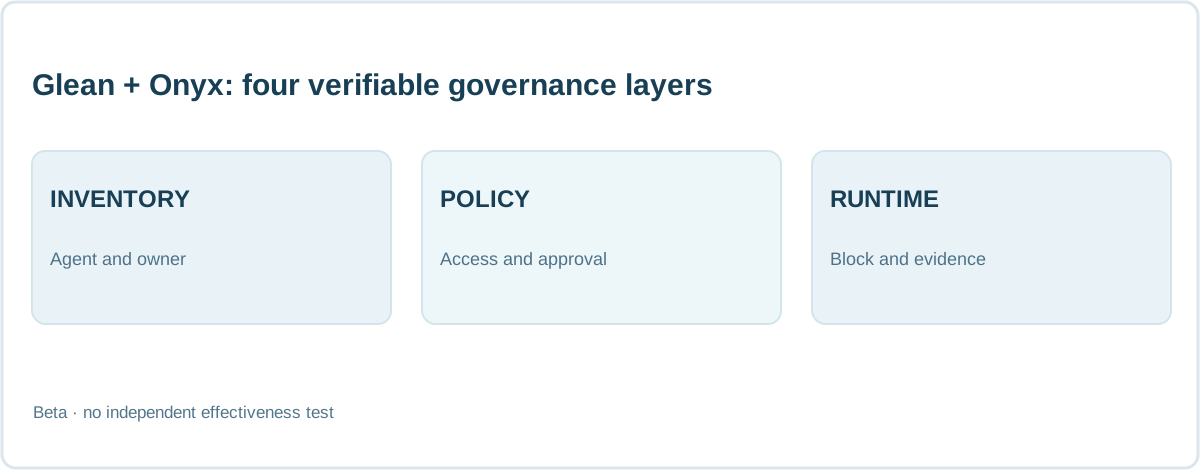
Inventory: Are agents, owners and business purposes accounted for? Permissions: Are data access and executable tools observable? Runtime: Which specific actions are synchronously blocked? Audit: Can investigators reconstruct decisions and results with evidence?
This is AgentenCode's independent procurement checklist, not an Onyx or Glean benchmark, and not a certification of the integration.
Beta access, pricing and geography
Glean labels the connector both MCP and Beta, with a demo-based route to access. The publicly inspected page does not establish self-service availability for everyone, pricing, data residency, service-level commitments or feature parity across deployments.
Organizations need precise written answers on availability, licenses, processing regions and supported enforcement paths before assigning the control to critical production duties.
Who remains accountable?
A cross-platform security layer does not eliminate the operating organization's responsibilities. If an agent publishes incorrect content or exports a sensitive file, operators must still identify the workflow, approvals, identities and relevant logs.
A runtime block cannot retroactively protect data that has already been read. Minimize data access, scope credentials and preserve review evidence before expanding autonomy.
AgentenCode view: security claims require workflow evidence
This integration reflects an important shift from securing logins and infrastructure toward examining agent actions and permissions as work happens. That can be valuable for enterprise deployments if the controls actually cover the relevant tool chain.
We classify this as an announced integration with a Beta Glean connector, not an independently certified protection system. Related: AgentenTrust and AI agent security.
Frequently asked questions
Is the integration generally available?
Glean currently marks the connector Beta and offers a demo route. Universal availability is not established.
What capabilities are described?
Agent inventory, ownership and risk, permission monitoring and policy enforcement around prompts, responses and tool actions.
Does that prove the agents are secure?
No. Product descriptions and a press release are not independent effectiveness tests.
What should a buyer verify?
Licensing and residency, connector and tool coverage, actual enforcement points, audit evidence and incident response.
RESEARCH & CONTEXT
Sources for this article
This analysis relies on the original publications linked below, which readers can inspect directly.
- Onyx Security und Glean – Original-Pressemitteilung, 16 Nov 2026
- Glean – Onyx Secure AI Control Plane connector (Beta)
- Glean – Agent governance: product overview
- Onyx Security – Onyx and Glean Enable Secure, Governed AI Agents (16 Nov 2026)
Checked November 17, 2026. Vendor statements, pilot scope and preview benchmarks have not been independently reproduced or certified.