
Expo Simulators lets AI coding agents test iOS and Android apps in the cloud
Expo launches iOS simulators and Android emulators for AI coding agents. How recordings, logs, usage pricing and testing limitations work.

Writing mobile code is not the same as verifying it
On November 12, 2026, Expo launched Expo Simulators, a cloud service offering iOS simulators and Android emulators to developers, CI systems and AI coding agents. Agents can execute mobile applications remotely without a locally running Mac or nested virtualization for the testing step.
The important change is evidence of actual runtime behavior. A coding agent may create syntactically correct source code and report a passing build while still overlooking a broken login screen or a misaligned button. A simulator gives the agent a way to open its app, reproduce the visible workflow and record what happened.
Remote device control inside an agent workflow
Expo provides command-line and compatible device-control integrations for launching a session, installing an appropriate application build and navigating the user interface. It names agent-device, Argent, Appium and popular coding assistants such as Claude Code, Codex and Cursor as potential components of these workflows.
The devices are virtual machines and emulators, not physical iPhones or Android devices. Testing requires the proper simulator-compatible build. Some behavior involving cellular networks, sensors or particular hardware configurations may differ from real-device results.
From bug report to reviewed pull request
A proposed workflow starts with an issue report. The agent locates the code defect, applies a change, launches a cloud simulator and repeats the relevant user interaction. It can then attach the recorded test result to a pull request, allowing a human reviewer to inspect actual behavior before approving the code.
Expo positions this as a step toward agentic bug triage and feature testing. It is a documented product use case, not an independently demonstrated AgentenCode success rate for autonomous debugging. Teams still need defined acceptance criteria and independent checks that the original problem is genuinely resolved.
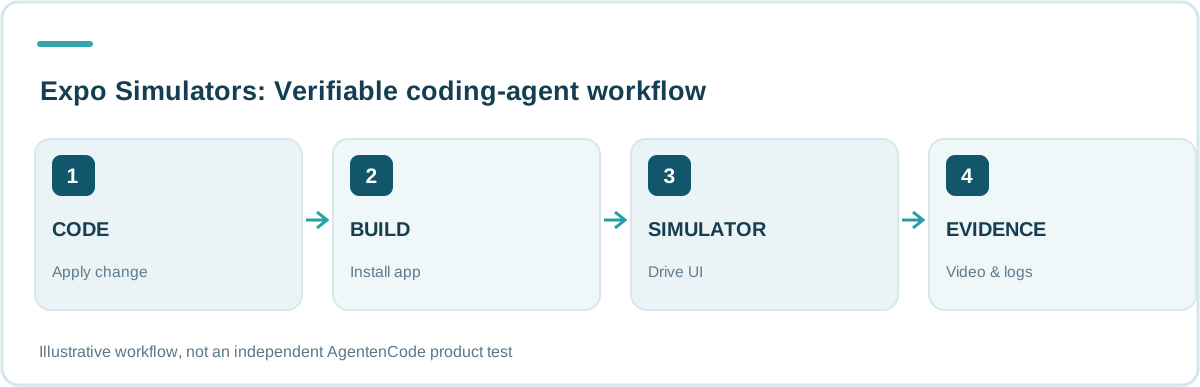
Recorded evidence goes beyond a text claim
Expo says each simulator session can collect a screen recording, screenshots, device actions, application logs, network activity and certain CPU or memory measurements. Developers can monitor the session in a browser or inspect artifacts later. This is much stronger review material than a coding agent simply saying the fix works.
However, recordings cover only what actually ran. A single successful click does not establish complete navigation coverage, privacy compliance or correct behavior under unusual inputs. A screenshot is one instant of state, and a video should be paired with assertions when the outcome matters.
Isolated sessions help multiple agents work in parallel
The service provisions separate virtual environments for sessions, letting multiple coding agents or test workers explore different app changes without competing for one local device. Expo describes end-to-end and Appium integration, as well as concurrent workflows that produce separate recordings and logs.
Concurrency is not free and does not eliminate shared dependencies. Teams must check account quotas, session duration, test-data boundaries and whether multiple automated tests might alter the same backend records.
Pricing: $0.10 per simulator minute
Expo announces usage-based pricing at US$0.10 per simulator minute, for both iOS and Android. Its Starter, Production and Enterprise paid plans initially include 60 minutes each month until 2027, according to the launch. The billing guide should be reviewed for current entitlements and operational limits.
A stalled or abandoned agent session can consume usage unexpectedly. For ongoing deployment, implement explicit stop commands, idle timeouts, budgets and ownership checks rather than assuming a terminal command finishing will automatically stop all remote resources.
Simulation has technical and privacy boundaries
A cloud simulator cannot perfectly reproduce every physical handset feature. Hardware performance, sensors, network behavior and certain OS-specific conditions require real-device testing. Expo's limitations guide is relevant when defining the test scope.
The cloud session may also generate recordings containing visible personal data, login sessions or application logs. Teams should use disposable test credentials, limit retention, review sharing-link access and avoid exposing production accounts to an unattended agent. A test recording is an artifact that may itself need protection.
AgentenCode assessment: accountable coding agents need proof
Expo Simulators is notable because the bottleneck in AI-assisted development increasingly lies between writing code and verifying that the resulting app behaves correctly. Remote device execution can make a coding agent's changes more observable and its tests easier to reproduce across machines.
It does not make self-evaluation infallible. Agents can miss the same cases they failed to consider while implementing a feature. We therefore favor autonomous preparation combined with visible recordings, deterministic tests and independent approvals. The Agent Architect can map the required tool and human controls. Verified behavior matters more than the speed of code generation alone.
Frequently asked questions
What is Expo Simulators?
A cloud service providing iOS simulators and Android emulators for developers, CI systems and AI coding agents.
Can Claude Code or Codex use it?
Expo describes agent workflows using its CLI and compatible remote device-control tools.
How much does it cost?
The announced rate is US$0.10 per simulator minute, with an initial monthly allowance on paid plans.
Can a cloud simulator replace physical-device testing?
No. Hardware-specific features and some real-world conditions still require testing on actual devices.
RESEARCH & CONTEXT
Sources for this article
This analysis relies on the original publications linked below, which readers can inspect directly.
- Expo — Introducing Expo Simulators: cloud simulators built for agents (12 November 2026)
- Expo — Official Simulators documentation: getting started
- Expo — Simulators usage and billing rules
- Expo — Simulator limitations and caveats
Checked November 16, 2026. Vendor statements, pilot scope and preview benchmarks have not been independently reproduced or certified.